




Two men on either side of the cliff 90m height observe the angle of elevation of the top of the cliff to be 30 degrees and 60 degrees respectively. Find the distance between the two men.
Answer
 Verified
592.8k+ views
Hint: First, draw a diagram of the given situation and assume the height of the cliff as ‘h’. Assume \[{{x}_{1}}\] and \[{{x}_{2}}\] as the distance of the first and second man respectively from the foot of the cliff. Then form two right-angle triangles and use \[\tan \theta =\dfrac{\text{perpendicular}}{\text{base}}\] to form expressions in terms of \[{{x}_{1}}\] and \[{{x}_{2}}\] where \['\theta '\] is the angle of the elevation. Then add \[{{x}_{1}}\] and \[{{x}_{2}}\] to get the answer.
Complete step-by-step solution:
First, let us draw a rough diagram of the given situation.
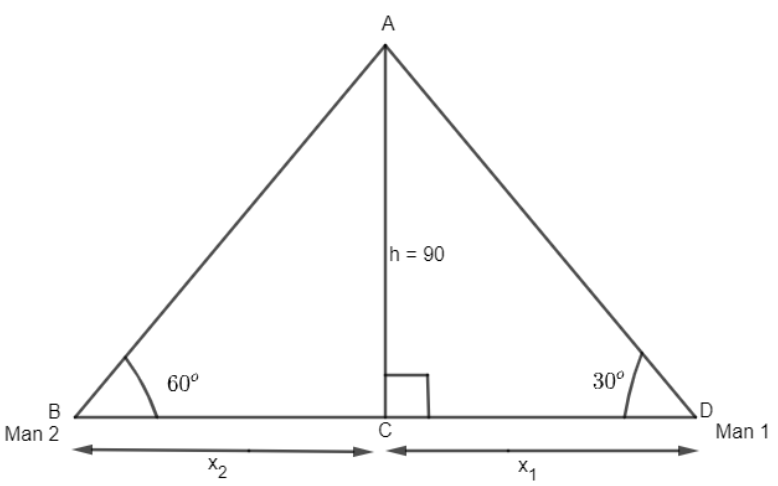
In the above figure, we have assumed AC as the cliff of the height is ‘h’. ‘A’ is the top of the cliff and ‘C’ is the foot of the cliff. Here, man 1 is assumed to be standing at point D at a distance of \[{{x}_{1}}\] from point C. And man 2 is assumed to be at point B at a distance of \[{{x}_{2}}\] from point C. The angle of elevation of the top of the cliff for man 1 and man 2 are 30 degrees and 60 degrees respectively.
Now, in right-angled triangle ACD, we have,
\[AC=h\]
\[CD={{x}_{1}}\]
\[\angle ADC={{30}^{\circ }}\]
Using \[\tan \theta =\dfrac{\text{perpendicular}}{\text{base}}\] where \['\theta '\] is the angle of elevation, we get,
\[\Rightarrow \tan {{30}^{\circ }}=\dfrac{AC}{CD}\]
\[\Rightarrow \tan {{30}^{\circ }}=\dfrac{h}{{{x}_{1}}}\]
\[\Rightarrow {{x}_{1}}=\dfrac{h}{\tan {{30}^{\circ }}}.....\left( i \right)\]
Now, in right angle triangle ACB, we have,
\[AC=h\]
\[CB={{x}_{2}}\]
\[\angle ABC={{60}^{\circ }}\]
Using \[\tan \theta =\dfrac{\text{perpendicular}}{\text{base}}\] we get,
\[\Rightarrow \tan {{60}^{\circ }}=\dfrac{AC}{CB}\]
\[\Rightarrow \tan {{60}^{\circ }}=\dfrac{h}{{{x}_{2}}}\]
\[\Rightarrow {{x}_{2}}=\dfrac{h}{\tan {{60}^{\circ }}}....\left( ii \right)\]
Now we can clearly see that the total distance between the two men is
\[BD=BC+CD\]
\[\Rightarrow BD={{x}_{1}}+{{x}_{2}}\]
So, adding equations (i) and (ii), we get,
\[\Rightarrow {{x}_{1}}+{{x}_{2}}=\dfrac{h}{\tan {{30}^{\circ }}}+\dfrac{h}{\tan {{60}^{\circ }}}\]
\[\Rightarrow {{x}_{1}}+{{x}_{2}}=h\left[ \dfrac{1}{\tan {{30}^{\circ }}}+\dfrac{1}{\tan {{60}^{\circ }}} \right]\]
Substituting \[h=90,\tan {{30}^{\circ }}=\dfrac{1}{\sqrt{3}},\tan {{60}^{\circ }}=\sqrt{3},\] we get,
\[\Rightarrow {{x}_{1}}+{{x}_{2}}=90\times \left[ \dfrac{1}{\dfrac{1}{\sqrt{3}}}+\dfrac{1}{\sqrt{3}} \right]\]
\[\Rightarrow {{x}_{1}}+{{x}_{2}}=90\times \left[ \sqrt{3}+\dfrac{1}{\sqrt{3}} \right]\]
\[\Rightarrow {{x}_{1}}+{{x}_{2}}=90\times \dfrac{4}{\sqrt{3}}\]
Rationalizing the denominator, we get,
\[\Rightarrow {{x}_{1}}+{{x}_{2}}=90\times \dfrac{4}{\sqrt{3}}\times \dfrac{\sqrt{3}}{\sqrt{3}}\]
\[\Rightarrow {{x}_{1}}+{{x}_{2}}=\dfrac{90\times 4\times \sqrt{3}}{3}\]
\[\Rightarrow {{x}_{1}}+{{x}_{2}}=120\sqrt{3}m\]
Substituting \[\sqrt{3}=1.732,\] we get,
\[\Rightarrow {{x}_{1}}+{{x}_{2}}=120\times 1.732\]
\[\Rightarrow {{x}_{1}}+{{x}_{2}}=207.84m\]
Hence, the distance between the two men is 207.84m.
Note: Students must remember that the side opposite to the assumed angle \['\theta '\] is always considered as perpendicular and that is why AC is considered as perpendicular in the two right-angle triangles. Now, we have used \[\tan \theta \] and not \[\sin \theta \] or \[\cos \theta \] in the right angle triangles. This is because we were provided the information regarding base and perpendicular but not the hypotenuse.
Complete step-by-step solution:
First, let us draw a rough diagram of the given situation.
In the above figure, we have assumed AC as the cliff of the height is ‘h’. ‘A’ is the top of the cliff and ‘C’ is the foot of the cliff. Here, man 1 is assumed to be standing at point D at a distance of \[{{x}_{1}}\] from point C. And man 2 is assumed to be at point B at a distance of \[{{x}_{2}}\] from point C. The angle of elevation of the top of the cliff for man 1 and man 2 are 30 degrees and 60 degrees respectively.
Now, in right-angled triangle ACD, we have,
\[AC=h\]
\[CD={{x}_{1}}\]
\[\angle ADC={{30}^{\circ }}\]
Using \[\tan \theta =\dfrac{\text{perpendicular}}{\text{base}}\] where \['\theta '\] is the angle of elevation, we get,
\[\Rightarrow \tan {{30}^{\circ }}=\dfrac{AC}{CD}\]
\[\Rightarrow \tan {{30}^{\circ }}=\dfrac{h}{{{x}_{1}}}\]
\[\Rightarrow {{x}_{1}}=\dfrac{h}{\tan {{30}^{\circ }}}.....\left( i \right)\]
Now, in right angle triangle ACB, we have,
\[AC=h\]
\[CB={{x}_{2}}\]
\[\angle ABC={{60}^{\circ }}\]
Using \[\tan \theta =\dfrac{\text{perpendicular}}{\text{base}}\] we get,
\[\Rightarrow \tan {{60}^{\circ }}=\dfrac{AC}{CB}\]
\[\Rightarrow \tan {{60}^{\circ }}=\dfrac{h}{{{x}_{2}}}\]
\[\Rightarrow {{x}_{2}}=\dfrac{h}{\tan {{60}^{\circ }}}....\left( ii \right)\]
Now we can clearly see that the total distance between the two men is
\[BD=BC+CD\]
\[\Rightarrow BD={{x}_{1}}+{{x}_{2}}\]
So, adding equations (i) and (ii), we get,
\[\Rightarrow {{x}_{1}}+{{x}_{2}}=\dfrac{h}{\tan {{30}^{\circ }}}+\dfrac{h}{\tan {{60}^{\circ }}}\]
\[\Rightarrow {{x}_{1}}+{{x}_{2}}=h\left[ \dfrac{1}{\tan {{30}^{\circ }}}+\dfrac{1}{\tan {{60}^{\circ }}} \right]\]
Substituting \[h=90,\tan {{30}^{\circ }}=\dfrac{1}{\sqrt{3}},\tan {{60}^{\circ }}=\sqrt{3},\] we get,
\[\Rightarrow {{x}_{1}}+{{x}_{2}}=90\times \left[ \dfrac{1}{\dfrac{1}{\sqrt{3}}}+\dfrac{1}{\sqrt{3}} \right]\]
\[\Rightarrow {{x}_{1}}+{{x}_{2}}=90\times \left[ \sqrt{3}+\dfrac{1}{\sqrt{3}} \right]\]
\[\Rightarrow {{x}_{1}}+{{x}_{2}}=90\times \dfrac{4}{\sqrt{3}}\]
Rationalizing the denominator, we get,
\[\Rightarrow {{x}_{1}}+{{x}_{2}}=90\times \dfrac{4}{\sqrt{3}}\times \dfrac{\sqrt{3}}{\sqrt{3}}\]
\[\Rightarrow {{x}_{1}}+{{x}_{2}}=\dfrac{90\times 4\times \sqrt{3}}{3}\]
\[\Rightarrow {{x}_{1}}+{{x}_{2}}=120\sqrt{3}m\]
Substituting \[\sqrt{3}=1.732,\] we get,
\[\Rightarrow {{x}_{1}}+{{x}_{2}}=120\times 1.732\]
\[\Rightarrow {{x}_{1}}+{{x}_{2}}=207.84m\]
Hence, the distance between the two men is 207.84m.
Note: Students must remember that the side opposite to the assumed angle \['\theta '\] is always considered as perpendicular and that is why AC is considered as perpendicular in the two right-angle triangles. Now, we have used \[\tan \theta \] and not \[\sin \theta \] or \[\cos \theta \] in the right angle triangles. This is because we were provided the information regarding base and perpendicular but not the hypotenuse.
Recently Updated Pages
Master Class 10 Social Science: Engaging Questions & Answers for Success

Master Class 10 Science: Engaging Questions & Answers for Success
Master Class 10 Maths: Engaging Questions & Answers for Success
Master Class 10 General Knowledge: Engaging Questions & Answers for Success
Master Class 10 Computer Science: Engaging Questions & Answers for Success
Class 10 Question and Answer - Your Ultimate Solutions Guide
Trending doubts
What is the full form of PNG A Petrol Natural Gas B class 10 chemistry CBSE
Explain the Treaty of Vienna of 1815 class 10 social science CBSE
In cricket, how many legal balls are there in a standard over?
Why is there a time difference of about 5 hours between class 10 social science CBSE
Who Won 36 Oscar Awards? Record Holder Revealed
What is the median of the first 10 natural numbers class 10 maths CBSE