




If a normal of slope m to the parabola ${{y}^{2}}=4ax$ touches the hyperbola ${{x}^{2}}-{{y}^{2}}={{a}^{2}}$ , then:
(a) ${{m}^{6}}-4{{m}^{4}}-3{{m}^{2}}+1=0$
(b) ${{m}^{6}}-4{{m}^{4}}+3{{m}^{2}}-1=0$
(c) ${{m}^{6}}+4{{m}^{4}}-3{{m}^{2}}+1=0$
(d) ${{m}^{6}}+4{{m}^{4}}+3{{m}^{2}}+1=0$
Answer
 Verified
649.2k+ views
Hint: The normal of slope m to the parabola ${{y}^{2}}=4ax$ is given by $y=mx-2am-a{{m}^{3}}$ while the tangent of slope m to the hyperbola $\dfrac{{{x}^{2}}}{{{a}^{2}}}-\dfrac{{{y}^{2}}}{{{b}^{2}}}=1$ is given by $y=mx\pm \sqrt{{{a}^{2}}{{m}^{2}}-{{b}^{2}}}$ . Also, the statement that the normal to the parabola touches the hyperbola indicates that the equation of normal of slope m to the parabola is the same as the equation of tangent of slope m to the given hyperbola, so equate the constants of both the equations to get the answer.
Complete step-by-step solution -
Let us start by drawing a representative diagram of the situation mentioned in the question.
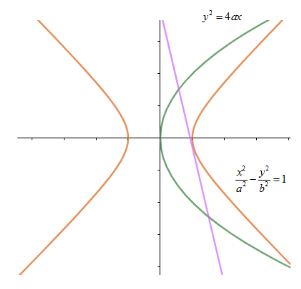
Now let us first find the equation of normal to the parabola. We know that the normal of slope m to the parabola ${{y}^{2}}=4ax$ is given by $y=mx-2am-a{{m}^{3}}$ .
Now as it is given that the normal to the parabola touches the hyperbola indicates that the equation of normal of slope m to the parabola is the same as the equation of tangent of slope m to the given hyperbola.
Also, we know that the tangent of slope m to the hyperbola $\dfrac{{{x}^{2}}}{{{a}^{2}}}-\dfrac{{{y}^{2}}}{{{b}^{2}}}=1$ is given by $y=mx\pm \sqrt{{{a}^{2}}{{m}^{2}}-{{b}^{2}}}$ . So, for the hyperbola $\dfrac{{{x}^{2}}}{{{a}^{2}}}-\dfrac{{{y}^{2}}}{{{a}^{2}}}=1$ , the tangent of slope m has equation:
$y=mx\pm \sqrt{{{a}^{2}}{{m}^{2}}-{{a}^{2}}}$
$\Rightarrow y=mx\pm a\sqrt{{{m}^{2}}-1}$
Now as it is given that the normal to the parabola touches the hyperbola indicates that the equation of normal of slope m to the parabola is the same as the equation of tangent of slope m to the given hyperbola. So, we will equate the constant terms of the tangent of the hyperbola and the constant term of the normal to the parabola.
$\pm a\sqrt{{{m}^{2}}-1}=-2am-a{{m}^{3}}$
Now we will square both sides of the equation. On doing so, we get
${{\left( \pm \sqrt{{{m}^{2}}-1} \right)}^{2}}={{\left( -2m-{{m}^{3}} \right)}^{2}}$
$\Rightarrow {{\left( \sqrt{{{m}^{2}}-1} \right)}^{2}}={{\left( 2m+{{m}^{3}} \right)}^{2}}$
For squaring RHS, we will use the formula ${{\left( a+b \right)}^{2}}={{a}^{2}}+{{b}^{2}}+2ab$.
${{m}^{2}}-1={{m}^{6}}+4{{m}^{2}}+4{{m}^{4}}$
$\Rightarrow {{m}^{6}}+4{{m}^{4}}+4{{m}^{2}}-{{m}^{2}}+1=0$
$\Rightarrow {{m}^{6}}+4{{m}^{4}}+3{{m}^{2}}+1=0$
Therefore, the answer to the above question is option (d).
Note: If you don’t remember the formulas of normal and tangents of conics with a given slope you can use the method of application of derivatives for finding the equations. Also, if you are using the formulas be very careful about each and every sign, as one sign can change the whole result and the signs are very confusing too.
Complete step-by-step solution -
Let us start by drawing a representative diagram of the situation mentioned in the question.
Now let us first find the equation of normal to the parabola. We know that the normal of slope m to the parabola ${{y}^{2}}=4ax$ is given by $y=mx-2am-a{{m}^{3}}$ .
Now as it is given that the normal to the parabola touches the hyperbola indicates that the equation of normal of slope m to the parabola is the same as the equation of tangent of slope m to the given hyperbola.
Also, we know that the tangent of slope m to the hyperbola $\dfrac{{{x}^{2}}}{{{a}^{2}}}-\dfrac{{{y}^{2}}}{{{b}^{2}}}=1$ is given by $y=mx\pm \sqrt{{{a}^{2}}{{m}^{2}}-{{b}^{2}}}$ . So, for the hyperbola $\dfrac{{{x}^{2}}}{{{a}^{2}}}-\dfrac{{{y}^{2}}}{{{a}^{2}}}=1$ , the tangent of slope m has equation:
$y=mx\pm \sqrt{{{a}^{2}}{{m}^{2}}-{{a}^{2}}}$
$\Rightarrow y=mx\pm a\sqrt{{{m}^{2}}-1}$
Now as it is given that the normal to the parabola touches the hyperbola indicates that the equation of normal of slope m to the parabola is the same as the equation of tangent of slope m to the given hyperbola. So, we will equate the constant terms of the tangent of the hyperbola and the constant term of the normal to the parabola.
$\pm a\sqrt{{{m}^{2}}-1}=-2am-a{{m}^{3}}$
Now we will square both sides of the equation. On doing so, we get
${{\left( \pm \sqrt{{{m}^{2}}-1} \right)}^{2}}={{\left( -2m-{{m}^{3}} \right)}^{2}}$
$\Rightarrow {{\left( \sqrt{{{m}^{2}}-1} \right)}^{2}}={{\left( 2m+{{m}^{3}} \right)}^{2}}$
For squaring RHS, we will use the formula ${{\left( a+b \right)}^{2}}={{a}^{2}}+{{b}^{2}}+2ab$.
${{m}^{2}}-1={{m}^{6}}+4{{m}^{2}}+4{{m}^{4}}$
$\Rightarrow {{m}^{6}}+4{{m}^{4}}+4{{m}^{2}}-{{m}^{2}}+1=0$
$\Rightarrow {{m}^{6}}+4{{m}^{4}}+3{{m}^{2}}+1=0$
Therefore, the answer to the above question is option (d).
Note: If you don’t remember the formulas of normal and tangents of conics with a given slope you can use the method of application of derivatives for finding the equations. Also, if you are using the formulas be very careful about each and every sign, as one sign can change the whole result and the signs are very confusing too.
Recently Updated Pages
Basicity of sulphurous acid and sulphuric acid are

Master Class 11 English: Engaging Questions & Answers for Success
Master Class 11 Physics: Engaging Questions & Answers for Success
Master Class 11 Computer Science: Engaging Questions & Answers for Success
Master Class 11 Chemistry: Engaging Questions & Answers for Success
Master Class 11 Social Science: Engaging Questions & Answers for Success
Trending doubts
Difference Between Prokaryotic Cells and Eukaryotic Cells
Two of the body parts which do not appear in MRI are class 11 biology CBSE
One Metric ton is equal to kg A 10000 B 1000 C 100 class 11 physics CBSE
10 examples of friction in our daily life
Draw a diagram of nephron and explain its structur class 11 biology CBSE
What will happen if the mucus is not secreted by the class 11 biology CBSE