




How do you graph $y=3-\cos x$?
Answer
 Verified
563.4k+ views
Hint: For graphing the function which is given in the question as $y=3-\cos x$, we first have to draw the graph of the function $y=\cos x$. Then, we have to obtain the graph of the $y=-\cos x$ from the graph of $y=\cos x$ by taking the reflection of the graph of $y=\cos x$ with respect to the x axis. Finally, the graph of the function $y=3-\cos x$ will be obtained from the graph of the function $y=3-\cos x$ by shifting its graph by three units in the vertical direction.
Complete step by step answer:
From the equation given in the question, we have
$y=3-\cos x......(i)$
We can see that it is related to the basic cosine function, which is given by
$y=\cos x.......(ii)$
The graph corresponding to the above equation is, as we know drawn as
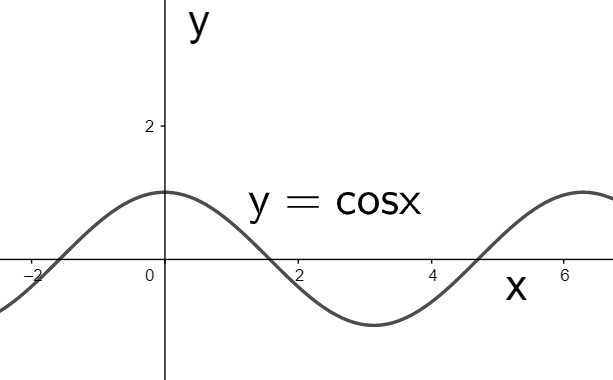
But as we can see in equation (i) that it has negative of $\cos x$. So we have to obtain the graph of
\[\Rightarrow y=-\cos x.......(ii)\]
By comparing equations (ii) and (iii) we can see that the only change is the negative of the dependent variable $y$. So its graph will be obtained by taking the reflection of the above graph with respect to the x-axis, as shown below
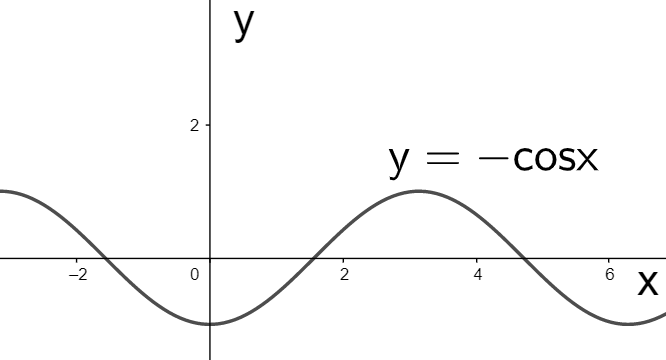
Considering the given equation
\[\begin{align}
& \Rightarrow y=3-\cos x \\
& \Rightarrow \left( y-3 \right)=-\cos x.......(iii) \\
\end{align}\]
By comparing (ii) and (iii) we see that the only change is that $3$ in subtracted from the dependent variable $y$. So we need to shift the above graph by $3$ units vertically to obtain the final graph as
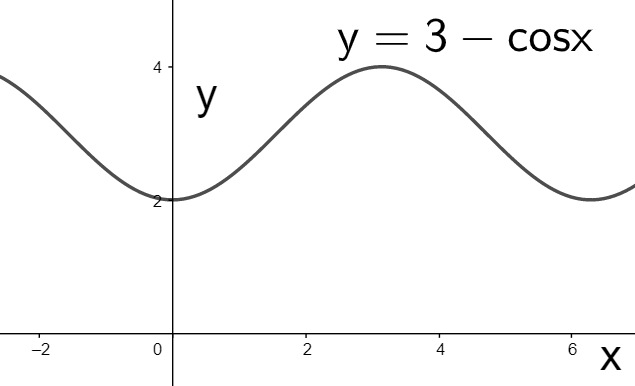
Hence, we have drawn the graph of $y=3-\cos x$
Note: Do not do the shifting of the graph before inverting it. Always remember that the shifting of the dependent variable is always done after scaling or inverting it. Also, we must not be confused regarding the direction of shifting. We might argue that as the sign of $3$ in $\left( y-3 \right)$ is negative, the graph must be shifted in the downward direction. But it must be remembered as a key point that the shifting is always done in the opposite direction.
Complete step by step answer:
From the equation given in the question, we have
$y=3-\cos x......(i)$
We can see that it is related to the basic cosine function, which is given by
$y=\cos x.......(ii)$
The graph corresponding to the above equation is, as we know drawn as
But as we can see in equation (i) that it has negative of $\cos x$. So we have to obtain the graph of
\[\Rightarrow y=-\cos x.......(ii)\]
By comparing equations (ii) and (iii) we can see that the only change is the negative of the dependent variable $y$. So its graph will be obtained by taking the reflection of the above graph with respect to the x-axis, as shown below
Considering the given equation
\[\begin{align}
& \Rightarrow y=3-\cos x \\
& \Rightarrow \left( y-3 \right)=-\cos x.......(iii) \\
\end{align}\]
By comparing (ii) and (iii) we see that the only change is that $3$ in subtracted from the dependent variable $y$. So we need to shift the above graph by $3$ units vertically to obtain the final graph as
Hence, we have drawn the graph of $y=3-\cos x$
Note: Do not do the shifting of the graph before inverting it. Always remember that the shifting of the dependent variable is always done after scaling or inverting it. Also, we must not be confused regarding the direction of shifting. We might argue that as the sign of $3$ in $\left( y-3 \right)$ is negative, the graph must be shifted in the downward direction. But it must be remembered as a key point that the shifting is always done in the opposite direction.
Recently Updated Pages
Basicity of sulphurous acid and sulphuric acid are

Master Class 11 Business Studies: Engaging Questions & Answers for Success
Master Class 11 Computer Science: Engaging Questions & Answers for Success
Master Class 11 Economics: Engaging Questions & Answers for Success
Master Class 11 Social Science: Engaging Questions & Answers for Success
Master Class 11 English: Engaging Questions & Answers for Success
Trending doubts
One Metric ton is equal to kg A 10000 B 1000 C 100 class 11 physics CBSE
The largest wind power cluster is located in the state class 11 social science CBSE
Explain zero factorial class 11 maths CBSE
State and prove Bernoullis theorem class 11 physics CBSE
What steps did the French revolutionaries take to create class 11 social science CBSE
Which among the following are examples of coming together class 11 social science CBSE