




Heterocysts are present in
A. Riccia
B. Ulothrix
C. Albugo
D. Nostoc
Answer
 Verified
609.9k+ views
Hint: The major function of heterocysts is to fix nitrogen for organisms in aerobic conditions and so they are mainly found in cyanobacteria. In addition, Riccia is liverwort, Ulothrix is a type of algae, Albugo is a type of fungi and Nostoc is a bacterium.
Step by step answer:
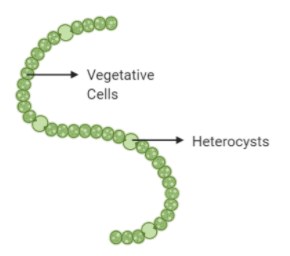
The heterocysts are the specialized cells that help in fixing the atmospheric nitrogen in anaerobic conditions. But sometimes heterocysts also form under suitable and favorable environmental conditions if the fixed nitrogen is scarce. They are exclusively present in the cyanobacteria only. The heterocysts help the cyanobacteria in fixing or converting the nitrogen gas into ammonia, nitrites, or nitrates that can be easily absorbed by the plants and converted into proteins and nucleic acids.
Riccia –
Riccia belongs to the phylum bryophytes. It is of the genus of liverworts. Its order is Marchantiales. It has a small thalloid body that is not differentiated into root, stem, and leaves.
Ulothrix –
Ulothrix belongs to the kingdom Algae. It is a non-branching and filamentous green algae. It is found in both fresh and marine water.
Albugo –
Albugo belongs to the kingdom of fungi. It belongs to the phylum oomycetes. It is a plant parasite and is known to cause several diseases in plants.
Nostoc –
Nostoc is a genus of cyanobacteria that also fixes atmospheric nitrogen. They generally form filamentous colonies. Thus, Nostoc is a cyanobacterium. So, it will possess heterocysts.
Hence, the correct answer is option (D)
Note: The cyanobacteria are commonly known as Blue-Green algae or BGA also. This is because they are bluish-green. Due to this reason earlier, they were kept along with algae but later it was discovered that they are actually bacteria.
Step by step answer:
The heterocysts are the specialized cells that help in fixing the atmospheric nitrogen in anaerobic conditions. But sometimes heterocysts also form under suitable and favorable environmental conditions if the fixed nitrogen is scarce. They are exclusively present in the cyanobacteria only. The heterocysts help the cyanobacteria in fixing or converting the nitrogen gas into ammonia, nitrites, or nitrates that can be easily absorbed by the plants and converted into proteins and nucleic acids.
Riccia –
Riccia belongs to the phylum bryophytes. It is of the genus of liverworts. Its order is Marchantiales. It has a small thalloid body that is not differentiated into root, stem, and leaves.
Ulothrix –
Ulothrix belongs to the kingdom Algae. It is a non-branching and filamentous green algae. It is found in both fresh and marine water.
Albugo –
Albugo belongs to the kingdom of fungi. It belongs to the phylum oomycetes. It is a plant parasite and is known to cause several diseases in plants.
Nostoc –
Nostoc is a genus of cyanobacteria that also fixes atmospheric nitrogen. They generally form filamentous colonies. Thus, Nostoc is a cyanobacterium. So, it will possess heterocysts.
Hence, the correct answer is option (D)
Note: The cyanobacteria are commonly known as Blue-Green algae or BGA also. This is because they are bluish-green. Due to this reason earlier, they were kept along with algae but later it was discovered that they are actually bacteria.
Recently Updated Pages
Master Class 11 Social Science: Engaging Questions & Answers for Success

Master Class 11 English: Engaging Questions & Answers for Success
Master Class 11 Maths: Engaging Questions & Answers for Success
Master Class 11 Chemistry: Engaging Questions & Answers for Success
Master Class 11 Biology: Engaging Questions & Answers for Success
Master Class 11 Physics: Engaging Questions & Answers for Success
Trending doubts
One Metric ton is equal to kg A 10000 B 1000 C 100 class 11 physics CBSE
Difference Between Prokaryotic Cells and Eukaryotic Cells
How many of the following diseases can be studied with class 11 biology CBSE
Draw a diagram of a plant cell and label at least eight class 11 biology CBSE
Two of the body parts which do not appear in MRI are class 11 biology CBSE
10 examples of friction in our daily life