




Haustoria or sucking roots occurs in
(a) Betel
(b) Orchid
(c) Cuscuta
(d) Tinospora
Answer
 Verified
636.9k+ views
Hint: In this plant, the process of photosynthesis does not take place, so they get their nutrition through sucking roots from the other plant on which they survive.
Complete answer:
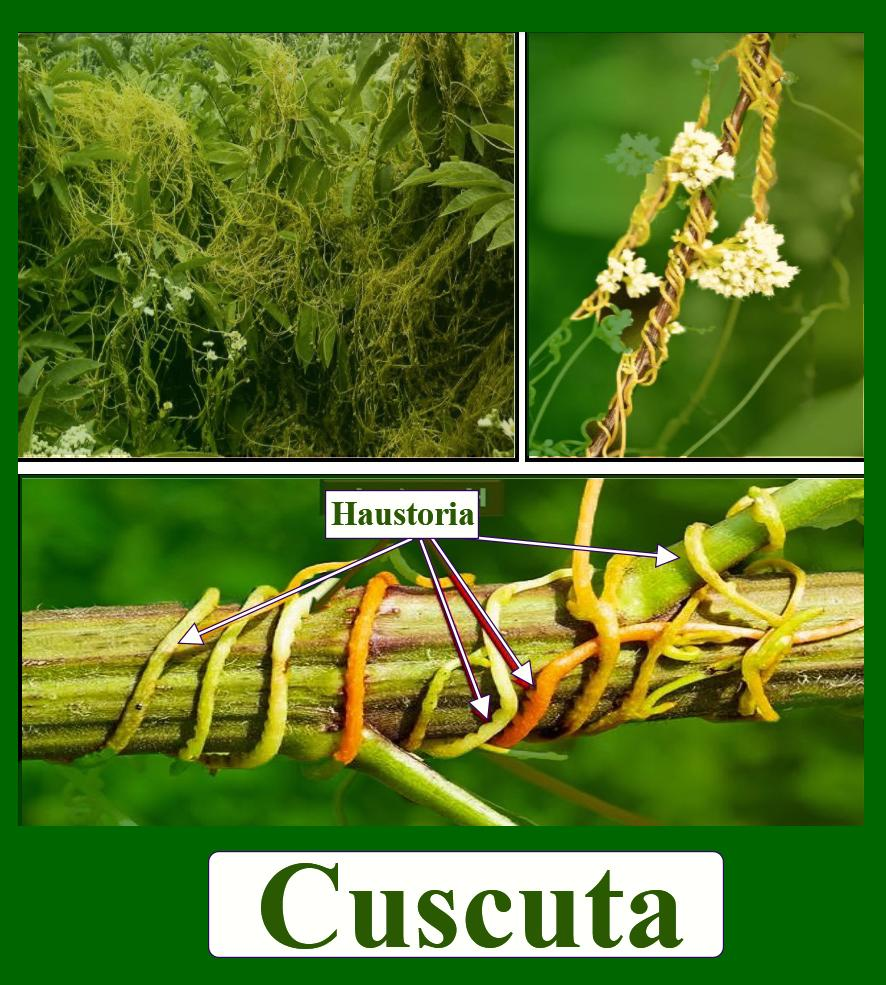
Haustoria or sucking roots occur in Cuscuta. Cuscuta bears non-green stems and scale leaves. They have no connection with the soil. Haustorial roots are also called sucking roots and are found especially in parasitic plants. These roots penetrate the host tissue for the absorption of nutrients and they are small in size.
The parasitic plant fixes its root with the surface of the host plant and makes a connection with both the xylem and the phloem of the host plant for the absorption of water and food for their nutrition.
For example, the Viscum album and Cuscuta.
Additional Information: -Betel is also known as pan. These plants bear two types of root system:
Taproot system - taproots are very thick and straight tapering in shape growing directly downwards. E.g., radish and carrot
Adventitious root systems - these roots develop from an organ such as rhizomes, corms, and tubers. other than the root. E.g., Ivy, Horsetails, Oak trees, and Cypress.
-Orchid plants bear tuberous roots. Some more examples of tuberous roots are the sweet potato, cassava, and dahlia.
-Tinospora also bears adventitious roots.
So, the correct answer is “Cuscuta.”
Note: -All major divisions of Fungi also form haustoria.
-Generally, when penetrating, the fungus increases the surface area in contact with the host plasma membrane and releases enzymes that break up the cell walls.
-This enables the greater potential movement of organic carbon from host to fungus.
-An insect hosting a parasitic fungus if we may look though it seems"eaten from the inside out" because the haustoria expands inside of it.e.g, cordyceps.
Complete answer:
Haustoria or sucking roots occur in Cuscuta. Cuscuta bears non-green stems and scale leaves. They have no connection with the soil. Haustorial roots are also called sucking roots and are found especially in parasitic plants. These roots penetrate the host tissue for the absorption of nutrients and they are small in size.
The parasitic plant fixes its root with the surface of the host plant and makes a connection with both the xylem and the phloem of the host plant for the absorption of water and food for their nutrition.
For example, the Viscum album and Cuscuta.
Additional Information: -Betel is also known as pan. These plants bear two types of root system:
Taproot system - taproots are very thick and straight tapering in shape growing directly downwards. E.g., radish and carrot
Adventitious root systems - these roots develop from an organ such as rhizomes, corms, and tubers. other than the root. E.g., Ivy, Horsetails, Oak trees, and Cypress.
-Orchid plants bear tuberous roots. Some more examples of tuberous roots are the sweet potato, cassava, and dahlia.
-Tinospora also bears adventitious roots.
So, the correct answer is “Cuscuta.”
Note: -All major divisions of Fungi also form haustoria.
-Generally, when penetrating, the fungus increases the surface area in contact with the host plasma membrane and releases enzymes that break up the cell walls.
-This enables the greater potential movement of organic carbon from host to fungus.
-An insect hosting a parasitic fungus if we may look though it seems"eaten from the inside out" because the haustoria expands inside of it.e.g, cordyceps.
Recently Updated Pages
Write structures of the following compounds i 2 Chloro3methylpentane class 11 chemistry CBSE

What is BLO What is the full form of BLO class 8 social science CBSE
Explain the Treaty of Vienna of 1815 class 10 social science CBSE
A Paragraph on Pollution in about 100-150 Words
XIX+XXX A 49 B 51 C 55 D 44 class 5 maths CBSE
If x a + bt + ct2 where x is in meters and t is in class 11 physics CBSE
Trending doubts
One Metric ton is equal to kg A 10000 B 1000 C 100 class 11 physics CBSE
Find the value of the expression given below sin 30circ class 11 maths CBSE
Draw a diagram of nephron and explain its structur class 11 biology CBSE
10 examples of friction in our daily life
Draw a diagram of a plant cell and label at least eight class 11 biology CBSE
Proton was discovered by A Thomson B Rutherford C Chadwick class 11 chemistry CBSE