




What happens if Mutations are not corrected?
Answer
 Verified
546.6k+ views
Hint: Mutations are the changes in the DNA sequence. These changes can arise due to improper or faulty DNA replication, external factors like viruses, UV radiations etc. Mutations can disrupt normal activity of genes.
Complete answer:
• The DNA polymerase enzyme adds nucleotides during DNA replication. Sometimes mistakes can arise during adding nucleotides. It can be in the form of substitution, insertion, deletion or translocation of the sequence. This leads to mutation.
• Most of the time, the mutations are corrected by the process of proofreading by the exonuclease activity and mismatch corrections.
• If the mutations are not corrected, the cell does not recognise the errors and the incorrect sequence gets replicated. It leads to permanent change in the sequence of the DNA.
• The mutations lead to disruption of the normal activity of the DNA or the gene. This leads to faulty synthesis of protein and sometimes no expression of the genes. It can lead to various complications such as cancer, sickle cell anaemia, and many other genetic disorders.
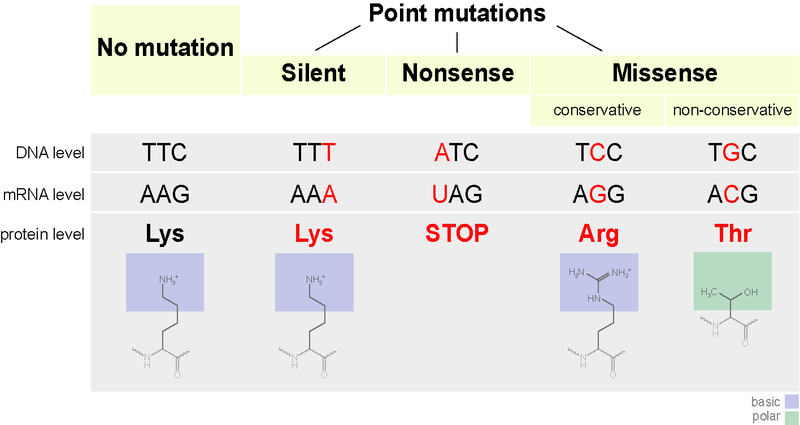
• Certain types of mutations are shown in the figure below.
Additional Information:
The proofreading activity of the DNA polymerase helps in correcting faulty replication. This enzyme shows the spell check activity which helps in removing the error nucleotides from the 3’ end before the primer extension.
Note:
The errors are also corrected by the process of mismatch pairing. It occurs after the replication. Some mutations are good which lead to evolution whereas the others are harmful for the organism. The mutations lead to the genetic drift in an organism.
Complete answer:
• The DNA polymerase enzyme adds nucleotides during DNA replication. Sometimes mistakes can arise during adding nucleotides. It can be in the form of substitution, insertion, deletion or translocation of the sequence. This leads to mutation.
• Most of the time, the mutations are corrected by the process of proofreading by the exonuclease activity and mismatch corrections.
• If the mutations are not corrected, the cell does not recognise the errors and the incorrect sequence gets replicated. It leads to permanent change in the sequence of the DNA.
• The mutations lead to disruption of the normal activity of the DNA or the gene. This leads to faulty synthesis of protein and sometimes no expression of the genes. It can lead to various complications such as cancer, sickle cell anaemia, and many other genetic disorders.
• Certain types of mutations are shown in the figure below.
Additional Information:
The proofreading activity of the DNA polymerase helps in correcting faulty replication. This enzyme shows the spell check activity which helps in removing the error nucleotides from the 3’ end before the primer extension.
Note:
The errors are also corrected by the process of mismatch pairing. It occurs after the replication. Some mutations are good which lead to evolution whereas the others are harmful for the organism. The mutations lead to the genetic drift in an organism.
Recently Updated Pages
Which of the following graphs shows the variation of class 12 physics CBSE

Draw a labelled diagram of the human male reproductive class 12 biology CBSE
Describe the experiment to compare the emf of two cells class 12 physics CBSE
What is standard hydrogen electrode
What is conventional current and electric current class 12 physics CBSE
2Bromopentane is treated with an alcoholic KOH solution class 12 chemistry CBSE
Trending doubts
Draw a labelled sketch of the human eye class 12 physics CBSE
Which are the Top 10 Largest Countries of the World?
Differentiate between homogeneous and heterogeneous class 12 chemistry CBSE
Draw ray diagrams each showing i myopic eye and ii class 12 physics CBSE
Which is the correct genotypic ratio of mendel dihybrid class 12 biology CBSE
What is the Full Form of PVC, PET, HDPE, LDPE, PP and PS ?