




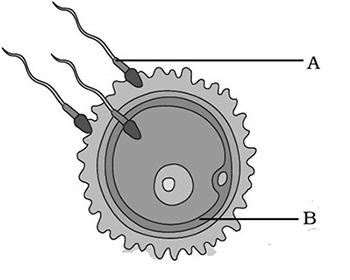
What happens during this process and what is formed?
A. Fertilisation, zygote forms
B. Fertilisation, gamete forms
C. Sporogenesis, spore forms
D. Mitosis, spore forms
Answer
 Verified
561k+ views
Hint: In humans, fertilization is the fusion of male and female gametes that allows the birth of a new organism. Fertilization is a natural life process that involves the union of male and female gametes, resulting in the development of a zygote. In humans, the fallopian tube is where fertilization takes place. Thousands of sperms are inseminated into the female vagina during this process.
The sperms migrate towards the uterus and reach the fallopian tube's opening.
Complete answer:
Option A: The initial diploid cell generated by the union of male and female gametes that results in the creation of an embryo is called a zygote.
A fertilized ovum is referred to as a zygote. As part of spermatogenesis and oogenesis, germ cells go through meiosis to become haploid. The sperm and the unfertilized ovum restore a diploid chromosomal set in the zygote.
So, option A is correct.
Option B: Gametes, often known as sex cells, are an entity's reproductive cells. These are haploid cells, meaning they each have one copy of the chromosome. Sperms are the male gametes, whereas ova or eggs are the female gametes. Gametes are produced by a two-step process called meiosis. This process produces four haploid daughter cells, each of which has only one set of chromosomes. They come together to create the zygote during fertilization.
Hence, option B is not correct.
Option C: Sporogenesis is the process of producing spores. The phrase is also used to describe the process of spore reproduction. During the regular reproductive life cycle of eukaryotic organisms like plants, algae, and fungi, reproductive spores have been discovered. Certain fungi and algae, for example, produce dormant spores in response to poor growth conditions.
Hence option C is not correct.
Option D: “Mitosis is the process in which newly generated DNA is separated and two new cells with the same number and type of chromosomes as the parent nucleus are produced.”
Hence this is an incorrect option.
Hence, option A is the correct answer.
Note:
Fertilization is of two types:
Internal fertilisation- The male puts sperms into the female reproductive canal to unite with the egg during sexual reproduction. Internal fertilisation occurs when the fusion occurs within the female parent. A zygote is created within the mother and receives sustenance from her in this sort.
External fertilisation- External fertilisation refers to the fusing of sperm and egg that occurs outside of the female parent. This sort of gamete fusion is found in only a small percentage of organisms. Fish, frogs, and other animals are examples.
The chances of fusion are slim because eggs and sperm are deposited in the environment. Predators may consume eggs as well as the zygote that develops.
The sperms migrate towards the uterus and reach the fallopian tube's opening.
Complete answer:
Option A: The initial diploid cell generated by the union of male and female gametes that results in the creation of an embryo is called a zygote.
A fertilized ovum is referred to as a zygote. As part of spermatogenesis and oogenesis, germ cells go through meiosis to become haploid. The sperm and the unfertilized ovum restore a diploid chromosomal set in the zygote.
So, option A is correct.
Option B: Gametes, often known as sex cells, are an entity's reproductive cells. These are haploid cells, meaning they each have one copy of the chromosome. Sperms are the male gametes, whereas ova or eggs are the female gametes. Gametes are produced by a two-step process called meiosis. This process produces four haploid daughter cells, each of which has only one set of chromosomes. They come together to create the zygote during fertilization.
Hence, option B is not correct.
Option C: Sporogenesis is the process of producing spores. The phrase is also used to describe the process of spore reproduction. During the regular reproductive life cycle of eukaryotic organisms like plants, algae, and fungi, reproductive spores have been discovered. Certain fungi and algae, for example, produce dormant spores in response to poor growth conditions.
Hence option C is not correct.
Option D: “Mitosis is the process in which newly generated DNA is separated and two new cells with the same number and type of chromosomes as the parent nucleus are produced.”
Hence this is an incorrect option.
Hence, option A is the correct answer.
Note:
Fertilization is of two types:
Internal fertilisation- The male puts sperms into the female reproductive canal to unite with the egg during sexual reproduction. Internal fertilisation occurs when the fusion occurs within the female parent. A zygote is created within the mother and receives sustenance from her in this sort.
External fertilisation- External fertilisation refers to the fusing of sperm and egg that occurs outside of the female parent. This sort of gamete fusion is found in only a small percentage of organisms. Fish, frogs, and other animals are examples.
The chances of fusion are slim because eggs and sperm are deposited in the environment. Predators may consume eggs as well as the zygote that develops.
Recently Updated Pages
Write any three differences between metals and nonmetals class 10 social science CBSE

Amit standing on a horizontal plane finds a bird flying class 10 maths CBSE
Two circles of radii 5 cm and 3 cm intersect at two class 10 maths CBSE
Solve the following i John and Jivanti together have class 10 maths CBSE
What is the relation between orthocenter circumcentre class 10 maths CBSE
Two plane mirrors are inclined at 70circ A ray incident class 10 physics CBSE
Trending doubts
Explain the Treaty of Vienna of 1815 class 10 social science CBSE
1 GB equals how many MB?
10 examples of evaporation in daily life with explanations
What is the full form of POSCO class 10 social science CBSE
Which is the hottest planet in the Solar system A Earth class 10 social science CBSE
Name any four life processes in living things class 10 biology CBSE