




When the glandular cells break down completely, the gland is known as
(a)Holocrine gland
(b)Apocrine gland
(c)Merocrine gland
(d)None of these
Answer
 Verified
606k+ views
Hint: Glands are the organs that synthesize substances like hormones and release them into the bloodstream to perform specific functions in the body. Glands are of two types- endocrine glands and exocrine glands.
Complete answer:
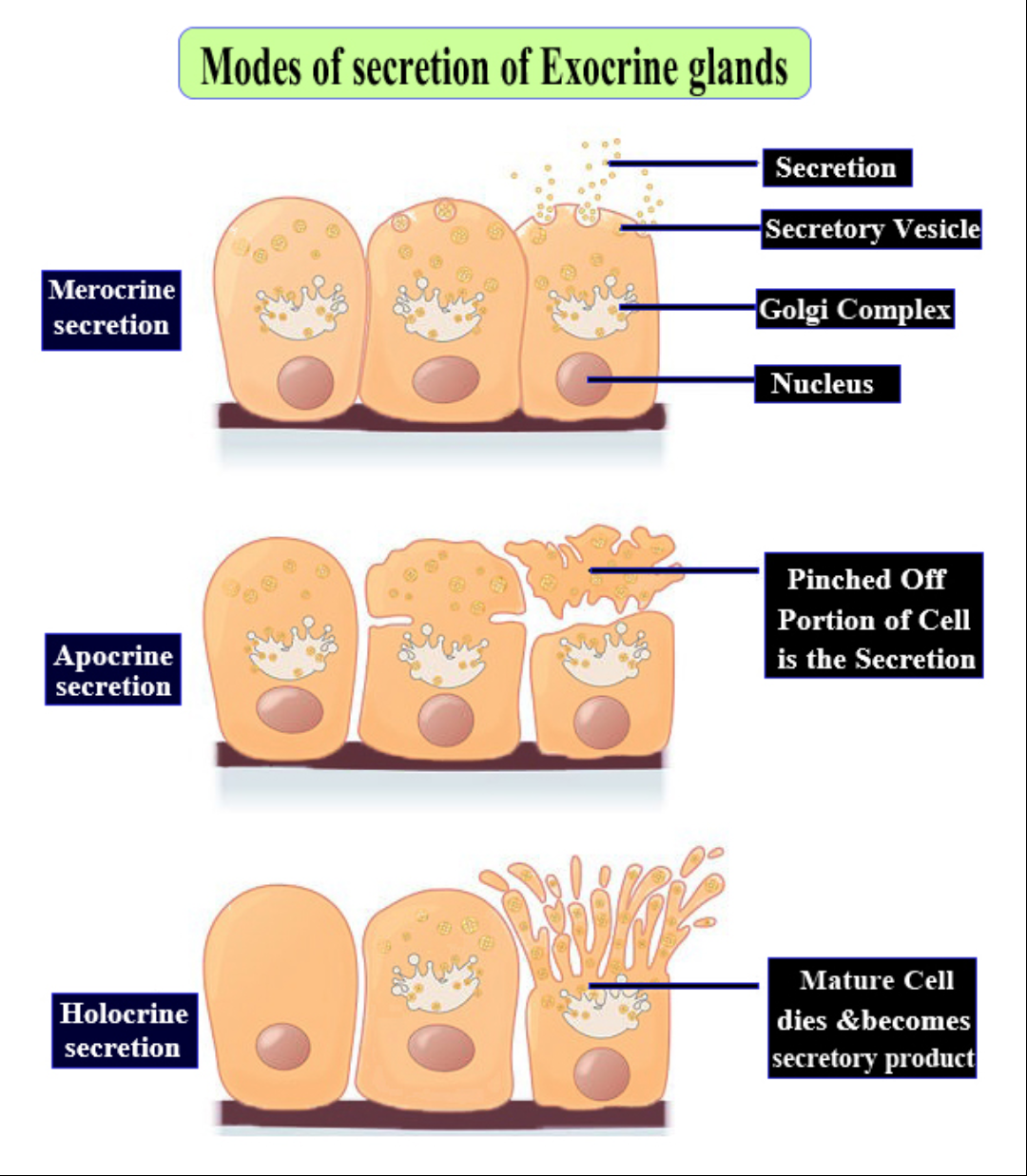
Holocrine glands are one of the types of exocrine glands. The secretion is produced in the cytoplasm of the cell and then released by the rupture of the plasma membrane. This results in the destruction of the cells and the secretion of the product into the lumen. The holocrine gland damages itself to release the secretion. One of the known holocrine glands is sebaceous glands, it releases sebum with the remains of the dead cells.
Additional Information: -Apocrine gland is also a part of the exocrine gland. The apocrine gland releases its secretion by budding off the apical surface cells from the cytoplasm into the lumen of the duct. This process of secretion is known as decapitation. They are non-functional before puberty. An example of the true apocrine gland is the mammary gland responsible for the secretion of breast milk.
-Merocrine gland is a part of the exocrine gland. The secretions of the merocrine gland occur via exocytosis from secretory cells into ducts and then into the lumen of the body. In this type of gland, no part of the gland is loose as in the case of the apocrine and holocrine glands. The merocrine gland is also known as an eccrine gland. The common examples of merocrine glands are salivary glands, pancreatic glands, and certain sweat glands.
So, the answer is ‘holocrine gland’.
Note: -Exocrine glands are those glands that release their secretion into the epithelial surface viaduct. It consists of two parts- a secretory unit and a duct.
-Exocrine gland can be classified on the basis of the shape of their secretory unit as tubular (tube-shaped) and alveolar (spherical shaped).
-According to its function it can be classified into serous glands, mucous glands, and mixed glands.
-According to their secretion mechanism exocrine glands can be classified into merocrine glands, apocrine glands, and holocrine glands.
Complete answer:
Holocrine glands are one of the types of exocrine glands. The secretion is produced in the cytoplasm of the cell and then released by the rupture of the plasma membrane. This results in the destruction of the cells and the secretion of the product into the lumen. The holocrine gland damages itself to release the secretion. One of the known holocrine glands is sebaceous glands, it releases sebum with the remains of the dead cells.
Additional Information: -Apocrine gland is also a part of the exocrine gland. The apocrine gland releases its secretion by budding off the apical surface cells from the cytoplasm into the lumen of the duct. This process of secretion is known as decapitation. They are non-functional before puberty. An example of the true apocrine gland is the mammary gland responsible for the secretion of breast milk.
-Merocrine gland is a part of the exocrine gland. The secretions of the merocrine gland occur via exocytosis from secretory cells into ducts and then into the lumen of the body. In this type of gland, no part of the gland is loose as in the case of the apocrine and holocrine glands. The merocrine gland is also known as an eccrine gland. The common examples of merocrine glands are salivary glands, pancreatic glands, and certain sweat glands.
So, the answer is ‘holocrine gland’.
Note: -Exocrine glands are those glands that release their secretion into the epithelial surface viaduct. It consists of two parts- a secretory unit and a duct.
-Exocrine gland can be classified on the basis of the shape of their secretory unit as tubular (tube-shaped) and alveolar (spherical shaped).
-According to its function it can be classified into serous glands, mucous glands, and mixed glands.
-According to their secretion mechanism exocrine glands can be classified into merocrine glands, apocrine glands, and holocrine glands.
Recently Updated Pages
Master Class 11 English: Engaging Questions & Answers for Success

Master Class 11 Social Science: Engaging Questions & Answers for Success
Master Class 11 Maths: Engaging Questions & Answers for Success
Master Class 11 Biology: Engaging Questions & Answers for Success
Master Class 11 Physics: Engaging Questions & Answers for Success
Master Class 11 Chemistry: Engaging Questions & Answers for Success
Trending doubts
One Metric ton is equal to kg A 10000 B 1000 C 100 class 11 physics CBSE
Difference Between Prokaryotic Cells and Eukaryotic Cells
Find the value of the expression given below sin 30circ class 11 maths CBSE
Difference between physical and chemical change class 11 chemistry CBSE
Two of the body parts which do not appear in MRI are class 11 biology CBSE
Draw a diagram of a plant cell and label at least eight class 11 biology CBSE