




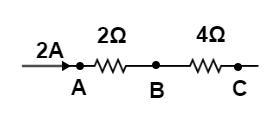
Given figure represents a path of closed circuit. What is the potential difference between points B and C?
Answer
 Verified
561k+ views
Hint: In order to solve this question, we should know about the series and parallel combination of resistances, when two resistors are connected end to end they are said to be series combination while when two resistors are connected with both their ends together, they are said to be parallel combination, here we the given circuit is in series combination, so will use the concept of series combination to find the value of potential difference between point B and C.
Complete answer:
As from the given diagram of circuit we can see that both resistors are connected in series combination and In series combination, the same amount of current passes through each resistor.
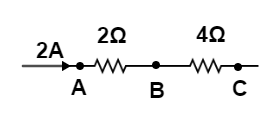
Now, current flowing in the given circuit is $ I = 2A $ and between point B and C the value of resistance is $ R = 4\Omega $ and as same current $ I = 2A $ will flow in $ R = 4\Omega $ because of series combination.
Now, by using the Ohm’s law we know that potential difference V can be written as $ V = RI $ hence, using this equation and putting the values of given parameters we get,
$ V = RI $
$ V = 4 \times 2volts $
$ V = 8volts $
Hence, the potential difference between the points B and C is $ V = 8volts $ .
Note:
It should be remembered that, same amount of current will also flow across the $ 2\Omega $ resistor and If two resistances are connected in parallel combination, then current will not pass equally, but the value of potential difference across each resistances will be the same.
Complete answer:
As from the given diagram of circuit we can see that both resistors are connected in series combination and In series combination, the same amount of current passes through each resistor.
Now, current flowing in the given circuit is $ I = 2A $ and between point B and C the value of resistance is $ R = 4\Omega $ and as same current $ I = 2A $ will flow in $ R = 4\Omega $ because of series combination.
Now, by using the Ohm’s law we know that potential difference V can be written as $ V = RI $ hence, using this equation and putting the values of given parameters we get,
$ V = RI $
$ V = 4 \times 2volts $
$ V = 8volts $
Hence, the potential difference between the points B and C is $ V = 8volts $ .
Note:
It should be remembered that, same amount of current will also flow across the $ 2\Omega $ resistor and If two resistances are connected in parallel combination, then current will not pass equally, but the value of potential difference across each resistances will be the same.
Recently Updated Pages
Which of the following graphs shows the variation of class 12 physics CBSE

Draw a labelled diagram of the human male reproductive class 12 biology CBSE
Describe the experiment to compare the emf of two cells class 12 physics CBSE
What is standard hydrogen electrode
What is conventional current and electric current class 12 physics CBSE
2Bromopentane is treated with an alcoholic KOH solution class 12 chemistry CBSE
Trending doubts
Draw a labelled sketch of the human eye class 12 physics CBSE
Which are the Top 10 Largest Countries of the World?
Differentiate between homogeneous and heterogeneous class 12 chemistry CBSE
Draw ray diagrams each showing i myopic eye and ii class 12 physics CBSE
Which is the correct genotypic ratio of mendel dihybrid class 12 biology CBSE
What is the Full Form of PVC, PET, HDPE, LDPE, PP and PS ?