




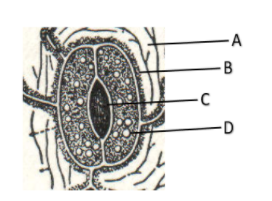
Given below is the diagram is a stomatal apparatus. In which of the following, all the four parts labeled as A, B, C, and D are correctly identified?
A B C D 1. Epidermal cell Subsidiary cell Stomatal aperture Guard cell 2. Subsidiary cell Epidermal cell Guard cell Stomatal aperture 3. Guard cell Stomatal aperture Subsidiary cell Epidermal cell 4. Epidermal cell Guard cell Stomatal aperture Subsidiary cell
A. 1
B. 2
C.3
D. 4
| A | B | C | D | |
| 1. | Epidermal cell | Subsidiary cell | Stomatal aperture | Guard cell |
| 2. | Subsidiary cell | Epidermal cell | Guard cell | Stomatal aperture |
| 3. | Guard cell | Stomatal aperture | Subsidiary cell | Epidermal cell |
| 4. | Epidermal cell | Guard cell | Stomatal aperture | Subsidiary cell |
Answer
 Verified
662.7k+ views
Hint: Stomata are small openings or gaps in plant tissue that enable the exchange of gases. They are found mostly on the lower surface of plant leaves and in some stems, allowing a plant to absorb carbon dioxide needed for photosynthesis.
Complete answer:
A. Epidermal cells often include cell types that make up the plant epidermis. While they serve a range of important roles, their primary role is to defend against a variety of harmful factors, including bacteria, chemical compounds, and ultraviolet light.
B. Subsidiary cell or accessory cell found in the stroma of a leaf next to a guard cell, and different in structure from other epidermal cells. In turn, the guard cells are surrounded by subsidiary cells which give the guard cells a supporting role.
C. Stomatal aperture is collectively used to refer to the whole stomatal complex, which consists of the paired guard cells and the pores themselves. Air reaches the plant by gaseous diffusion through these openings and includes carbon dioxide which is used in respiratory photosynthesis and oxygen. By these same openings, oxygen created as a by-product of photosynthesis diffuses out into the atmosphere.
D. Guard cells are large crescent-shaped structures, two of which are bound to and surround a stoma at both ends. These cells can expand and contract to open and close pores of the stomata. Guard cells also contain chloroplasts, the organelles which are caught by light in plants.
Stomata are tiny openings or pores in plant tissue which enable exchange of gases through specialized cells called guard cells that surround the stomata and act to open and close the pores of the stoma. These guard cells are enclosed by subsidiary cells, and the epidermal cells that serve as plant epidermis also shield these subsidiary cells.
Hence, The correct answer is option (A).
Note: Abscisic acid and jasmonic acid are typically positive stomatal closure regulators, while auxin and cytokinin are positive stomatal opening regulators. Ethylene's mode of action is unclear, since depending on the tissue and circumstances it may serve as a positive or negative regulator.
Complete answer:
A. Epidermal cells often include cell types that make up the plant epidermis. While they serve a range of important roles, their primary role is to defend against a variety of harmful factors, including bacteria, chemical compounds, and ultraviolet light.
B. Subsidiary cell or accessory cell found in the stroma of a leaf next to a guard cell, and different in structure from other epidermal cells. In turn, the guard cells are surrounded by subsidiary cells which give the guard cells a supporting role.
C. Stomatal aperture is collectively used to refer to the whole stomatal complex, which consists of the paired guard cells and the pores themselves. Air reaches the plant by gaseous diffusion through these openings and includes carbon dioxide which is used in respiratory photosynthesis and oxygen. By these same openings, oxygen created as a by-product of photosynthesis diffuses out into the atmosphere.
D. Guard cells are large crescent-shaped structures, two of which are bound to and surround a stoma at both ends. These cells can expand and contract to open and close pores of the stomata. Guard cells also contain chloroplasts, the organelles which are caught by light in plants.
Stomata are tiny openings or pores in plant tissue which enable exchange of gases through specialized cells called guard cells that surround the stomata and act to open and close the pores of the stoma. These guard cells are enclosed by subsidiary cells, and the epidermal cells that serve as plant epidermis also shield these subsidiary cells.
Hence, The correct answer is option (A).
Note: Abscisic acid and jasmonic acid are typically positive stomatal closure regulators, while auxin and cytokinin are positive stomatal opening regulators. Ethylene's mode of action is unclear, since depending on the tissue and circumstances it may serve as a positive or negative regulator.
Recently Updated Pages
Write any three differences between metals and nonmetals class 10 social science CBSE

Amit standing on a horizontal plane finds a bird flying class 10 maths CBSE
Two circles of radii 5 cm and 3 cm intersect at two class 10 maths CBSE
Solve the following i John and Jivanti together have class 10 maths CBSE
What is the relation between orthocenter circumcentre class 10 maths CBSE
Two plane mirrors are inclined at 70circ A ray incident class 10 physics CBSE
Trending doubts
Explain the Treaty of Vienna of 1815 class 10 social science CBSE
1 GB equals how many MB?
10 examples of evaporation in daily life with explanations
What is the full form of POSCO class 10 social science CBSE
Which is the hottest planet in the Solar system A Earth class 10 social science CBSE
Name any four life processes in living things class 10 biology CBSE