




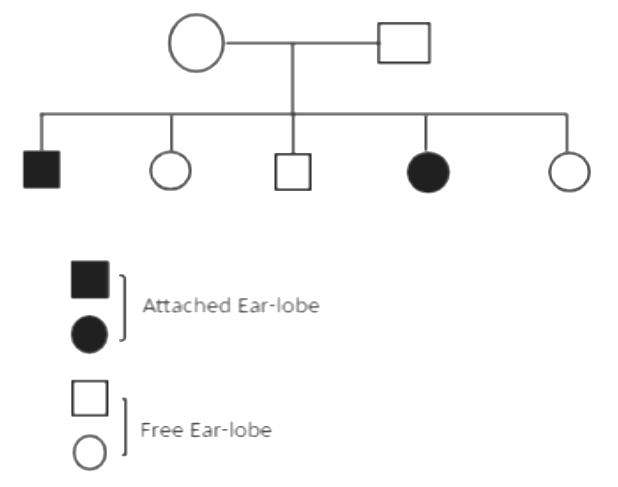
Given below is a pedigree chart of a family with five children. It shows the inheritance of attached ear-lobes as opposed to the free ones. The squares represent the male individuals and circles represent the female individuals. Which one of the following conclusions drawn is correct?
a. Parents are homozygous dominant
b. Parents are heterozygous
c. Parents are homozygous recessive
d. Trait is Y- linked
Answer
 Verified
642.3k+ views
Hint: From the above pedigree chart it is visible that both parents are not affected with the attached ear lobe therefore the trait is a recessive condition in parents. They served as a carrier of a trait as the next progeny gets affected. if the trait was dominant it would have been visible in one of the parents.
Complete answer:
> Considering the trait for dominant free ear lobe as E and the recessive attached are lobe as e. In the generation of parents, it is visible that none of them are affected. So based on this it is confirmed that the trait is recessive
> The parents are in heterozygous condition (Ee) with the carrier of the trait. In the next generation, one male one female progeny shows the defect as the recessive trait gets expressed. This is because the affected progeny are in the homozygous condition (ee).
> Thus from the above explanation, it is clear that the trait is recessive and it is not shown in the parents as both mother and father are heterozygous. It is a case of an autosomal inheritance trait.
Hence, the correct answer is option (B).
Note: The chart given above is called the pedigree chart. The pedigree is the diagram to show the ancestral relationship and transmission of characters over several generations in the human family.
Here the genes for attached ear lobes are located on autosomes in both the sexes and it is not expressed in heterozygous condition as allele E is dominant over allele.
Complete answer:
> Considering the trait for dominant free ear lobe as E and the recessive attached are lobe as e. In the generation of parents, it is visible that none of them are affected. So based on this it is confirmed that the trait is recessive
> The parents are in heterozygous condition (Ee) with the carrier of the trait. In the next generation, one male one female progeny shows the defect as the recessive trait gets expressed. This is because the affected progeny are in the homozygous condition (ee).
> Thus from the above explanation, it is clear that the trait is recessive and it is not shown in the parents as both mother and father are heterozygous. It is a case of an autosomal inheritance trait.
Hence, the correct answer is option (B).
Note: The chart given above is called the pedigree chart. The pedigree is the diagram to show the ancestral relationship and transmission of characters over several generations in the human family.
Here the genes for attached ear lobes are located on autosomes in both the sexes and it is not expressed in heterozygous condition as allele E is dominant over allele.
Recently Updated Pages
Which of the following graphs shows the variation of class 12 physics CBSE

Draw a labelled diagram of the human male reproductive class 12 biology CBSE
Describe the experiment to compare the emf of two cells class 12 physics CBSE
What is standard hydrogen electrode
What is conventional current and electric current class 12 physics CBSE
2Bromopentane is treated with an alcoholic KOH solution class 12 chemistry CBSE
Trending doubts
Draw a labelled sketch of the human eye class 12 physics CBSE
Which are the Top 10 Largest Countries of the World?
Differentiate between homogeneous and heterogeneous class 12 chemistry CBSE
Draw ray diagrams each showing i myopic eye and ii class 12 physics CBSE
Which is the correct genotypic ratio of mendel dihybrid class 12 biology CBSE
What is the Full Form of PVC, PET, HDPE, LDPE, PP and PS ?