




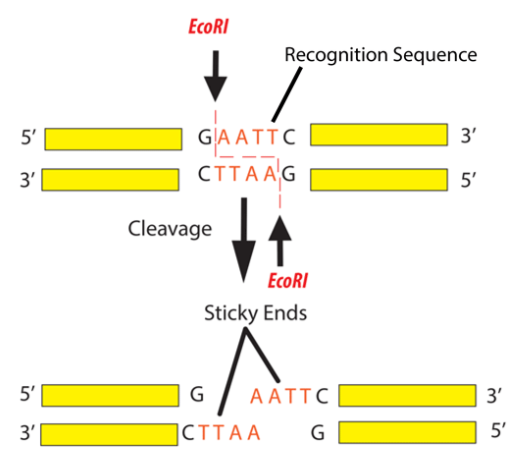
GAATTC is the recognition site for which of the following restrictions endonuclease?
a. Hind III
b. EcoR I
c. Bam II
d. Hae III
Answer
 Verified
662.7k+ views
Hint: The recognition sequence of nucleic acid where the enzyme cuts are G/AATTC, which has a complementary and palindromic sequence of CTTAA/G. Restriction endonuclease is also called the restriction enzyme. It cuts double helix DNA in a precise way.
Complete answer:
The species from which the restriction endonuclease enzyme, EcoR I, originated will state the end part of that enzyme.
Whereas the letter R is the representation of certain strains in this case it is RY13.
Figure – 2: structure of EcoRI
From the species E. coli, EcoR I is a restriction endonuclease enzyme that is isolated.
The number I which is the last part of its name, is the one which denotes that EcoR I was the first enzyme which is isolated from this straining.
The only restriction enzyme which cleaves the DNA double helices into fragments at precise positions is the EcoRI.
EcoRI is a restriction endonuclease enzyme which is also a part of the restriction-modification system.
The EcoR I is the endonuclease enzyme which is used as a restriction enzyme in molecular biology. EcoR I generate 4 nucleotide tacky split ends with 5' end ledges of AATT.
So, the correct option is 'EcoR I'.
Additional Information:
- A restriction enzyme (which is also called restriction endonuclease, or restrictive) can be termed as an enzyme that cleaves the complete DNA into fragments by the side of definite recognition locations within molecules known as restriction sites. The restriction enzymes are one class of the wider endonuclease group of enzymes.
- Hind III cleaves DNA at a particular site.
- The recurrent neural network that was introduced by Bart Kosko in 1988 is known as BAM (Bidirectional associative memory).
- The restriction enzyme that is of prokaryotic type of DNA and protects organisms from unknown, foreign DNA is called Hae III.
Note: In the above statements, the / in the classification designates the phosphodiester bond in the enzyme will disrupt the DNA particle. GAATTC is a palindromic sequence and can be defined as a sequence of the nucleic acid in a DNA or RNA molecule which is stranded double in which reading is in a firm direction.
Complete answer:
The species from which the restriction endonuclease enzyme, EcoR I, originated will state the end part of that enzyme.
Whereas the letter R is the representation of certain strains in this case it is RY13.
Figure – 2: structure of EcoRI
From the species E. coli, EcoR I is a restriction endonuclease enzyme that is isolated.
The number I which is the last part of its name, is the one which denotes that EcoR I was the first enzyme which is isolated from this straining.
The only restriction enzyme which cleaves the DNA double helices into fragments at precise positions is the EcoRI.
EcoRI is a restriction endonuclease enzyme which is also a part of the restriction-modification system.
The EcoR I is the endonuclease enzyme which is used as a restriction enzyme in molecular biology. EcoR I generate 4 nucleotide tacky split ends with 5' end ledges of AATT.
So, the correct option is 'EcoR I'.
Additional Information:
- A restriction enzyme (which is also called restriction endonuclease, or restrictive) can be termed as an enzyme that cleaves the complete DNA into fragments by the side of definite recognition locations within molecules known as restriction sites. The restriction enzymes are one class of the wider endonuclease group of enzymes.
- Hind III cleaves DNA at a particular site.
- The recurrent neural network that was introduced by Bart Kosko in 1988 is known as BAM (Bidirectional associative memory).
- The restriction enzyme that is of prokaryotic type of DNA and protects organisms from unknown, foreign DNA is called Hae III.
Note: In the above statements, the / in the classification designates the phosphodiester bond in the enzyme will disrupt the DNA particle. GAATTC is a palindromic sequence and can be defined as a sequence of the nucleic acid in a DNA or RNA molecule which is stranded double in which reading is in a firm direction.
Recently Updated Pages
Which of the following graphs shows the variation of class 12 physics CBSE

Draw a labelled diagram of the human male reproductive class 12 biology CBSE
Describe the experiment to compare the emf of two cells class 12 physics CBSE
What is standard hydrogen electrode
What is conventional current and electric current class 12 physics CBSE
2Bromopentane is treated with an alcoholic KOH solution class 12 chemistry CBSE
Trending doubts
Draw a labelled sketch of the human eye class 12 physics CBSE
Which are the Top 10 Largest Countries of the World?
Differentiate between homogeneous and heterogeneous class 12 chemistry CBSE
Draw ray diagrams each showing i myopic eye and ii class 12 physics CBSE
Which is the correct genotypic ratio of mendel dihybrid class 12 biology CBSE
What is the Full Form of PVC, PET, HDPE, LDPE, PP and PS ?