




What is the function of the jelly on the eggs laid by the frogs?
A) To hold the eggs together
B) To provide protection to the eggs
C) Both A and B
D) None of the above
Answer
 Verified
569.4k+ views
Hint: Frogs are the amphibians that belong to the class Amphibia under the phylum Chordata. These are cold blooded animals that can camouflage. In most of the species, external fertilization takes place. When there are extreme climatic conditions, they live in deep burrows to protect themselves from extreme temperatures.
Complete answer:
External fertilization means fusion of gametes outside the body of female organism. In frogs, the eggs and sperms are released into the water by female and male frogs respectively. The eggs produced by female frogs are large in number because there is very less chances of fusion of sperm with egg. T
he eggs produced by female frogs have a jelly like coating that surrounds the egg. The eggs are also surrounded by vitelline membrane. This vitelline membrane along with jelly coating is called tertiary egg membrane. When the egg passes from oviduct to cloaca, the tertiary egg membrane is deposited on the egg.
The jelly provides following advantages to the egg:
- As the eggs are released inside the water, it is vulnerable to water movements and predators because of its small size. Due to jelly coating, the egg appears large.
- The jelly acts as a receptor so that the compatible sperm easily fertilizes with the egg.
- It also keeps the female eggs moist.
- The jelly coating keeps the eggs together and thus protects it from wind and water.
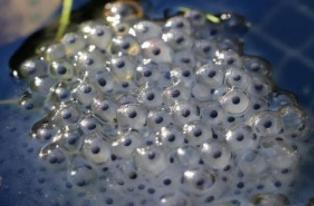
Therefore the correct answer is option ‘C’.
Note: Oviducts are also present in male frogs but they do not play any role in reproduction. In male frogs, it is a vestigial organ. In female frogs, the oviduct is very small in size due to the absence of lumen. Hence it is also called rudimentary oviduct.
Complete answer:
External fertilization means fusion of gametes outside the body of female organism. In frogs, the eggs and sperms are released into the water by female and male frogs respectively. The eggs produced by female frogs are large in number because there is very less chances of fusion of sperm with egg. T
he eggs produced by female frogs have a jelly like coating that surrounds the egg. The eggs are also surrounded by vitelline membrane. This vitelline membrane along with jelly coating is called tertiary egg membrane. When the egg passes from oviduct to cloaca, the tertiary egg membrane is deposited on the egg.
The jelly provides following advantages to the egg:
- As the eggs are released inside the water, it is vulnerable to water movements and predators because of its small size. Due to jelly coating, the egg appears large.
- The jelly acts as a receptor so that the compatible sperm easily fertilizes with the egg.
- It also keeps the female eggs moist.
- The jelly coating keeps the eggs together and thus protects it from wind and water.
Therefore the correct answer is option ‘C’.
Note: Oviducts are also present in male frogs but they do not play any role in reproduction. In male frogs, it is a vestigial organ. In female frogs, the oviduct is very small in size due to the absence of lumen. Hence it is also called rudimentary oviduct.
Recently Updated Pages
Which of the following graphs shows the variation of class 12 physics CBSE

Draw a labelled diagram of the human male reproductive class 12 biology CBSE
Describe the experiment to compare the emf of two cells class 12 physics CBSE
What is standard hydrogen electrode
What is conventional current and electric current class 12 physics CBSE
2Bromopentane is treated with an alcoholic KOH solution class 12 chemistry CBSE
Trending doubts
Draw a labelled sketch of the human eye class 12 physics CBSE
Which are the Top 10 Largest Countries of the World?
Differentiate between homogeneous and heterogeneous class 12 chemistry CBSE
Draw ray diagrams each showing i myopic eye and ii class 12 physics CBSE
Which is the correct genotypic ratio of mendel dihybrid class 12 biology CBSE
What is the Full Form of PVC, PET, HDPE, LDPE, PP and PS ?