




What is the function of a tapeworm's hooks and suckers?
Answer
 Verified
547.2k+ views
Hint: Tapeworms are flat, segmented worms that dwell in some animals' intestines. When animals graze in meadows or drink contaminated water, they might become infected with these parasites. Tapeworm infection in humans is caused by eating raw or undercooked meat from infected animals.
Complete answer:
The structure of Rostellum is made up of a series of concentric rows of hooks. The upper row hooks, which are larger and have a projecting, rounded stout guard, and the lower row hooks, which are smaller and have a flattened guard, are the two primary varieties of hooks. The rostellum's primary function is attachment. It protrudes during attachment and enters the intestinal mucosa with hooks. This is especially necessary during meal digestion and bowel movement in order to prevent the tapeworm from being ejected with the faeces.
Hooks are tough, curving projections that protrude from a parasite's surface. They are frequently numerous and help with attachment by penetrating the host's tissues. Hooks (H) on tapeworm oncospheres enable them to breach the first intermediate host's intestinal wall.
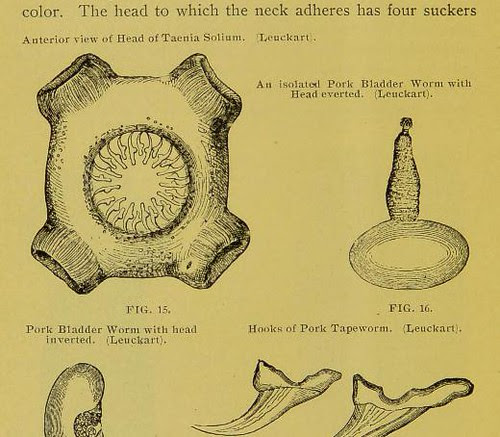
Humans and animals both have tapeworms in their intestines. On one end, they have a number of hooks (or suckers) that they utilise to adhere to the gut and feed on the host.
Tapeworms attach to the gut wall with their anterior scolex, which may have hooks in addition to four suckers. Although they can cause some damage at the attachment site, they generally compete for nutrients with the host. They take nutrients through their surface since they lack an alimentary system.
Suckers and other structures on tapeworms and flukes allow them to feed on their hosts. Tapeworms have a scolex, which is a ring of hooks on their head that allows them to connect to the host. Instead, they use their suckers to collect nutrients straight from the host's digestive tract. Suckers and Hooks for Tapeworms
Note:-
The scolex (head) is an anchoring organ that adheres to the mucosa of the intestine. The neck is an unsegmented area with a high capacity for regeneration. If the neck and scolex are not removed during therapy, the entire worm may regrow. The rest of the worm is made up of several proglottids (segments).
Complete answer:
The structure of Rostellum is made up of a series of concentric rows of hooks. The upper row hooks, which are larger and have a projecting, rounded stout guard, and the lower row hooks, which are smaller and have a flattened guard, are the two primary varieties of hooks. The rostellum's primary function is attachment. It protrudes during attachment and enters the intestinal mucosa with hooks. This is especially necessary during meal digestion and bowel movement in order to prevent the tapeworm from being ejected with the faeces.
Hooks are tough, curving projections that protrude from a parasite's surface. They are frequently numerous and help with attachment by penetrating the host's tissues. Hooks (H) on tapeworm oncospheres enable them to breach the first intermediate host's intestinal wall.
Humans and animals both have tapeworms in their intestines. On one end, they have a number of hooks (or suckers) that they utilise to adhere to the gut and feed on the host.
Tapeworms attach to the gut wall with their anterior scolex, which may have hooks in addition to four suckers. Although they can cause some damage at the attachment site, they generally compete for nutrients with the host. They take nutrients through their surface since they lack an alimentary system.
Suckers and other structures on tapeworms and flukes allow them to feed on their hosts. Tapeworms have a scolex, which is a ring of hooks on their head that allows them to connect to the host. Instead, they use their suckers to collect nutrients straight from the host's digestive tract. Suckers and Hooks for Tapeworms
Note:-
The scolex (head) is an anchoring organ that adheres to the mucosa of the intestine. The neck is an unsegmented area with a high capacity for regeneration. If the neck and scolex are not removed during therapy, the entire worm may regrow. The rest of the worm is made up of several proglottids (segments).
Recently Updated Pages
Difference Between Prokaryotic Cells and Eukaryotic Cells

If x a + bt + ct2 where x is in meters and t is in class 11 physics CBSE
A car covers the first half distance between two places class 11 physics CBSE
The resultant of two vectors overrightarrow P and overrightarrow class 11 physics CBSE
Find the value of cos 135 class 11 maths CBSE
A mass M is held in place by an applied force F and class 11 physics CBSE
Trending doubts
One Metric ton is equal to kg A 10000 B 1000 C 100 class 11 physics CBSE
Find the value of the expression given below sin 30circ class 11 maths CBSE
Draw a diagram of nephron and explain its structur class 11 biology CBSE
10 examples of friction in our daily life
Proton was discovered by A Thomson B Rutherford C Chadwick class 11 chemistry CBSE
Bond order ofO2 O2+ O2 and O22 is in order A O2 langle class 11 chemistry CBSE