




For higher plants, flowers are chiefly used as a basis of classification because
(a) These show a great variety in color
(b) It can be preserved easily
(c) Reproductive parts are more conservative than vegetative parts
(d) None of the above
Answer
 Verified
607.2k+ views
Hint: Floral properties help in emphasizing the structural features of higher plants because these aspects of flowers play a major role in classification. Flowers show a great variety of colors and also they can be preserved easily.
Complete Step by Step Answer:
- Plants divided into two groups- reproductive parts of plants are the stamen (male, collectively termed the androecium) and carpel( often the carpal is referred to as the pistil) and the female part collectively termed gynoecium.
- The root, leaves, shoots, and leaves are the vegetative parts and do not take part in the process of reproduction. Hence vegetative parts are relatively less stable and exhibit changes due to environmental factors quite readily. Floral features are more conservative. They are also similar to all plants in spite of environmental conditions which mostly affect the morphological character of the plant.
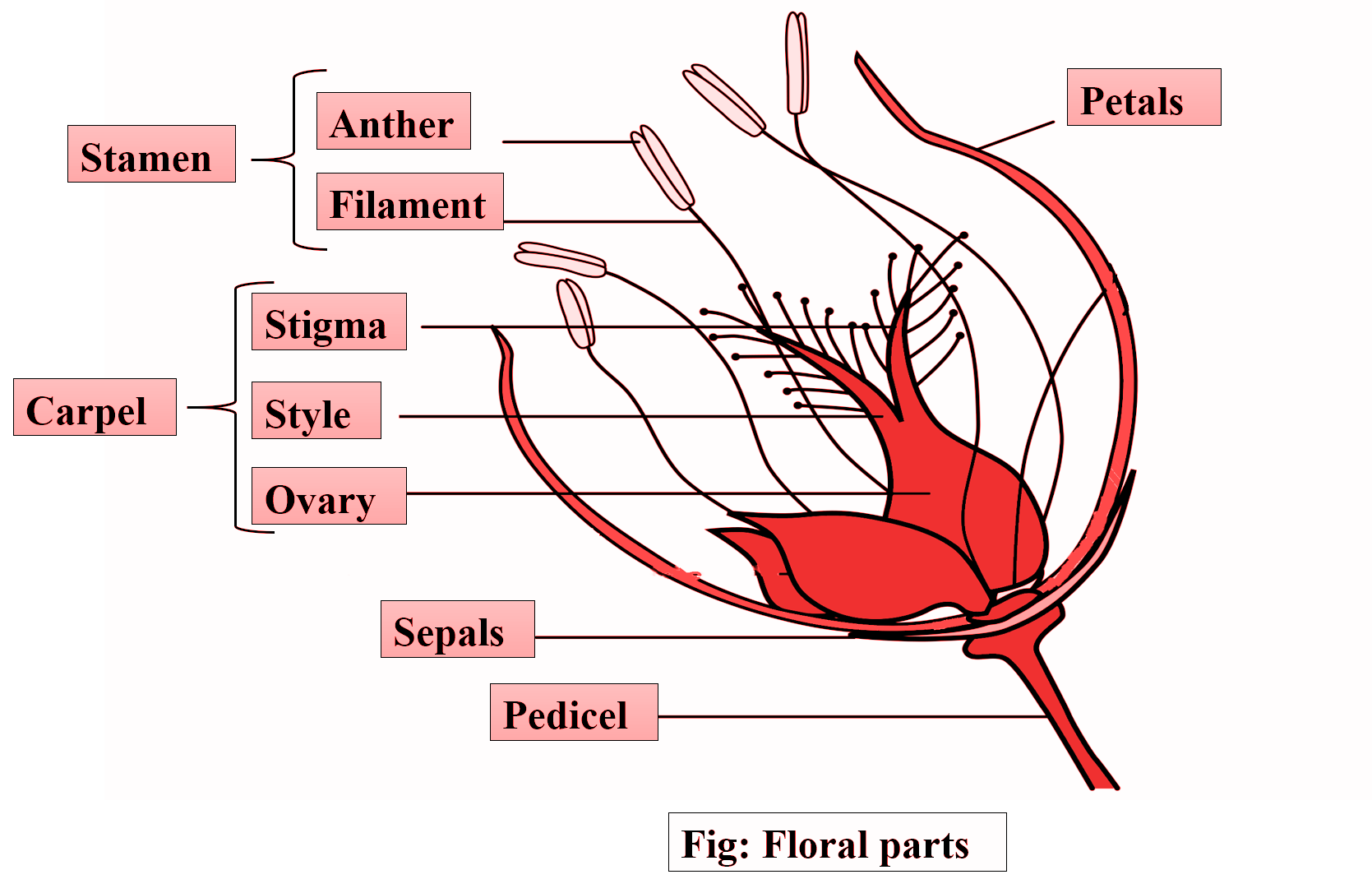
Hence the correct answer is, “Reproductive parts are more conservative than vegetative parts”.
Additional information:
- Flower color is a vegetative character and has great phenotypic plasticity. They are often more easily affected by the environment. It is also different within a genus and even In a different species. Thus they are not accepted by the taxonomist and fail in the criteria of classification.
- Leaves and stems can be preserved easily because of Dead sclerenchyma tissue as compared to flowers. hence option B is incorrect because the sexual phase of the plant is limited to a very short period of time as compared to vegetative parts.
Therefore for higher plants, flowers are chiefly used as a basis of classification because reproductive parts( floral features) are more conservative than vegetative parts.
Note:
- The term higher plants cover all plants which can be planted- all trees, shrubs, flowering herbs.
- Higher plants are also known as vascular plants.
- Sclerenchyma is the supporting tissue in plants which makes the plant hard and stiff.
Complete Step by Step Answer:
- Plants divided into two groups- reproductive parts of plants are the stamen (male, collectively termed the androecium) and carpel( often the carpal is referred to as the pistil) and the female part collectively termed gynoecium.
- The root, leaves, shoots, and leaves are the vegetative parts and do not take part in the process of reproduction. Hence vegetative parts are relatively less stable and exhibit changes due to environmental factors quite readily. Floral features are more conservative. They are also similar to all plants in spite of environmental conditions which mostly affect the morphological character of the plant.
Hence the correct answer is, “Reproductive parts are more conservative than vegetative parts”.
Additional information:
- Flower color is a vegetative character and has great phenotypic plasticity. They are often more easily affected by the environment. It is also different within a genus and even In a different species. Thus they are not accepted by the taxonomist and fail in the criteria of classification.
- Leaves and stems can be preserved easily because of Dead sclerenchyma tissue as compared to flowers. hence option B is incorrect because the sexual phase of the plant is limited to a very short period of time as compared to vegetative parts.
Therefore for higher plants, flowers are chiefly used as a basis of classification because reproductive parts( floral features) are more conservative than vegetative parts.
Note:
- The term higher plants cover all plants which can be planted- all trees, shrubs, flowering herbs.
- Higher plants are also known as vascular plants.
- Sclerenchyma is the supporting tissue in plants which makes the plant hard and stiff.
Recently Updated Pages
Master Class 11 Social Science: Engaging Questions & Answers for Success

Master Class 11 English: Engaging Questions & Answers for Success
Master Class 11 Maths: Engaging Questions & Answers for Success
Master Class 11 Chemistry: Engaging Questions & Answers for Success
Master Class 11 Biology: Engaging Questions & Answers for Success
Master Class 11 Physics: Engaging Questions & Answers for Success
Trending doubts
Differentiate between an exothermic and an endothermic class 11 chemistry CBSE
One Metric ton is equal to kg A 10000 B 1000 C 100 class 11 physics CBSE
Difference Between Prokaryotic Cells and Eukaryotic Cells
There are 720 permutations of the digits 1 2 3 4 5 class 11 maths CBSE
Draw a diagram of a plant cell and label at least eight class 11 biology CBSE
1 Quintal is equal to a 110 kg b 10 kg c 100kg d 1000 class 11 physics CBSE