




Find the value of the given trigonometric ratio, $\tan 15{}^\circ $ .
Answer
 Verified
690k+ views
Hint: Use the formula of $\tan 2A$ along with the value of $\tan 30{}^\circ $ , to get a quadratic equation. Solve the quadratic equation to reach the required answer.
Complete step-by-step answer:
We know;
$\tan 30{}^\circ =\dfrac{1}{\sqrt{3}}$
The other commonly used trigonometric values include:
$\tan 0{}^\circ =0$
$\tan 45{}^\circ =1$
$\tan 60{}^\circ =\sqrt{3}$
Also, we have, the formula: $\tan 2A=\dfrac{2\tan A}{1-{{\tan }^{2}}A}$
So, in the above formula substituting $A=15{}^\circ $ .
$\therefore \tan 2A=\dfrac{2\tan A}{1-{{\tan }^{2}}A}$
$\Rightarrow \tan \left( 2\times 15{}^\circ \right)=\dfrac{2\tan 15{}^\circ }{1-{{\tan }^{2}}15{}^\circ }$
$\Rightarrow \tan 30{}^\circ =\dfrac{2\tan 15{}^\circ }{1-{{\tan }^{2}}15{}^\circ }$
Putting the value of $\tan 30{}^\circ $ in the equation, we get;
$\dfrac{1}{\sqrt{3}}=\dfrac{2\tan 15{}^\circ }{1-{{\tan }^{2}}15{}^\circ }$
On cross-multiplication, we get;
$1-{{\tan }^{2}}15{}^\circ =2\sqrt{3}\tan 15{}^\circ $
$\Rightarrow {{\tan }^{2}}15{}^\circ +2\sqrt{3}\tan 15{}^\circ -1=0$
So, the equation we get is a quadratic equation, and one of the roots of this quadratic equation would be the value of $\tan 15{}^\circ $.
We know, for a quadratic equation of the form $a{{x}^{2}}+bx+c=0$ .
$x=\dfrac{-b\pm \sqrt{{{b}^{2}}-4ac}}{2a}$
Applying the formula to our quadratic equation, we have;
$\tan 15{}^\circ =\dfrac{-2\sqrt{3}\pm \sqrt{{{\left( 2\sqrt{3} \right)}^{2}}-4\times 1\times \left( -1 \right)}}{2\times 1}$
$\Rightarrow \tan 15{}^\circ =\dfrac{-2\sqrt{3}\pm \sqrt{12+4}}{2}$
$\Rightarrow \tan 15{}^\circ =\dfrac{-2\sqrt{3}\pm \sqrt{16}}{2}$
$\Rightarrow \tan 15{}^\circ =\dfrac{-2\sqrt{3}\pm 4}{2}$
We know, $15{}^\circ $ lies in the first quadrant.
According to the graph of $\tan (x)$ :
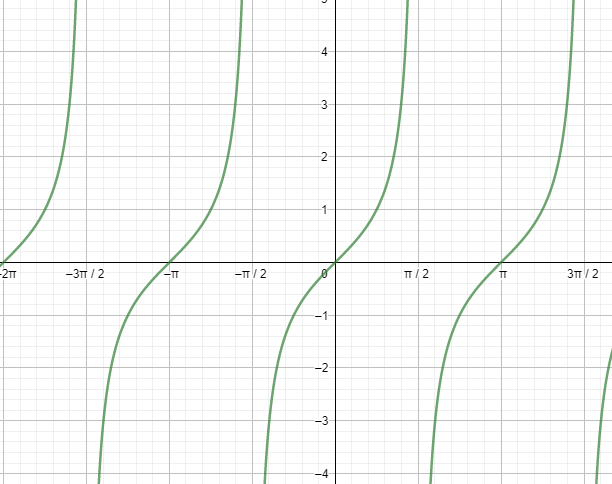
$\tan (x)$ is positive when x lies in the first quadrant.
Therefore, $\tan 15{}^\circ $ is also positive.
$\therefore \tan 15{}^\circ =\dfrac{-2\sqrt{3}+4}{2}$
$\Rightarrow \tan 15{}^\circ =\dfrac{\left( -\sqrt{3}+2 \right)}{{}}$
$\therefore \tan 15{}^\circ =2-\sqrt{3}$
Hence, the value of $\tan 15{}^\circ $ is $2-\sqrt{3}$ .
Note: Other useful formulas include:
$\tan (A+B)=\dfrac{\tan A+\tan B}{1-\tan A\tan B}$
$\tan (A-B)=\dfrac{\tan A-\tan B}{1+\tan A\tan B}$
And you are free to use any formula, just substitute the angles according to the need to get the desired values.
We can also find the value of $\tan 15{}^\circ $ using formula: $\tan (A-B)=\dfrac{\tan A-\tan B}{1+\tan A\tan B}$ .
On Substituting A and B in the above formula, we get;
$A=45{}^\circ $
$B=30{}^\circ $
The equation becomes:
$\tan (A-B)=\dfrac{\tan A-\tan B}{1+\tan A\tan B}$
$\Rightarrow \tan (45{}^\circ -30{}^\circ )=\dfrac{\tan 45{}^\circ -\tan 30{}^\circ }{1+\tan 45{}^\circ \tan 30{}^\circ }$
\[\Rightarrow \tan 15{}^\circ =\dfrac{1-\left( \dfrac{1}{\sqrt{3}} \right)}{1+1\times \dfrac{1}{\sqrt{3}}}\]
Point to remember: whenever you try to find the value of $\sin 15{}^\circ $ , don’t use the formula of $\sin 2A$ , instead, go for the formula: $\cos 2A=1-2{{\sin }^{2}}A$ . The reason being, whenever you use the formula of $\sin 2A$ , you get both $\cos A$ and $\sin A$ to be unknown, making it difficult to solve.
Complete step-by-step answer:
We know;
$\tan 30{}^\circ =\dfrac{1}{\sqrt{3}}$
The other commonly used trigonometric values include:
$\tan 0{}^\circ =0$
$\tan 45{}^\circ =1$
$\tan 60{}^\circ =\sqrt{3}$
Also, we have, the formula: $\tan 2A=\dfrac{2\tan A}{1-{{\tan }^{2}}A}$
So, in the above formula substituting $A=15{}^\circ $ .
$\therefore \tan 2A=\dfrac{2\tan A}{1-{{\tan }^{2}}A}$
$\Rightarrow \tan \left( 2\times 15{}^\circ \right)=\dfrac{2\tan 15{}^\circ }{1-{{\tan }^{2}}15{}^\circ }$
$\Rightarrow \tan 30{}^\circ =\dfrac{2\tan 15{}^\circ }{1-{{\tan }^{2}}15{}^\circ }$
Putting the value of $\tan 30{}^\circ $ in the equation, we get;
$\dfrac{1}{\sqrt{3}}=\dfrac{2\tan 15{}^\circ }{1-{{\tan }^{2}}15{}^\circ }$
On cross-multiplication, we get;
$1-{{\tan }^{2}}15{}^\circ =2\sqrt{3}\tan 15{}^\circ $
$\Rightarrow {{\tan }^{2}}15{}^\circ +2\sqrt{3}\tan 15{}^\circ -1=0$
So, the equation we get is a quadratic equation, and one of the roots of this quadratic equation would be the value of $\tan 15{}^\circ $.
We know, for a quadratic equation of the form $a{{x}^{2}}+bx+c=0$ .
$x=\dfrac{-b\pm \sqrt{{{b}^{2}}-4ac}}{2a}$
Applying the formula to our quadratic equation, we have;
$\tan 15{}^\circ =\dfrac{-2\sqrt{3}\pm \sqrt{{{\left( 2\sqrt{3} \right)}^{2}}-4\times 1\times \left( -1 \right)}}{2\times 1}$
$\Rightarrow \tan 15{}^\circ =\dfrac{-2\sqrt{3}\pm \sqrt{12+4}}{2}$
$\Rightarrow \tan 15{}^\circ =\dfrac{-2\sqrt{3}\pm \sqrt{16}}{2}$
$\Rightarrow \tan 15{}^\circ =\dfrac{-2\sqrt{3}\pm 4}{2}$
We know, $15{}^\circ $ lies in the first quadrant.
According to the graph of $\tan (x)$ :
$\tan (x)$ is positive when x lies in the first quadrant.
Therefore, $\tan 15{}^\circ $ is also positive.
$\therefore \tan 15{}^\circ =\dfrac{-2\sqrt{3}+4}{2}$
$\Rightarrow \tan 15{}^\circ =\dfrac{\left( -\sqrt{3}+2 \right)}{{}}$
$\therefore \tan 15{}^\circ =2-\sqrt{3}$
Hence, the value of $\tan 15{}^\circ $ is $2-\sqrt{3}$ .
Note: Other useful formulas include:
$\tan (A+B)=\dfrac{\tan A+\tan B}{1-\tan A\tan B}$
$\tan (A-B)=\dfrac{\tan A-\tan B}{1+\tan A\tan B}$
And you are free to use any formula, just substitute the angles according to the need to get the desired values.
We can also find the value of $\tan 15{}^\circ $ using formula: $\tan (A-B)=\dfrac{\tan A-\tan B}{1+\tan A\tan B}$ .
On Substituting A and B in the above formula, we get;
$A=45{}^\circ $
$B=30{}^\circ $
The equation becomes:
$\tan (A-B)=\dfrac{\tan A-\tan B}{1+\tan A\tan B}$
$\Rightarrow \tan (45{}^\circ -30{}^\circ )=\dfrac{\tan 45{}^\circ -\tan 30{}^\circ }{1+\tan 45{}^\circ \tan 30{}^\circ }$
\[\Rightarrow \tan 15{}^\circ =\dfrac{1-\left( \dfrac{1}{\sqrt{3}} \right)}{1+1\times \dfrac{1}{\sqrt{3}}}\]
Point to remember: whenever you try to find the value of $\sin 15{}^\circ $ , don’t use the formula of $\sin 2A$ , instead, go for the formula: $\cos 2A=1-2{{\sin }^{2}}A$ . The reason being, whenever you use the formula of $\sin 2A$ , you get both $\cos A$ and $\sin A$ to be unknown, making it difficult to solve.
Recently Updated Pages
Which of the following graphs shows the variation of class 12 physics CBSE

Draw a labelled diagram of the human male reproductive class 12 biology CBSE
Describe the experiment to compare the emf of two cells class 12 physics CBSE
What is standard hydrogen electrode
What is conventional current and electric current class 12 physics CBSE
2Bromopentane is treated with an alcoholic KOH solution class 12 chemistry CBSE
Trending doubts
Draw a labelled sketch of the human eye class 12 physics CBSE
Which are the Top 10 Largest Countries of the World?
Draw ray diagrams each showing i myopic eye and ii class 12 physics CBSE
Materials which do not allow an electric current to class 12 physics CBSE
Which is the correct genotypic ratio of mendel dihybrid class 12 biology CBSE
Which is the strongest oxidising agent out of the following class 12 chemistry CBSE