



Find the square root of $\sqrt 5 $ by division method.
Answer
 Verified
647.1k+ views
Hint:
For finding the square root of the given number, first, make pairs from the unit place. Now take the largest number whose square is equal to or just less than the number in the first bar from left. Now subtract the digit of the given number and the square of the number written in the quotient. Bring down the next pair. Then, take twice of the number taken in the first place and add the unit digit to that number such that when that unit digit is multiplied with the number formed, it is equal to less than the current dividend.
Complete step by step solution:
We shall begin by making groups of 2 digits starting from the unit place.
Make the pair such as $\overline {05} $, there is only one digit.
Now, take the divisor as the largest number whose square is equal to or just less than the first digit in the bar from the starting digits of the given number.
As ${2^2} = 4 < 5$ and ${3^2} = 9 > 5$
Therefore, our divisor is 2. Subtract the first pair from the square of 2 and then bring the next pair down by putting decimal sign.
Now, we get,
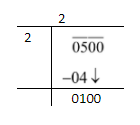
Next, our dividend is 100
Write the twice of the first divisor, which is $2 \times 2 = 4$
We will now find the unit digit placed with 10 such that when that digit is multiplied by the new number, the result is less than or equal to the dividend.
Therefore, we have
\[42 \times 2 = 84\]
Hence, the next digit in divisor is 2.
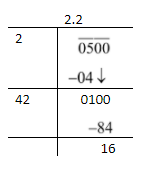
Now, the remainder is 16.
Hence, the square root of 5 is $ \approx 2.2$.
Note:
Many students make mistakes by making a pair from the starting of the number instead of a unit place, which gives the incorrect answer. Also, make sure when you bring down the digit, you take the whole pair and not the single digit.
For finding the square root of the given number, first, make pairs from the unit place. Now take the largest number whose square is equal to or just less than the number in the first bar from left. Now subtract the digit of the given number and the square of the number written in the quotient. Bring down the next pair. Then, take twice of the number taken in the first place and add the unit digit to that number such that when that unit digit is multiplied with the number formed, it is equal to less than the current dividend.
Complete step by step solution:
We shall begin by making groups of 2 digits starting from the unit place.
Make the pair such as $\overline {05} $, there is only one digit.
Now, take the divisor as the largest number whose square is equal to or just less than the first digit in the bar from the starting digits of the given number.
As ${2^2} = 4 < 5$ and ${3^2} = 9 > 5$
Therefore, our divisor is 2. Subtract the first pair from the square of 2 and then bring the next pair down by putting decimal sign.
Now, we get,
Next, our dividend is 100
Write the twice of the first divisor, which is $2 \times 2 = 4$
We will now find the unit digit placed with 10 such that when that digit is multiplied by the new number, the result is less than or equal to the dividend.
Therefore, we have
\[42 \times 2 = 84\]
Hence, the next digit in divisor is 2.
Now, the remainder is 16.
Hence, the square root of 5 is $ \approx 2.2$.
Note:
Many students make mistakes by making a pair from the starting of the number instead of a unit place, which gives the incorrect answer. Also, make sure when you bring down the digit, you take the whole pair and not the single digit.
Recently Updated Pages
Which will be the least stable resonating structure class 11 chemistry CBSE

Explain the structure of megasporangium class 12 biology CBSE
Differentiate between voluntary action and reflex class 10 biology CBSE
How many 5 digit telephone numbers can be construc-class-11-maths-CBSE
How do you find the angle of the resultant vector class 11 physics CBSE
Why is chloroform kept in dark coloured bottles class 12 chemistry CBSE
Trending doubts
The common name of Rheo leaf is A Oyster plant B Boat class 9 biology CBSE
Difference Between Plant Cell and Animal Cell
Fill the blanks with the suitable prepositions 1 The class 9 english CBSE
What is the full form of pH?
Any five important events between the years 1930 to class 9 social science CBSE
On an outline map of India show its neighbouring c class 9 social science CBSE