



Find the locus of the point of intersection of those normal to the parabola \[{{x}^{2}}=8y\] which are at right angles to each other.
Answer
 Verified
633k+ views
Hint- Apply the concept of co-normal points over here. Co normal points are the feet of any three normal that are drawn from any point. Note that, there can be at the most, only 3 normals possible to be drawn on a parabola from a single point. You’ll eventually get a cubic equation in their slopes, and apply general results of cubic equations, like sum of roots, sum of product of roots taken two at a time, and the product of the roots, to get to the final answer.
Let’s assume a parabola \[{{x}^{2}}=8y\].
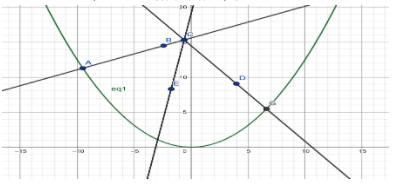
General equation of normal of the parabola \[{{x}^{2}}=8y\]is
\[x=ym-2bm-b{{m}^{3}}\] …………………. (1)
Where \[\dfrac{1}{m}=\]slope of normal
As we can see that the equation of normal \[x=ym-2bm-b{{m}^{3}}\]is a $3$ degree polynomial in $m$.
Therefore; this equation will have three solutions.
It means three normals can be drawn on a parabola from one point, lying anywhere.
Let the point of the intersection of normal is \[C\left( h,k \right)\].
Therefore, point $C$ will satisfy the equation (1).
From equation (1) and the point $C$, we get :
\[h=km-2bm-b{{m}^{3}}\]
\[\Rightarrow b{{m}^{3}}+m\left( 2b-k \right)+h=0\] ……….. (2)
Let \[{{m}_{1}},{{m}_{2}}\,and\,{{m}_{3}}\]are solutions of equation (2).
Therefore,
\[{{m}_{1}}+{{m}_{2}}+{{m}_{3}}=0\],
\[{{m}_{1}}{{m}_{2}}+{{m}_{2}}{{m}_{3}}+{{m}_{3}}{{m}_{1}}=\dfrac{\left( 2b-k \right)}{b}\] and
\[{{m}_{1}}{{m}_{2}}{{m}_{3}}=-\dfrac{h}{b}\] …….. (3)
Let’s assume \[{{m}_{1}}\,and\,{{m}_{2}}\,\]are the slopes of two normals which intersect normally each other at point $C$.
Therefore, the product of their slopes \[=-1\]
\[{{m}_{1}}{{m}_{2}}=-1\] ………. (4)
Put the value of \[{{m}_{1}}{{m}_{2}}=-1\]in equation (3)
Therefore, from equation (3) and (4), we get :
\[\left( -1 \right){{m}_{3}}=-\dfrac{h}{b}\]
\[\Rightarrow {{m}_{3}}=\dfrac{h}{b}\] ……… (5)
As \[{{m}_{3}}\]is also a solution to equation (2), it will satisfy the equation.
Therefore, from equation (2) and (5)
Put the value of \[{{m}_{3}}=\dfrac{h}{b}\] in equation (3), we get :
\[\Rightarrow b{{\left( \dfrac{h}{b} \right)}^{3}}+\dfrac{h}{b}\left( 2b-k \right)+h=0\]
\[\Rightarrow {{\dfrac{h}{{{b}^{2}}}}^{3}}+2h-\dfrac{hk}{b}+h=0\]
Taking $h$ common, we get :
\[\Rightarrow h\left( \dfrac{{{h}^{2}}}{{{b}^{2}}}+3-\dfrac{k}{b} \right)=0\]
\[\therefore \dfrac{{{h}^{2}}}{{{b}^{2}}}+3-\dfrac{k}{b}=0\]
\[\Rightarrow {{h}^{2}}+3{{b}^{2}}-kb=0\]
\[\Rightarrow {{h}^{2}}=b\left( k-3b \right)\] ……….. (6)
Interchange \[\left( h,k \right)\to \left( x,y \right)\]and equation (6) becomes
\[\Rightarrow {{x}^{2}}=b\left( y-3b \right)\] …………. (7)
According to the question, the given parabola is \[{{x}^{2}}=8y\].
Comparing with the general equation of a parabola \[{{x}^{2}}=4ay\]
\[{{x}^{2}}=4by\] ……… (A)
\[{{x}^{2}}=8y\] ………… (B)
From (A) and (B),
\[b=2\] Put this value in equation (7)
Form equation (7)
\[\Rightarrow {{x}^{2}}=2\left( y-3\times 2 \right)\]
\[\Rightarrow {{x}^{2}}=2\left( y-6 \right)\] Locus of point of intersection.
Note: We can also start from parabola \[{{y}^{2}}=4ax\]and there general equation of normal\[y=xm-2am-a{{m}^{3}}\]. But at the end of calculation just interchange the values
\[x\to y,y\to x\,and\,a\to b\].
Let’s assume a parabola \[{{x}^{2}}=8y\].
General equation of normal of the parabola \[{{x}^{2}}=8y\]is
\[x=ym-2bm-b{{m}^{3}}\] …………………. (1)
Where \[\dfrac{1}{m}=\]slope of normal
As we can see that the equation of normal \[x=ym-2bm-b{{m}^{3}}\]is a $3$ degree polynomial in $m$.
Therefore; this equation will have three solutions.
It means three normals can be drawn on a parabola from one point, lying anywhere.
Let the point of the intersection of normal is \[C\left( h,k \right)\].
Therefore, point $C$ will satisfy the equation (1).
From equation (1) and the point $C$, we get :
\[h=km-2bm-b{{m}^{3}}\]
\[\Rightarrow b{{m}^{3}}+m\left( 2b-k \right)+h=0\] ……….. (2)
Let \[{{m}_{1}},{{m}_{2}}\,and\,{{m}_{3}}\]are solutions of equation (2).
Therefore,
\[{{m}_{1}}+{{m}_{2}}+{{m}_{3}}=0\],
\[{{m}_{1}}{{m}_{2}}+{{m}_{2}}{{m}_{3}}+{{m}_{3}}{{m}_{1}}=\dfrac{\left( 2b-k \right)}{b}\] and
\[{{m}_{1}}{{m}_{2}}{{m}_{3}}=-\dfrac{h}{b}\] …….. (3)
Let’s assume \[{{m}_{1}}\,and\,{{m}_{2}}\,\]are the slopes of two normals which intersect normally each other at point $C$.
Therefore, the product of their slopes \[=-1\]
\[{{m}_{1}}{{m}_{2}}=-1\] ………. (4)
Put the value of \[{{m}_{1}}{{m}_{2}}=-1\]in equation (3)
Therefore, from equation (3) and (4), we get :
\[\left( -1 \right){{m}_{3}}=-\dfrac{h}{b}\]
\[\Rightarrow {{m}_{3}}=\dfrac{h}{b}\] ……… (5)
As \[{{m}_{3}}\]is also a solution to equation (2), it will satisfy the equation.
Therefore, from equation (2) and (5)
Put the value of \[{{m}_{3}}=\dfrac{h}{b}\] in equation (3), we get :
\[\Rightarrow b{{\left( \dfrac{h}{b} \right)}^{3}}+\dfrac{h}{b}\left( 2b-k \right)+h=0\]
\[\Rightarrow {{\dfrac{h}{{{b}^{2}}}}^{3}}+2h-\dfrac{hk}{b}+h=0\]
Taking $h$ common, we get :
\[\Rightarrow h\left( \dfrac{{{h}^{2}}}{{{b}^{2}}}+3-\dfrac{k}{b} \right)=0\]
\[\therefore \dfrac{{{h}^{2}}}{{{b}^{2}}}+3-\dfrac{k}{b}=0\]
\[\Rightarrow {{h}^{2}}+3{{b}^{2}}-kb=0\]
\[\Rightarrow {{h}^{2}}=b\left( k-3b \right)\] ……….. (6)
Interchange \[\left( h,k \right)\to \left( x,y \right)\]and equation (6) becomes
\[\Rightarrow {{x}^{2}}=b\left( y-3b \right)\] …………. (7)
According to the question, the given parabola is \[{{x}^{2}}=8y\].
Comparing with the general equation of a parabola \[{{x}^{2}}=4ay\]
\[{{x}^{2}}=4by\] ……… (A)
\[{{x}^{2}}=8y\] ………… (B)
From (A) and (B),
\[b=2\] Put this value in equation (7)
Form equation (7)
\[\Rightarrow {{x}^{2}}=2\left( y-3\times 2 \right)\]
\[\Rightarrow {{x}^{2}}=2\left( y-6 \right)\] Locus of point of intersection.
Note: We can also start from parabola \[{{y}^{2}}=4ax\]and there general equation of normal\[y=xm-2am-a{{m}^{3}}\]. But at the end of calculation just interchange the values
\[x\to y,y\to x\,and\,a\to b\].
Recently Updated Pages
Basicity of sulphurous acid and sulphuric acid are

Master Class 11 Business Studies: Engaging Questions & Answers for Success
Master Class 11 Computer Science: Engaging Questions & Answers for Success
Master Class 11 Economics: Engaging Questions & Answers for Success
Master Class 11 Social Science: Engaging Questions & Answers for Success
Master Class 11 English: Engaging Questions & Answers for Success
Trending doubts
The largest wind power cluster is located in the state class 11 social science CBSE
Explain zero factorial class 11 maths CBSE
Which among the following are examples of coming together class 11 social science CBSE
Draw a diagram of a plant cell and label at least eight class 11 biology CBSE
Why was the Vernacular Press Act passed by British class 11 social science CBSE
10 examples of friction in our daily life