




Find the image of point $\left( 1,7 \right)$ in x-axis and y-axis.
Answer
 Verified
518.4k+ views
Hint: For solving these problems, we need to have a clear understanding of the graphical method of representing points and the properties of reflection of points on the respective axes. By employing these rules of reflection, we can easily find out the point when it gets reflected on the x-axis or the y-axis.
Complete step-by-step solution:
Two numbers that represent a point on a graph, are also called the coordinates. Abscissa - The horizontal line, or x-axis, of a graph. Ordinate - The vertical line, or y-axis, of a graph. Origin - The origin is the point where the X and Y axis intersect on a graph. This is the point $\left( 0,0 \right)$ in a two-dimensional graph. The x-coordinate of a point is the value that tells you how far from the origin the point is on the horizontal, or x-axis. The y-coordinate of a point is the value that tells you how far from the origin the point is on the vertical, or y-axis.
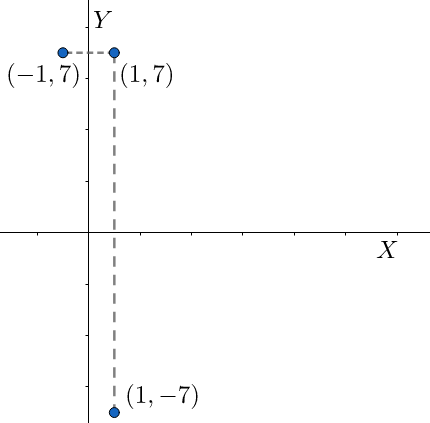
To find the coordinates, the x-axis represents the plain mirror. M is the point in the rectangular axes in the first quadrant whose coordinates are $\left( h,k \right)$ . When point M is reflected in the x-axis, the image M’ is formed in the fourth quadrant whose coordinates are $\left( h,-k \right)$ . Thus, we conclude that when a point is reflected in the x-axis, then the x-co-ordinate remains the same, but the y-coordinate becomes negative. Thus, the image of point $M\left( h,k \right)$ is $M'\left( h,-k \right)$ . Thus, the reflection of the point $\left( 1,7 \right)$ , lying in the first quadrant, in the x-axis will be $\left( 1,-7 \right)$ .
To find the coordinates, the y-axis represents the plain mirror. N is the point in the rectangular axes in the first quadrant whose coordinates are $\left( h,k \right)$ . When point N is reflected in the y-axis, the image N’ is formed in the second quadrant whose coordinates are $\left( -h,k \right)$ . Thus, we conclude that when a point is reflected in the y-axis, then the y-coordinate remains the same, but the x-co-ordinate becomes negative. Thus, the image of point $N\left( h,k \right)$ is $N'\left( -h,k \right)$ . Thus, the reflection of the point $\left( 1,7 \right)$ , lying in the first quadrant, in the y-axis will be $\left( -1,7 \right)$ .
Hence, the image of the point $\left( 1,7 \right)$ after being reflected in the x and y axes respectively are $\left( -1,-7 \right)$ and $\left( -1,7 \right)$ .
Note: These types of problems are pretty easy to solve, but one needs to be careful otherwise small misjudgements can lead to a totally different answer. We need to carefully employ the properties of the reflection of the points in x and y axes to arrive at the correct answer and get the correct image.
Complete step-by-step solution:
Two numbers that represent a point on a graph, are also called the coordinates. Abscissa - The horizontal line, or x-axis, of a graph. Ordinate - The vertical line, or y-axis, of a graph. Origin - The origin is the point where the X and Y axis intersect on a graph. This is the point $\left( 0,0 \right)$ in a two-dimensional graph. The x-coordinate of a point is the value that tells you how far from the origin the point is on the horizontal, or x-axis. The y-coordinate of a point is the value that tells you how far from the origin the point is on the vertical, or y-axis.
To find the coordinates, the x-axis represents the plain mirror. M is the point in the rectangular axes in the first quadrant whose coordinates are $\left( h,k \right)$ . When point M is reflected in the x-axis, the image M’ is formed in the fourth quadrant whose coordinates are $\left( h,-k \right)$ . Thus, we conclude that when a point is reflected in the x-axis, then the x-co-ordinate remains the same, but the y-coordinate becomes negative. Thus, the image of point $M\left( h,k \right)$ is $M'\left( h,-k \right)$ . Thus, the reflection of the point $\left( 1,7 \right)$ , lying in the first quadrant, in the x-axis will be $\left( 1,-7 \right)$ .
To find the coordinates, the y-axis represents the plain mirror. N is the point in the rectangular axes in the first quadrant whose coordinates are $\left( h,k \right)$ . When point N is reflected in the y-axis, the image N’ is formed in the second quadrant whose coordinates are $\left( -h,k \right)$ . Thus, we conclude that when a point is reflected in the y-axis, then the y-coordinate remains the same, but the x-co-ordinate becomes negative. Thus, the image of point $N\left( h,k \right)$ is $N'\left( -h,k \right)$ . Thus, the reflection of the point $\left( 1,7 \right)$ , lying in the first quadrant, in the y-axis will be $\left( -1,7 \right)$ .
Hence, the image of the point $\left( 1,7 \right)$ after being reflected in the x and y axes respectively are $\left( -1,-7 \right)$ and $\left( -1,7 \right)$ .
Note: These types of problems are pretty easy to solve, but one needs to be careful otherwise small misjudgements can lead to a totally different answer. We need to carefully employ the properties of the reflection of the points in x and y axes to arrive at the correct answer and get the correct image.
Recently Updated Pages
Master Class 11 Computer Science: Engaging Questions & Answers for Success

Master Class 11 Business Studies: Engaging Questions & Answers for Success
Master Class 11 Economics: Engaging Questions & Answers for Success
Master Class 11 English: Engaging Questions & Answers for Success
Master Class 11 Maths: Engaging Questions & Answers for Success
Master Class 11 Biology: Engaging Questions & Answers for Success
Trending doubts
One Metric ton is equal to kg A 10000 B 1000 C 100 class 11 physics CBSE
There are 720 permutations of the digits 1 2 3 4 5 class 11 maths CBSE
Discuss the various forms of bacteria class 11 biology CBSE
Draw a diagram of a plant cell and label at least eight class 11 biology CBSE
State the laws of reflection of light
Explain zero factorial class 11 maths CBSE