




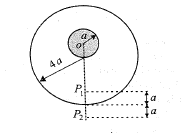
Find the gravitational field intensity at point ${P_1}$ .
A.$\dfrac{{GM}}{{16{a^2}}}$
B.$\dfrac{{GM}}{{8{a^2}}}$
C.$\dfrac{{GM}}{{2{a^2}}}$
D.$\dfrac{{GM}}{{4{a^2}}}$
Answer
 Verified
665.1k+ views
Hint: To solve this type of problem firstly we should understand about Gravitational Field, Gravitational field intensity and the concept behind these terms. We will study all the related information as well. And by using this information we can easily approach our answer.
Complete answer:
Gravitational Field: It is the region of space which surrounds a body in which another body incident a force of gravitational attraction.
Gravitational Field Intensity: It is defined as gravitational force per unit mass. Gravitational field intensity at any point is defined as negative of the gradient of gravitational potential at a point.
${E_g} = F/m$
Or, ${E_g} = - \left[ {GMm/{r^2}} \right]\,/m\,\mathop r\limits^ \wedge $
$ \Rightarrow $ Gravitational field Intensity$\left( {Eg} \right) = - GM/{r^2}\mathop r\limits^ \wedge $
Where $\mathop r\limits^ \wedge $ represent the unit vector along the radial direction,$\mathop r\limits^ \to = x\mathop i\limits^ \wedge + y\mathop j\limits^ \wedge + z\mathop k\limits^ \wedge $ represents the position vector of the test mass from the source mass. The gravitational field intensity depends only upon the source mass and the distance of unit test mass from the source mass. The gravitational field intensity is having unit $N/kg$ . The dimensional formula is given by$\left[ {{M^0}{L^1}{T^{ - 2}}} \right]$ .The dimensional formula of gravitational field intensity is similar to the acceleration (preferably we call it as acceleration due to gravity from the view of gravitation.)
Field at point ${P_1}$ due to the superposition of inner and outer spheres,
Gravitational field intensity of a point mass
${E_g} = - GM/{r^2}\,\mathop r\limits^ \wedge $
Gravitational Field Intensity due to Ring
$dE = Gdm/{r^2}$
So,${g_1} = \dfrac{{GM}}{{{{\left( {4a} \right)}^2}}} = \dfrac{{GM}}{{16{a^2}}}$
The field inside a shell is constant.
So, the correct answer is option A - $\dfrac{{GM}}{{16{a^2}}}$
Note: Gravitational field intensity states that, if we bring a unit test mass from intensity to a gravitational field, then the gravitational force acted on that unit test mass due to a comparable bigger mass for which the gravitational field is created is called gravitational field intensity.
Complete answer:
Gravitational Field: It is the region of space which surrounds a body in which another body incident a force of gravitational attraction.
Gravitational Field Intensity: It is defined as gravitational force per unit mass. Gravitational field intensity at any point is defined as negative of the gradient of gravitational potential at a point.
${E_g} = F/m$
Or, ${E_g} = - \left[ {GMm/{r^2}} \right]\,/m\,\mathop r\limits^ \wedge $
$ \Rightarrow $ Gravitational field Intensity$\left( {Eg} \right) = - GM/{r^2}\mathop r\limits^ \wedge $
Where $\mathop r\limits^ \wedge $ represent the unit vector along the radial direction,$\mathop r\limits^ \to = x\mathop i\limits^ \wedge + y\mathop j\limits^ \wedge + z\mathop k\limits^ \wedge $ represents the position vector of the test mass from the source mass. The gravitational field intensity depends only upon the source mass and the distance of unit test mass from the source mass. The gravitational field intensity is having unit $N/kg$ . The dimensional formula is given by$\left[ {{M^0}{L^1}{T^{ - 2}}} \right]$ .The dimensional formula of gravitational field intensity is similar to the acceleration (preferably we call it as acceleration due to gravity from the view of gravitation.)
Field at point ${P_1}$ due to the superposition of inner and outer spheres,
Gravitational field intensity of a point mass
${E_g} = - GM/{r^2}\,\mathop r\limits^ \wedge $
Gravitational Field Intensity due to Ring
$dE = Gdm/{r^2}$
So,${g_1} = \dfrac{{GM}}{{{{\left( {4a} \right)}^2}}} = \dfrac{{GM}}{{16{a^2}}}$
The field inside a shell is constant.
So, the correct answer is option A - $\dfrac{{GM}}{{16{a^2}}}$
Note: Gravitational field intensity states that, if we bring a unit test mass from intensity to a gravitational field, then the gravitational force acted on that unit test mass due to a comparable bigger mass for which the gravitational field is created is called gravitational field intensity.
Recently Updated Pages
Which of the following graphs shows the variation of class 12 physics CBSE

Draw a labelled diagram of the human male reproductive class 12 biology CBSE
Describe the experiment to compare the emf of two cells class 12 physics CBSE
What is standard hydrogen electrode
What is conventional current and electric current class 12 physics CBSE
2Bromopentane is treated with an alcoholic KOH solution class 12 chemistry CBSE
Trending doubts
Draw a labelled sketch of the human eye class 12 physics CBSE
Which are the Top 10 Largest Countries of the World?
Differentiate between homogeneous and heterogeneous class 12 chemistry CBSE
Draw ray diagrams each showing i myopic eye and ii class 12 physics CBSE
Which is the correct genotypic ratio of mendel dihybrid class 12 biology CBSE
What is the Full Form of PVC, PET, HDPE, LDPE, PP and PS ?