




Find the equation of the director circle of the circle ${\left( {x - h} \right)^2} + {\left( {y - k} \right)^2} = {a^2}$
Answer
 Verified
638.1k+ views
Hint- Here, we will be using the general equation of the director circle to any given circle. The required equation of the director circle is obtained by finding the radius of the given circle and then multiplying it with $\sqrt 2 $ in order to get the radius of the director circle.
Complete step-by-step answer:
Given equation of circle is ${\left( {x - h} \right)^2} + {\left( {y - k} \right)^2} = {a^2}{\text{ }} \to {\text{(1)}}$
The general equation of any circle having centre coordinates (b,c) and radius r is given by
${\left( {x - b} \right)^2} + {\left( {y - c} \right)^2} = {r^2}{\text{ }} \to {\text{(2)}}$
By comparing equations (1) and (2), we have
The centre coordinates of the given circle is (h,k) and radius of the given circle is a.
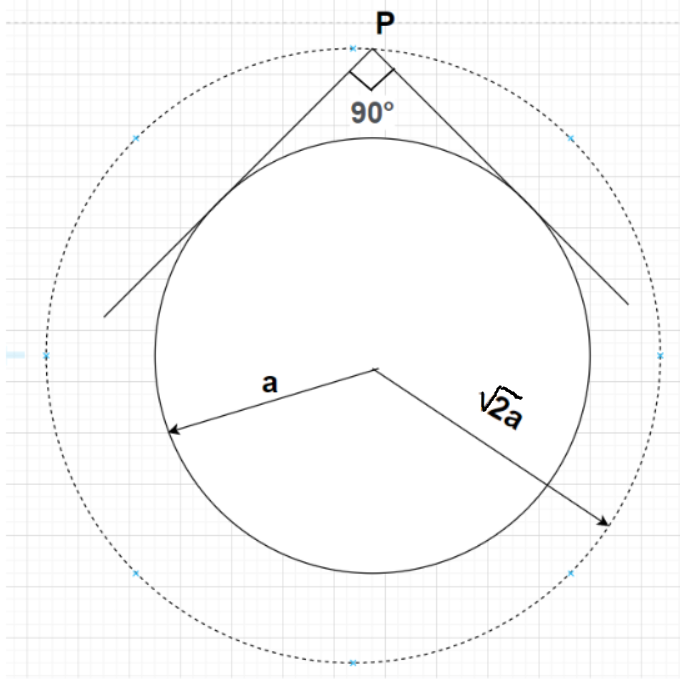
As we know that the director circle is the locus of the point of intersection of two perpendicular tangents to the given circle.
For any general circle whose equation is ${\left( {x - b} \right)^2} + {\left( {y - c} \right)^2} = {r^2}$, the equation of director circle is given by ${\left( {x - b} \right)^2} + {\left( {y - c} \right)^2} = {\left( {\sqrt 2 r} \right)^2}$.
Clearly, in the case of a director circle the coordinates of the centre of the director circle and the given circle will be the same whereas the radius of the director circle will become $\sqrt 2 $ times the radius of the given circle.
So, the radius of the director circle for the given circle ${\left( {x - h} \right)^2} + {\left( {y - k} \right)^2} = {a^2}$ whose radius is a will become $\sqrt 2 a$ and the centre coordinates of the director circle being the same as that of the i.e., (h,k).
So, the equation of director circle with centre coordinates (h,k) and radius $\sqrt 2 a$ is given by
$
{\left( {x - h} \right)^2} + {\left( {y - k} \right)^2} = {\left( {\sqrt 2 a} \right)^2} \\
\Rightarrow {\left( {x - h} \right)^2} + {\left( {y - k} \right)^2} = 2{a^2} \\
$
Hence equation of the director circle of the circle ${\left( {x - h} \right)^2} + {\left( {y - k} \right)^2} = {a^2}$ is ${\left( {x - h} \right)^2} + {\left( {y - k} \right)^2} = 2{a^2}$.
Note- In this problem, the figure is drawn and point P in the figure represents the point of intersection of two perpendicular tangents to the given radius. The locus of this point P will give the director circle to the given circle (any point on the outer circle whose radius is $\sqrt 2 a$ corresponds to the point of intersection of two perpendicular tangents to the smaller circle whose radius is a).
Complete step-by-step answer:
Given equation of circle is ${\left( {x - h} \right)^2} + {\left( {y - k} \right)^2} = {a^2}{\text{ }} \to {\text{(1)}}$
The general equation of any circle having centre coordinates (b,c) and radius r is given by
${\left( {x - b} \right)^2} + {\left( {y - c} \right)^2} = {r^2}{\text{ }} \to {\text{(2)}}$
By comparing equations (1) and (2), we have
The centre coordinates of the given circle is (h,k) and radius of the given circle is a.
As we know that the director circle is the locus of the point of intersection of two perpendicular tangents to the given circle.
For any general circle whose equation is ${\left( {x - b} \right)^2} + {\left( {y - c} \right)^2} = {r^2}$, the equation of director circle is given by ${\left( {x - b} \right)^2} + {\left( {y - c} \right)^2} = {\left( {\sqrt 2 r} \right)^2}$.
Clearly, in the case of a director circle the coordinates of the centre of the director circle and the given circle will be the same whereas the radius of the director circle will become $\sqrt 2 $ times the radius of the given circle.
So, the radius of the director circle for the given circle ${\left( {x - h} \right)^2} + {\left( {y - k} \right)^2} = {a^2}$ whose radius is a will become $\sqrt 2 a$ and the centre coordinates of the director circle being the same as that of the i.e., (h,k).
So, the equation of director circle with centre coordinates (h,k) and radius $\sqrt 2 a$ is given by
$
{\left( {x - h} \right)^2} + {\left( {y - k} \right)^2} = {\left( {\sqrt 2 a} \right)^2} \\
\Rightarrow {\left( {x - h} \right)^2} + {\left( {y - k} \right)^2} = 2{a^2} \\
$
Hence equation of the director circle of the circle ${\left( {x - h} \right)^2} + {\left( {y - k} \right)^2} = {a^2}$ is ${\left( {x - h} \right)^2} + {\left( {y - k} \right)^2} = 2{a^2}$.
Note- In this problem, the figure is drawn and point P in the figure represents the point of intersection of two perpendicular tangents to the given radius. The locus of this point P will give the director circle to the given circle (any point on the outer circle whose radius is $\sqrt 2 a$ corresponds to the point of intersection of two perpendicular tangents to the smaller circle whose radius is a).
Recently Updated Pages
Master Class 11 Social Science: Engaging Questions & Answers for Success

Master Class 11 Physics: Engaging Questions & Answers for Success
Master Class 11 Maths: Engaging Questions & Answers for Success
Master Class 11 Economics: Engaging Questions & Answers for Success
Master Class 11 Computer Science: Engaging Questions & Answers for Success
Master Class 11 Chemistry: Engaging Questions & Answers for Success
Trending doubts
One Metric ton is equal to kg A 10000 B 1000 C 100 class 11 physics CBSE
There are 720 permutations of the digits 1 2 3 4 5 class 11 maths CBSE
1 Quintal is equal to a 110 kg b 10 kg c 100kg d 1000 class 11 physics CBSE
State and prove Bernoullis theorem class 11 physics CBSE
Difference Between Prokaryotic Cells and Eukaryotic Cells
Which among the following are examples of coming together class 11 social science CBSE