




Explain the working of electroscopes?
Answer
 Verified
634.5k+ views
Hint: Electroscope is the device which is to find the electricity present in the object. It works on the principle of the Coulomb electrostatic force. It detects the charge by the movement of the object due to the Coulomb electrostatic force.
Complete step by step answer:
The electroscope is an early instrument used to detect the presence of electric current present in the body. The electroscope was first invented by British scientist William Gilbert. It finds the charge by the movement of the test object near the body. By the principle of the Coulomb electrostatic force, it detects the charge present in the body.
The amount of the charge produced in the object is directly proportional to its voltage. The electroscope requires hundreds and thousands of volts, so the electroscope is used in high voltage sources such as electrostatic machines and static electricity.
Electroscope can give an indication of the charge present in the body; it doesn’t give the correct amount of the charge present in the body. The device which gives the correct amount of electricity is the electroscope.
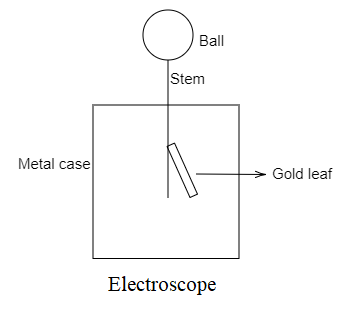
The electroscope consists of a metal rod with a knob (stem ball) in the top and the pair of metals are connected in the bottom. If the object is kept near to the top end of the electroscope, if the object is charged, the pair of metal and the gold leaf in the bottom side gets separated. If the object is not charged, the pair of metals and gold leaf in the bottom just hangs.
Note:
The principle of the electroscope is the Coulomb electrostatic force. By this principle, the current is induced in the metal rod, the pair of a metal rod in the bottom side, and gets separated. The current is not induced, the pair of metals is not separated.
Complete step by step answer:
The electroscope is an early instrument used to detect the presence of electric current present in the body. The electroscope was first invented by British scientist William Gilbert. It finds the charge by the movement of the test object near the body. By the principle of the Coulomb electrostatic force, it detects the charge present in the body.
The amount of the charge produced in the object is directly proportional to its voltage. The electroscope requires hundreds and thousands of volts, so the electroscope is used in high voltage sources such as electrostatic machines and static electricity.
Electroscope can give an indication of the charge present in the body; it doesn’t give the correct amount of the charge present in the body. The device which gives the correct amount of electricity is the electroscope.
The electroscope consists of a metal rod with a knob (stem ball) in the top and the pair of metals are connected in the bottom. If the object is kept near to the top end of the electroscope, if the object is charged, the pair of metal and the gold leaf in the bottom side gets separated. If the object is not charged, the pair of metals and gold leaf in the bottom just hangs.
Note:
The principle of the electroscope is the Coulomb electrostatic force. By this principle, the current is induced in the metal rod, the pair of a metal rod in the bottom side, and gets separated. The current is not induced, the pair of metals is not separated.
Recently Updated Pages
Match columnI with columnII and choose the correct class 12 biology NEET_UG

Match columnI with columnII and choose the correct class 12 biology NEET_UG
Match columnI with columnII and choose the correct class 12 biology NEET_UG
Which plant will lose its economic value if its fruits class 12 biology NEET_UG
Human insulin is being commercially produced from a class 12 biology NEET_UG
Match columnI with columnII and choose the correct class 12 biology NEET_UG
Trending doubts
Draw a labelled sketch of the human eye class 12 physics CBSE
Why is the cell called the structural and functional class 12 biology CBSE
Differentiate between homogeneous and heterogeneous class 12 chemistry CBSE
Which is the correct genotypic ratio of mendel dihybrid class 12 biology CBSE
Draw the diagram of the chloroplast class 12 biology CBSE
Suicide bags of cells are aEndoplasmic reticulum bLysosome class 12 biology CBSE