




Explain taxonomic categories showing hierarchical arrangement in ascending order.
Answer
 Verified
660.6k+ views
Hint: Classification involves hierarchy of steps in which each step represents a rank or category as it is not a single step process.
Complete Answer:
The category is a part of overall taxonomic arrangement it is called the taxonomic category and all the categories together constitute ‘taxonomic hierarchy’. Each category referred to as a unit of classification represents a rank termed as ‘texan’ or ‘taxa’.
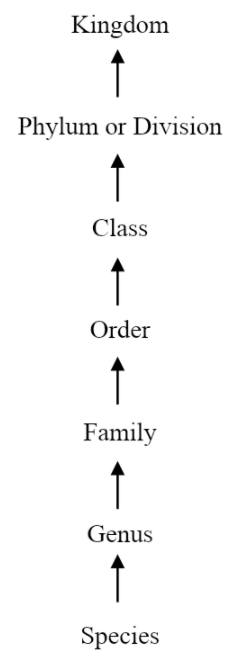
Taxonomic studies of all known organisms have led to the development of common categories such as Kingdom phylum class order family genus and species. Let's discuss all of them one by one
1) Species - Taxonomic studies considered a group of individual organisms with fundamental similarities as a species.
For example- human beings belong to the species Sapiens which is a group in the genus ‘homo’. For human beings the scientific name is written as ‘homo Sapiens’.
2) Genus - Genus comprises a group of selected species which has more characters in common in comparison to species of other genera.
For example- lion Leopard and tiger all share common features and are all species of the genus ‘panthera’. Hence their scientific name is written as lion (Panthera leo), leopard (P pardus) and tiger (P tigris)
Family - Family has a group of related genera with still less number of similarities as compared to genus and species.
For example- if you observe the features of a cat and dog you will find some differences and some similarities as well. Hence they are separated into different families- felidae(cat) and canidae(dog) respectively.
Order - Order and other higher taxonomic categories are identified based on the aggregates of characters. Other being a higher category is the assemblage of families which exhibit a few similar characters.
For example- the animal order carnivora includes families life ‘Felidae’ and Canidae for cats and dogs respectively.
Class - Class includes related order.
For example- order ‘primata’ comprising monkey gorilla and gibbon is placed in class ‘mammalia’ along with order ‘carnivora’ that includes animals like tiger cat and dog
Phylum - Classes comprising animals like fishes amphibians reptiles Birds along with mammals Institute the next higher category called phylum.
For example- all based on common features like presence of notochord and dorsal Hollow neural system are included in phylum chordata.
Kingdom - All animals belonging to various phyla are assigned to the highest category called Kingdom ‘Animalia’ in the classification system of animals.
Note: As we move further from species to Kingdom the number of common characters decreases with lower the taxa, are the characteristics that the members within the taxon share.
Complete Answer:
The category is a part of overall taxonomic arrangement it is called the taxonomic category and all the categories together constitute ‘taxonomic hierarchy’. Each category referred to as a unit of classification represents a rank termed as ‘texan’ or ‘taxa’.
Taxonomic studies of all known organisms have led to the development of common categories such as Kingdom phylum class order family genus and species. Let's discuss all of them one by one
1) Species - Taxonomic studies considered a group of individual organisms with fundamental similarities as a species.
For example- human beings belong to the species Sapiens which is a group in the genus ‘homo’. For human beings the scientific name is written as ‘homo Sapiens’.
2) Genus - Genus comprises a group of selected species which has more characters in common in comparison to species of other genera.
For example- lion Leopard and tiger all share common features and are all species of the genus ‘panthera’. Hence their scientific name is written as lion (Panthera leo), leopard (P pardus) and tiger (P tigris)
Family - Family has a group of related genera with still less number of similarities as compared to genus and species.
For example- if you observe the features of a cat and dog you will find some differences and some similarities as well. Hence they are separated into different families- felidae(cat) and canidae(dog) respectively.
Order - Order and other higher taxonomic categories are identified based on the aggregates of characters. Other being a higher category is the assemblage of families which exhibit a few similar characters.
For example- the animal order carnivora includes families life ‘Felidae’ and Canidae for cats and dogs respectively.
Class - Class includes related order.
For example- order ‘primata’ comprising monkey gorilla and gibbon is placed in class ‘mammalia’ along with order ‘carnivora’ that includes animals like tiger cat and dog
Phylum - Classes comprising animals like fishes amphibians reptiles Birds along with mammals Institute the next higher category called phylum.
For example- all based on common features like presence of notochord and dorsal Hollow neural system are included in phylum chordata.
Kingdom - All animals belonging to various phyla are assigned to the highest category called Kingdom ‘Animalia’ in the classification system of animals.
Note: As we move further from species to Kingdom the number of common characters decreases with lower the taxa, are the characteristics that the members within the taxon share.
Recently Updated Pages
If x a + bt + ct2 where x is in meters and t is in class 11 physics CBSE

A car covers the first half distance between two places class 11 physics CBSE
The resultant of two vectors overrightarrow P and overrightarrow class 11 physics CBSE
Find the value of cos 135 class 11 maths CBSE
A mass M is held in place by an applied force F and class 11 physics CBSE
A solution of glucose in water is labelled as 10 dfracwv class 11 chemistry CBSE
Trending doubts
One Metric ton is equal to kg A 10000 B 1000 C 100 class 11 physics CBSE
Find the value of the expression given below sin 30circ class 11 maths CBSE
What do you mean by retardation What is its SI uni class 11 physics CBSE
Draw a diagram of nephron and explain its structur class 11 biology CBSE
10 examples of friction in our daily life
Difference between physical and chemical change class 11 chemistry CBSE