




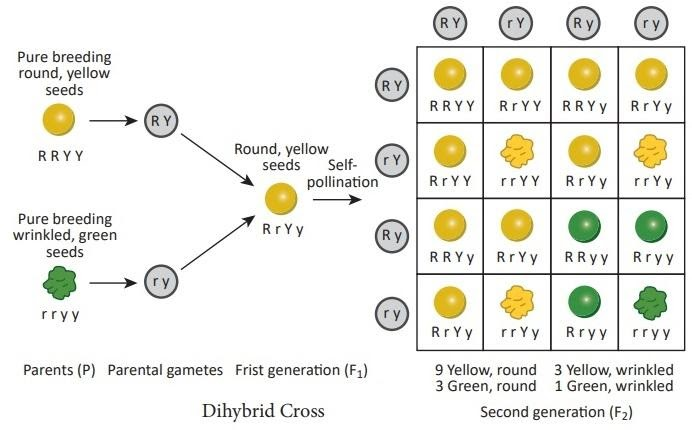
Explain independent inheritance of two separate traits, i.e., shape and colour of seed (Round -Green RRyy and Wrinkled - yellow rrYY) Draw flow chart for \[F1\] and self-pollinated \[F2\] generation. Write the ratio.
Answer
 Verified
576.6k+ views
Hint: In the field of genetics, Mendel laid the foundations and ultimately formulated the laws of inheritance. Gregor Mendel suggested three laws of inheritance: The Law of Segregation, the Law of Independent Assortment, and the Law of Dominance. His studies on pea plants with a range of traits resulted in these rules. Mendel used monohybrid crosses to investigate the inheritance of one gene in plants.
Complete answer:
True-breeding lines of wrinkled yellow peas (rrYY) and round green peas form the P (Parental) cross (RRyy). As a result, all are RrYy alleles, these show round and yellow seeds. The alleles at the two loci segregate independently in the formation of \[F2\] plants. That is, the odds of having a R and a Y allele are $\dfrac{1}{2} \times \dfrac{1}{2}$, a R and a y are $\dfrac{1}{2} \times \dfrac{1}{2}$, and so on. As a result, all four potential diallelic combinations have a $\dfrac{1}{4}$ chance of occurring. Both parents are in the same boat. There are \[4 \times 4 = 16\] possible \[F2\] combinations given four possible gamete types in each parent, and the likelihood of any particular dihybrid form is $\dfrac{1}{4} \times \dfrac{1}{4} = \dfrac{1}{{16}}$.
That is, we expect round-yellow: wrinkled-yellow: round-green: wrinkled-green pea seeds to have a \[9:3:3:1\] phenotypic ratio.
Note:
A breeding experiment between two species that are similar hybrids for two traits is known as a dihybrid cross. A dihybrid cross, to put it another way, is a cross between two species that are heterozygous for two different traits. This type of trait has individuals that are homozygous for a particular trait. Genes, which are DNA segments, decide these characteristics.
In a dihybrid cross, each phenotype is represented by a separate pair of alleles carried by the parents. The dominant allele is carried by one parent, while the recessive allele is carried by the other. The \[F1\] generation's offspring are all heterozygous for particular traits as a result of the crosses.
Complete answer:
True-breeding lines of wrinkled yellow peas (rrYY) and round green peas form the P (Parental) cross (RRyy). As a result, all are RrYy alleles, these show round and yellow seeds. The alleles at the two loci segregate independently in the formation of \[F2\] plants. That is, the odds of having a R and a Y allele are $\dfrac{1}{2} \times \dfrac{1}{2}$, a R and a y are $\dfrac{1}{2} \times \dfrac{1}{2}$, and so on. As a result, all four potential diallelic combinations have a $\dfrac{1}{4}$ chance of occurring. Both parents are in the same boat. There are \[4 \times 4 = 16\] possible \[F2\] combinations given four possible gamete types in each parent, and the likelihood of any particular dihybrid form is $\dfrac{1}{4} \times \dfrac{1}{4} = \dfrac{1}{{16}}$.
That is, we expect round-yellow: wrinkled-yellow: round-green: wrinkled-green pea seeds to have a \[9:3:3:1\] phenotypic ratio.
Note:
A breeding experiment between two species that are similar hybrids for two traits is known as a dihybrid cross. A dihybrid cross, to put it another way, is a cross between two species that are heterozygous for two different traits. This type of trait has individuals that are homozygous for a particular trait. Genes, which are DNA segments, decide these characteristics.
In a dihybrid cross, each phenotype is represented by a separate pair of alleles carried by the parents. The dominant allele is carried by one parent, while the recessive allele is carried by the other. The \[F1\] generation's offspring are all heterozygous for particular traits as a result of the crosses.
Recently Updated Pages
Which of the following graphs shows the variation of class 12 physics CBSE

Draw a labelled diagram of the human male reproductive class 12 biology CBSE
Describe the experiment to compare the emf of two cells class 12 physics CBSE
What is standard hydrogen electrode
What is conventional current and electric current class 12 physics CBSE
2Bromopentane is treated with an alcoholic KOH solution class 12 chemistry CBSE
Trending doubts
Draw a labelled sketch of the human eye class 12 physics CBSE
Which are the Top 10 Largest Countries of the World?
Differentiate between homogeneous and heterogeneous class 12 chemistry CBSE
Draw ray diagrams each showing i myopic eye and ii class 12 physics CBSE
Which is the correct genotypic ratio of mendel dihybrid class 12 biology CBSE
What is the Full Form of PVC, PET, HDPE, LDPE, PP and PS ?