




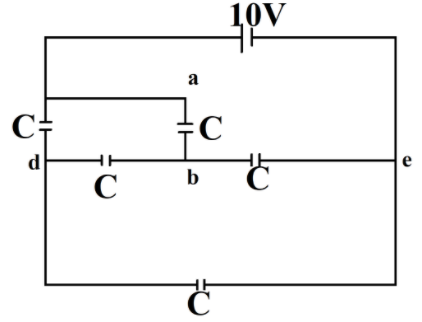
What is the energy stored in the capacitor between the terminals a and b of the network shown in the figure?
Capacitance of each capacitor $C=1\mu F$)
A. $12.5\mu J$
B. Zero
C. $25\mu J$
D. $50\mu J$
Answer
 Verified
599.7k+ views
Hint: If you look closely at the diagram, you will notice that there is a wheatstone network in here. It is a balanced Wheatstone network. So, it can easily be solved using the concept of a wheatstone bridge. In a balanced Wheatstone Bridge, It is said that both sides of the parallel bridge network are balanced since the voltage at point C is equal to the voltage at point D, with zero being the difference.
Formula used:
For solving this question, we will be using the formula
Q = CV
Step by step solution:
First, let us redraw the diagram to make it a Wheatstone network
Now, Applying the concept of the balanced Wheatstone bridge,
${{C}_{eq}}=C$
Now, The Charge on capacitor between the terminals a and b
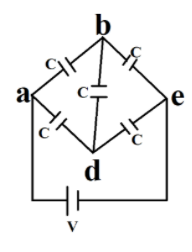
$\dfrac{Q}{2}=\dfrac{CV}{2}$
Now, for the energy stored in the capacitor between a and b,
\[=\dfrac{{{(\dfrac{Q}{2})}^{2}}}{2C}=\dfrac{{{Q}^{2}}}{8C}\]
Now, using
Q = CV
We have
$\begin{align}
& \Rightarrow Q=\dfrac{{{C}^{2}}{{V}^{2}}}{8C} \\
& \\
\end{align}$
$\Rightarrow Q=\dfrac{C{{V}^{2}}}{8}$
Now, as
$C=1\mu F$
And, V = 10 V
Takin the given values,
$\begin{align}
& \Rightarrow U=\dfrac{(1\times {{10}^{-6}})\times {{10}^{2}}}{2C} \\
& \\
\end{align}$
$\Rightarrow U=\dfrac{100}{8}\times {{10}^{-6}}$
$\Rightarrow U=12.5\mu J$
So, the energy stored in the capacitor between the terminals a and b of the network shown in the figure will be $12.5\mu J$, i.e., Option – A.
Note:
The network (or bridge) of Wheatstone is a circuit for indirect resistance calculation by a null reference approach relative to an established normal resistance. It consists of four R1, R2, R3 and R4 resistors connected to a quadrilateral ABCD. The Wheatstone bridge was created by the British Scientist, mathematician and physicist, Samuel Hunter Christie in 1843.
Formula used:
For solving this question, we will be using the formula
Q = CV
Step by step solution:
First, let us redraw the diagram to make it a Wheatstone network
Now, Applying the concept of the balanced Wheatstone bridge,
${{C}_{eq}}=C$
Now, The Charge on capacitor between the terminals a and b
$\dfrac{Q}{2}=\dfrac{CV}{2}$
Now, for the energy stored in the capacitor between a and b,
\[=\dfrac{{{(\dfrac{Q}{2})}^{2}}}{2C}=\dfrac{{{Q}^{2}}}{8C}\]
Now, using
Q = CV
We have
$\begin{align}
& \Rightarrow Q=\dfrac{{{C}^{2}}{{V}^{2}}}{8C} \\
& \\
\end{align}$
$\Rightarrow Q=\dfrac{C{{V}^{2}}}{8}$
Now, as
$C=1\mu F$
And, V = 10 V
Takin the given values,
$\begin{align}
& \Rightarrow U=\dfrac{(1\times {{10}^{-6}})\times {{10}^{2}}}{2C} \\
& \\
\end{align}$
$\Rightarrow U=\dfrac{100}{8}\times {{10}^{-6}}$
$\Rightarrow U=12.5\mu J$
So, the energy stored in the capacitor between the terminals a and b of the network shown in the figure will be $12.5\mu J$, i.e., Option – A.
Note:
The network (or bridge) of Wheatstone is a circuit for indirect resistance calculation by a null reference approach relative to an established normal resistance. It consists of four R1, R2, R3 and R4 resistors connected to a quadrilateral ABCD. The Wheatstone bridge was created by the British Scientist, mathematician and physicist, Samuel Hunter Christie in 1843.
Recently Updated Pages
Master Class 11 Social Science: Engaging Questions & Answers for Success

Master Class 11 Physics: Engaging Questions & Answers for Success
Master Class 11 Maths: Engaging Questions & Answers for Success
Master Class 11 Economics: Engaging Questions & Answers for Success
Master Class 11 Computer Science: Engaging Questions & Answers for Success
Master Class 11 Chemistry: Engaging Questions & Answers for Success
Trending doubts
One Metric ton is equal to kg A 10000 B 1000 C 100 class 11 physics CBSE
There are 720 permutations of the digits 1 2 3 4 5 class 11 maths CBSE
1 Quintal is equal to a 110 kg b 10 kg c 100kg d 1000 class 11 physics CBSE
State and prove Bernoullis theorem class 11 physics CBSE
Difference Between Prokaryotic Cells and Eukaryotic Cells
Which among the following are examples of coming together class 11 social science CBSE