




Draw the graph of function ${{\sin }^{-1}}\left( x \right)$ .
Answer
 Verified
670.2k+ views
Hint: We should know that the range of ${{\sin }^{-1}}\left( x \right)$ function is $1-to-1$ . This when converted to radian form comes in the range of ${{\sin }^{-1}}1={{\sin }^{-1}}\left( {{90}^{\circ }} \right)=\dfrac{\pi }{2}$ . So, the range becomes $\left[ -\dfrac{\pi }{2},\dfrac{\pi }{2} \right]$ from minimum to maximum. So, while drawing the graph, take functions as $y={{\sin }^{-1}}\left( x \right)$ . Therefore, the graph will be along the y-axis.
Complete step-by-step answer:
Now, here we have to draw graph of $f\left( x \right)={{\sin }^{-1}}\left( x \right)$
Trigonometric functions are periodic functions. Thus, the graphs of none of them pass the horizontal line test. This means none of them have an inverse unless the domain of each trigonometric function is restricted to make each of them $1-to-1$ . We call the domain the range of the function.
If we restrict the domain of $f\left( x \right)=\sin \left( x \right)$ to $\left[ -\dfrac{\pi }{2},\dfrac{\pi }{2} \right]$ , we have made the function $1-to-1$ . So, the range is $\left[ -1,1 \right]$ .
Now, we denote the inverse function as $y={{\sin }^{-1}}\left( x \right)$ . It is read as y is inverse of $\sin x$ means y is the real number angle whose sine value is x.
Therefore, the graph of $y={{\sin }^{-1}}\left( x \right)$ is as shown below:
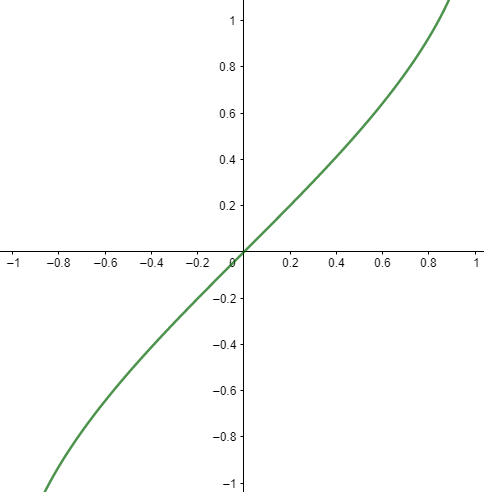
Note: Be careful while using the notation used. The superscript $-1$ is not an exponent. To avoid this, somewhere it is denoted as $y=arc\sin \left( x \right)$ instead. Also, notice that the domain is now the range and range is now domain. Because the domain is restricted to all positive values will be in the first quadrant and all negative values will be in the fourth quadrant. We should know the range of function $f\left( x \right)=\sin \left( x \right)$ along with this range of this function which is given as $\left[ 0,1 \right]$ for positive values by finding value of function at different value of $\theta $ . So, by getting this, we get the graph for all the values of $\theta $ .
Complete step-by-step answer:
Now, here we have to draw graph of $f\left( x \right)={{\sin }^{-1}}\left( x \right)$
Trigonometric functions are periodic functions. Thus, the graphs of none of them pass the horizontal line test. This means none of them have an inverse unless the domain of each trigonometric function is restricted to make each of them $1-to-1$ . We call the domain the range of the function.
If we restrict the domain of $f\left( x \right)=\sin \left( x \right)$ to $\left[ -\dfrac{\pi }{2},\dfrac{\pi }{2} \right]$ , we have made the function $1-to-1$ . So, the range is $\left[ -1,1 \right]$ .
Now, we denote the inverse function as $y={{\sin }^{-1}}\left( x \right)$ . It is read as y is inverse of $\sin x$ means y is the real number angle whose sine value is x.
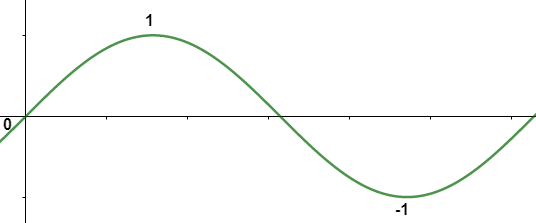
Therefore, the graph of $y={{\sin }^{-1}}\left( x \right)$ is as shown below:
Note: Be careful while using the notation used. The superscript $-1$ is not an exponent. To avoid this, somewhere it is denoted as $y=arc\sin \left( x \right)$ instead. Also, notice that the domain is now the range and range is now domain. Because the domain is restricted to all positive values will be in the first quadrant and all negative values will be in the fourth quadrant. We should know the range of function $f\left( x \right)=\sin \left( x \right)$ along with this range of this function which is given as $\left[ 0,1 \right]$ for positive values by finding value of function at different value of $\theta $ . So, by getting this, we get the graph for all the values of $\theta $ .
Recently Updated Pages
Which of the following graphs shows the variation of class 12 physics CBSE

Draw a labelled diagram of the human male reproductive class 12 biology CBSE
Describe the experiment to compare the emf of two cells class 12 physics CBSE
What is standard hydrogen electrode
What is conventional current and electric current class 12 physics CBSE
2Bromopentane is treated with an alcoholic KOH solution class 12 chemistry CBSE
Trending doubts
Draw a labelled sketch of the human eye class 12 physics CBSE
Which are the Top 10 Largest Countries of the World?
Differentiate between homogeneous and heterogeneous class 12 chemistry CBSE
Draw ray diagrams each showing i myopic eye and ii class 12 physics CBSE
Which is the correct genotypic ratio of mendel dihybrid class 12 biology CBSE
What is the Full Form of PVC, PET, HDPE, LDPE, PP and PS ?