




Draw a neat labeled diagram of a multipolar neuron.
Answer
 Verified
624.6k+ views
Hint: Multipolar neurons can be found in the central nervous system (brain and spinal cord). It allows the integration of a great deal of information from other neurons.
Complete answer:
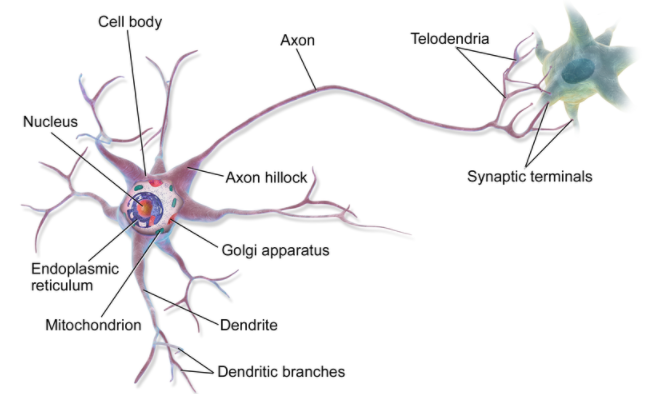
Neurons are broadly divided into four types: unipolar, bipolar, pseudounipolar, and multipolar. Multipolar neurons can be found in the central nervous system (brain and spinal cord). The Purkinje cell, a multipolar neuron in the cerebellum, has only one axon but many branching dendrites. Multipolar neurons have either three or more processes attached to cell bodies. One process serves as axon, which conducts the action potentials or electrochemical impulses between cells. The remaining processes are called dendrites. Together, the dendrites and cell body form a receptive zone of multipolar neurons. The dendrites and its branches provide an additional surface area for axons of other neurons to approach and form synapses. A combination of inhibitory and excitatory synapses allows neural integration to occur between CNS or central nervous system neurons. The axons of multipolar neurons are very long and can conduct the action potentials throughout the brain, down the spinal cord, and along the nerves. Axons are often covered by a series of cells called Schwann cells. Impulses only occur at the gaps between the Schwann cells that accelerate impulse conduction.
Note: Multipolar neurons differ in shape and size depending on their function and location. Some of the neurons that control body movements have this variation. Pyramidal cells or the upper motor neurons originate in the motor cortex of the brain and carry action potentials to the spinal cord.
Complete answer:
Neurons are broadly divided into four types: unipolar, bipolar, pseudounipolar, and multipolar. Multipolar neurons can be found in the central nervous system (brain and spinal cord). The Purkinje cell, a multipolar neuron in the cerebellum, has only one axon but many branching dendrites. Multipolar neurons have either three or more processes attached to cell bodies. One process serves as axon, which conducts the action potentials or electrochemical impulses between cells. The remaining processes are called dendrites. Together, the dendrites and cell body form a receptive zone of multipolar neurons. The dendrites and its branches provide an additional surface area for axons of other neurons to approach and form synapses. A combination of inhibitory and excitatory synapses allows neural integration to occur between CNS or central nervous system neurons. The axons of multipolar neurons are very long and can conduct the action potentials throughout the brain, down the spinal cord, and along the nerves. Axons are often covered by a series of cells called Schwann cells. Impulses only occur at the gaps between the Schwann cells that accelerate impulse conduction.
Note: Multipolar neurons differ in shape and size depending on their function and location. Some of the neurons that control body movements have this variation. Pyramidal cells or the upper motor neurons originate in the motor cortex of the brain and carry action potentials to the spinal cord.
Recently Updated Pages
Master Class 11 Social Science: Engaging Questions & Answers for Success

Master Class 11 English: Engaging Questions & Answers for Success
Master Class 11 Accountancy: Engaging Questions & Answers for Success
Master Class 11 Physics: Engaging Questions & Answers for Success
Master Class 11 Computer Science: Engaging Questions & Answers for Success
Master Class 11 Business Studies: Engaging Questions & Answers for Success
Trending doubts
One Metric ton is equal to kg A 10000 B 1000 C 100 class 11 physics CBSE
Find the value of the expression given below sin 30circ class 11 maths CBSE
Draw a diagram of nephron and explain its structur class 11 biology CBSE
10 examples of friction in our daily life
Proton was discovered by A Thomson B Rutherford C Chadwick class 11 chemistry CBSE
The teeth used for biting and cutting food are called class 11 biology CBSE