




Draw a diagram of vertical section of human eye and label the following parts:
(i) Fovea
(ii) Lens
Answer
 Verified
639k+ views
Hint: Eyes, most important of all human senses, allow us to experience this beautiful and colourful world. The binocular vision of humans allows us to see a single combined image formed by our both eyes. Our eyes are of the shape of an asymmetrical globe and have approximately one inch diameter. Our eyes depend upon our brain to interpret what we see.
Complete Answer:
- The parts of our eyes are categorized as external and internal based on their location and function. The external components of our eyes include eyelids, eyelashes, cornea, iris and pupil. The internal components of our eyes are lens, retina, macula, fovea, sclera, choroid and optic disc. Each of these components have specific parts to play to allow us to see an image.
- The fovea and lens are part of internal components of our eyes.
Let’s first get to know the eye parts mentioned in the question for better understanding and to localize them in the diagram.
(i) Fovea: Fovea is located in the macula of the retina and it is shaped like a tiny pit. It is in the centre of macula. The small, very sensitive area in the retina of our eyes is known as macula. The fovea has the highest concentration of cone cells, the cells in our retina are responsible for bright light vision. It provides clearest vision which is necessary for driving, reading or activities which needs minute details of the visual in humans.
(ii) Lens: The lens is an internal component of our eyes and is located directly behind the iris and the pupil. It is made up of transparent and flexible tissues. Like cornea, it also helps to focus light and images on the retina of our eyes. Because of the flexible nature of the lens, the curved shape of the lens can be changed to focus on objects that are near or far from our eyesight. The 25-30% of focusing power of eyes is contributed by the lens. The ciliary muscles of the lens are responsible for changing the shape and curvature of the lens.
The diagram given below is of the vertical section of the eye and the said parts are labelled in it.
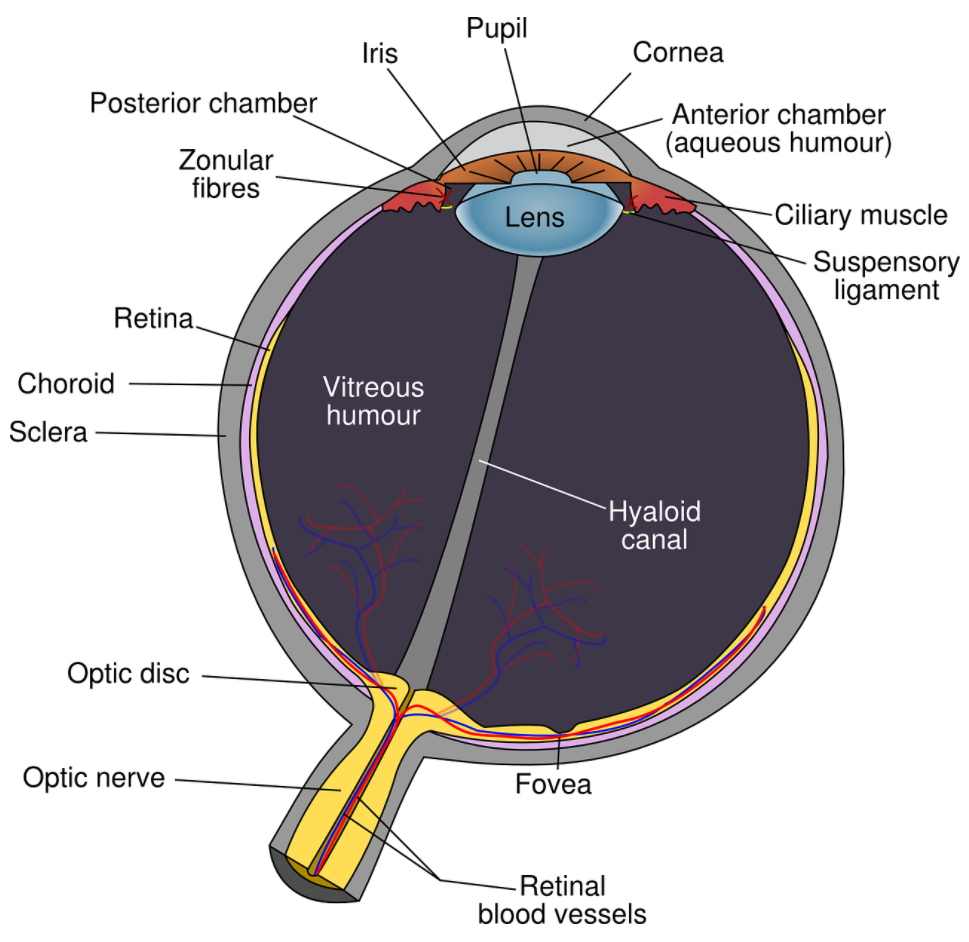
Note: The lens has flexible and elastic nature which is helpful while seeing near and far objects. The lens, when focusing on near objects, becomes more rounded. While focusing on objects located at far distance, the lens becomes more stretched or elongated.
Complete Answer:
- The parts of our eyes are categorized as external and internal based on their location and function. The external components of our eyes include eyelids, eyelashes, cornea, iris and pupil. The internal components of our eyes are lens, retina, macula, fovea, sclera, choroid and optic disc. Each of these components have specific parts to play to allow us to see an image.
- The fovea and lens are part of internal components of our eyes.
Let’s first get to know the eye parts mentioned in the question for better understanding and to localize them in the diagram.
(i) Fovea: Fovea is located in the macula of the retina and it is shaped like a tiny pit. It is in the centre of macula. The small, very sensitive area in the retina of our eyes is known as macula. The fovea has the highest concentration of cone cells, the cells in our retina are responsible for bright light vision. It provides clearest vision which is necessary for driving, reading or activities which needs minute details of the visual in humans.
(ii) Lens: The lens is an internal component of our eyes and is located directly behind the iris and the pupil. It is made up of transparent and flexible tissues. Like cornea, it also helps to focus light and images on the retina of our eyes. Because of the flexible nature of the lens, the curved shape of the lens can be changed to focus on objects that are near or far from our eyesight. The 25-30% of focusing power of eyes is contributed by the lens. The ciliary muscles of the lens are responsible for changing the shape and curvature of the lens.
The diagram given below is of the vertical section of the eye and the said parts are labelled in it.
Note: The lens has flexible and elastic nature which is helpful while seeing near and far objects. The lens, when focusing on near objects, becomes more rounded. While focusing on objects located at far distance, the lens becomes more stretched or elongated.
Recently Updated Pages
A Paragraph on Pollution in about 100-150 Words

What is BLO What is the full form of BLO class 8 social science CBSE
10 examples of friction in our daily life
Draw a diagram of nephron and explain its structur class 11 biology CBSE
Write structures of the following compounds i 2 Chloro3methylpentane class 11 chemistry CBSE
XIX+XXX A 49 B 51 C 55 D 44 class 5 maths CBSE
Trending doubts
Explain the Treaty of Vienna of 1815 class 10 social science CBSE
1 GB equals how many MB?
10 examples of evaporation in daily life with explanations
What is the full form of POSCO class 10 social science CBSE
Which is the hottest planet in the Solar system A Earth class 10 social science CBSE
Name any four life processes in living things class 10 biology CBSE