




Draw a diagram of the human alimentary canal and label the following.
Oesophagus, gallbladder, liver and pancreas.
Answer
 Verified
662.1k+ views
Hint: In humans digestive system consists of alimentary canal and associated gland. These glands help in the digestion of food.
Complete answer:
Alimentary canal starts with the mouth and opens outside through anus . The mouth leads to the buccal cavity or oral cavity. The oral cavity has a number of teeth and a muscular tongue.
The tongue is a voluntary muscular and glandular structure which occupies the floor of the mouth . The pharynx leads to oesophagus.
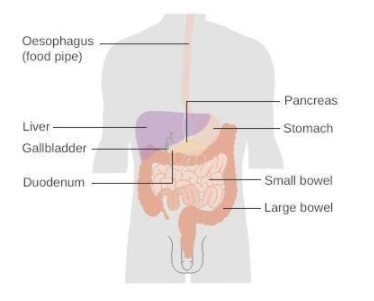
FIGURE SHOWING A WELL LABELLED HUMAN DIGESTIVE SYSTEM
Majority of mammals, including human beings, have two sets of teeth during their life that is one temporary set and one permanent or adult tooth. Such type of dentition is called diphyodont.
Note: Oesophagus- the oesophagus is a thin, long tube which extends posteriorly passing through the neck, thorax and diaphragm and leads to a j- shaped bag like structure called stomach.
Liver- It is the largest gland of the body weighing about 1.2 to 1.5 kg in an adult human. It is situated in the abdominal cavity, just below the diaphragm, it has two lobes that are right and left lobes.
Gall bladder:- It produces and stores bile. Bile is used to convert large globules of fats to small globules of fat. This process is called emulsification.
Pancreas:- Pancreas is a merocrine gland. It releases enzymes such as pepsin that converts protein into amino acids.
Complete answer:
Alimentary canal starts with the mouth and opens outside through anus . The mouth leads to the buccal cavity or oral cavity. The oral cavity has a number of teeth and a muscular tongue.
The tongue is a voluntary muscular and glandular structure which occupies the floor of the mouth . The pharynx leads to oesophagus.
FIGURE SHOWING A WELL LABELLED HUMAN DIGESTIVE SYSTEM
Majority of mammals, including human beings, have two sets of teeth during their life that is one temporary set and one permanent or adult tooth. Such type of dentition is called diphyodont.
Note: Oesophagus- the oesophagus is a thin, long tube which extends posteriorly passing through the neck, thorax and diaphragm and leads to a j- shaped bag like structure called stomach.
Liver- It is the largest gland of the body weighing about 1.2 to 1.5 kg in an adult human. It is situated in the abdominal cavity, just below the diaphragm, it has two lobes that are right and left lobes.
Gall bladder:- It produces and stores bile. Bile is used to convert large globules of fats to small globules of fat. This process is called emulsification.
Pancreas:- Pancreas is a merocrine gland. It releases enzymes such as pepsin that converts protein into amino acids.
Recently Updated Pages
A Paragraph on Pollution in about 100-150 Words

What is BLO What is the full form of BLO class 8 social science CBSE
10 examples of friction in our daily life
Draw a diagram of nephron and explain its structur class 11 biology CBSE
Write structures of the following compounds i 2 Chloro3methylpentane class 11 chemistry CBSE
XIX+XXX A 49 B 51 C 55 D 44 class 5 maths CBSE
Trending doubts
Explain the Treaty of Vienna of 1815 class 10 social science CBSE
1 GB equals how many MB?
10 examples of evaporation in daily life with explanations
What is the full form of POSCO class 10 social science CBSE
Which is the hottest planet in the Solar system A Earth class 10 social science CBSE
Name any four life processes in living things class 10 biology CBSE