




Double fertilization or triple fusion are common in
A) Gymnosperms
B) Pteridophytes
C) Angiosperms
D) Bryophytes
Answer
 Verified
655.2k+ views
Hint: Double fertilization involves fusion of two different components of the embryo sac by the two male gametes. First event of fusion results in a diploid (2n) zygote. The second event of fusion results in a triploid (3n) nucleus. The second fertilization is called triple fusion as it involves fusion of three nuclei. Both double fertilization and triple fusion are the characteristic features of a group of plants.
Complete Answer:
- In Bryophytes and Pteridophytes, antheridia and archegonia are the male and female reproductive structures respectively. In Gymnosperms, male and female cones are present as their reproductive structures. Angiosperms are the flower bearing plants. The flowers are the reproductive parts of angiosperms.
- Reproduction in angiosperms is described below –
1) A typical angiosperm flower consists of four basic whorls – Gynoecium (whorl of Carpel), Androecium (whorl of Stamens), Corolla (whorl of Petals) and Calyx (whorl of Sepals). Out of these, calyx and corolla are the accessory whorls whereas; Gynoecium and androecium are essential whorls as these are the female and male reproductive parts.
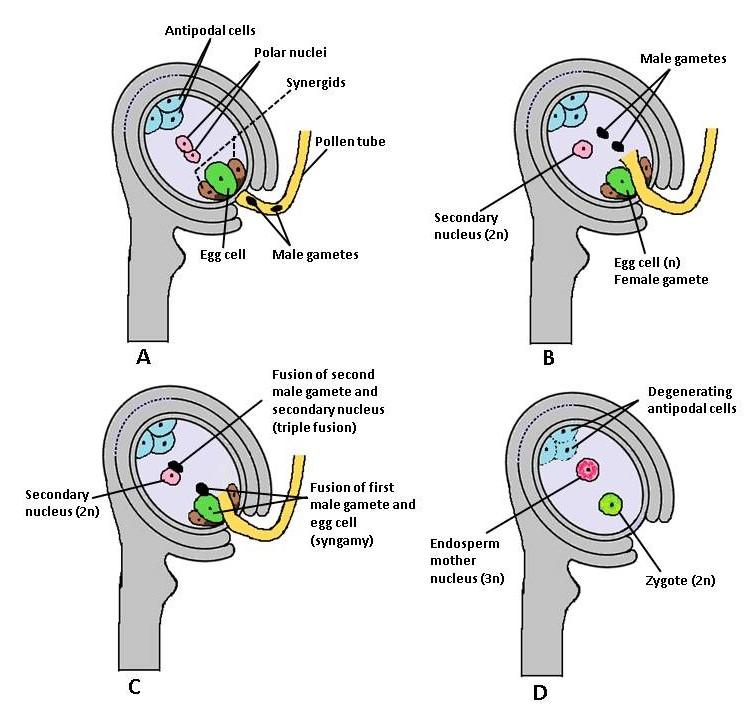
2) A carpel is differentiated into three parts – stigma, style and ovary (basal swollen structure). The female gametophyte or embryo sac is present inside the ovary. In most of the angiosperms, the embryo sac is a 7-celled structure. There is a large central cell with two polar nuclei, the egg apparatus consisting of an egg cell and two synergids and three antipodal cells.
3) A stamen is made up of two parts – anther and filament. Anthers produce pollen grains that are the male gametophytes. Each pollen grain consists of two male gametes.
4) After pollination, germination of the pollen tube takes place and both the male gametes are released into the embryo sac. One male gamete fuses with the egg cell and forms a zygote. Since the nuclei of egg cells as well as of the male gamete are haploid (n) that is why when they fuse, a diploid (2n) zygote is formed. Fusion of egg nucleus with male gamete is called syngamy or true fertilization.
5) The second male gamete migrates to the central cell where it fuses with the two polar nuclei or their fusion product, the secondary nucleus. Consequently, the second fertilization involves the fusion of three haploid nuclei, and thus, the phenomenon is called triple fusion. As, both the male gametes take part in fertilization, thus, the fertilization takes place twice. This is called double fertilization. Double fertilization was discovered by S.G. Nawaschin in 1898.
- Double fertilization and triple fusion are the key features of angiosperms and are completely absent in other groups of plants such as bryophytes, Pteridophytes and gymnosperms.
Thus, the correct answer is C, i.e., Angiosperms.
Note: The product of syngamy, i.e. zygote develops into an embryo, and, the triploid nucleus which is formed by triple fusion develops into endosperm. The endosperm provides nutrients to the developing embryo.
Complete Answer:
- In Bryophytes and Pteridophytes, antheridia and archegonia are the male and female reproductive structures respectively. In Gymnosperms, male and female cones are present as their reproductive structures. Angiosperms are the flower bearing plants. The flowers are the reproductive parts of angiosperms.
- Reproduction in angiosperms is described below –
1) A typical angiosperm flower consists of four basic whorls – Gynoecium (whorl of Carpel), Androecium (whorl of Stamens), Corolla (whorl of Petals) and Calyx (whorl of Sepals). Out of these, calyx and corolla are the accessory whorls whereas; Gynoecium and androecium are essential whorls as these are the female and male reproductive parts.
2) A carpel is differentiated into three parts – stigma, style and ovary (basal swollen structure). The female gametophyte or embryo sac is present inside the ovary. In most of the angiosperms, the embryo sac is a 7-celled structure. There is a large central cell with two polar nuclei, the egg apparatus consisting of an egg cell and two synergids and three antipodal cells.
3) A stamen is made up of two parts – anther and filament. Anthers produce pollen grains that are the male gametophytes. Each pollen grain consists of two male gametes.
4) After pollination, germination of the pollen tube takes place and both the male gametes are released into the embryo sac. One male gamete fuses with the egg cell and forms a zygote. Since the nuclei of egg cells as well as of the male gamete are haploid (n) that is why when they fuse, a diploid (2n) zygote is formed. Fusion of egg nucleus with male gamete is called syngamy or true fertilization.
5) The second male gamete migrates to the central cell where it fuses with the two polar nuclei or their fusion product, the secondary nucleus. Consequently, the second fertilization involves the fusion of three haploid nuclei, and thus, the phenomenon is called triple fusion. As, both the male gametes take part in fertilization, thus, the fertilization takes place twice. This is called double fertilization. Double fertilization was discovered by S.G. Nawaschin in 1898.
- Double fertilization and triple fusion are the key features of angiosperms and are completely absent in other groups of plants such as bryophytes, Pteridophytes and gymnosperms.
Thus, the correct answer is C, i.e., Angiosperms.
Note: The product of syngamy, i.e. zygote develops into an embryo, and, the triploid nucleus which is formed by triple fusion develops into endosperm. The endosperm provides nutrients to the developing embryo.
Recently Updated Pages
Which of the following graphs shows the variation of class 12 physics CBSE

Draw a labelled diagram of the human male reproductive class 12 biology CBSE
Describe the experiment to compare the emf of two cells class 12 physics CBSE
What is standard hydrogen electrode
What is conventional current and electric current class 12 physics CBSE
2Bromopentane is treated with an alcoholic KOH solution class 12 chemistry CBSE
Trending doubts
Draw a labelled sketch of the human eye class 12 physics CBSE
Which are the Top 10 Largest Countries of the World?
Differentiate between homogeneous and heterogeneous class 12 chemistry CBSE
Draw ray diagrams each showing i myopic eye and ii class 12 physics CBSE
Which is the correct genotypic ratio of mendel dihybrid class 12 biology CBSE
What is the Full Form of PVC, PET, HDPE, LDPE, PP and PS ?