




Do arteries exchange nutrients?
Answer
 Verified
595.8k+ views
Hint: Arteries start from the aorta, the largest blood vessel, and leaves the heart while carrying nutrients and oxygen from the heart and transporting it to various parts of the body. The blood carried by then is the oxygenated blood.
Complete answer:
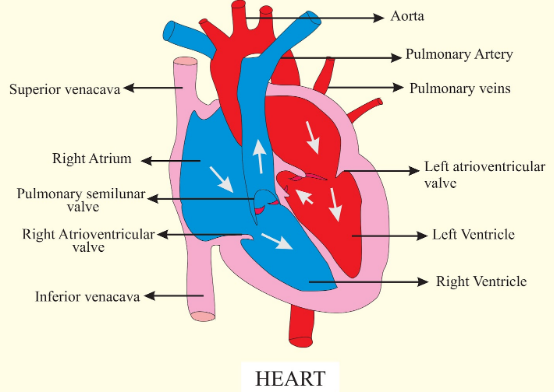
The anterior vein is also called the superior vein which carries deoxygenated blood from the upper half of the body to the right atrium of the heart. The pulmonary artery is the only artery in the human body that carries deoxygenated blood from the heart to the lungs where it is filtered. While the pulmonary veins are the only vein in the human body that carries oxygenated blood back to the heart from the lungs and is then transported to the whole body by the aorta. These arteries then connect to the capillary smallest blood vessels called capillaries which help in the exchange of nutrients, oxygen, and waste that occurs between the blood and body cells.
Additional information:
The three important types of blood vessels are the arteries, the veins, and the capillaries.
- Arteries carry blood away from the heart, ending into arterioles that supply substances to the body parts, thus, forming the capillary network.
- Now, it carries out the exchange of chemicals between the tissues and blood.
- Further, capillaries combine into venules that combine to form larger veins. Veins are important for returning the blood to the heart. Anastomoses are the junctions between blood and the heart.
- Arteries and veins have three layers - tunica intima, tunica media, tunica adventitia. Capillaries, on the other hand, are composed of a single layer of endothelial cells.
Note:
The wall of an artery consists of three layers, namely tunica intima, tunica media, and tunica externa.
- The tunica intima is the innermost layer. It is also known as tunica interna.
- Tunica media is the middle layer. It is primarily a smooth muscle and it is the thickest layer. Tunica externa is the outermost layer.
Complete answer:
The anterior vein is also called the superior vein which carries deoxygenated blood from the upper half of the body to the right atrium of the heart. The pulmonary artery is the only artery in the human body that carries deoxygenated blood from the heart to the lungs where it is filtered. While the pulmonary veins are the only vein in the human body that carries oxygenated blood back to the heart from the lungs and is then transported to the whole body by the aorta. These arteries then connect to the capillary smallest blood vessels called capillaries which help in the exchange of nutrients, oxygen, and waste that occurs between the blood and body cells.
Additional information:
The three important types of blood vessels are the arteries, the veins, and the capillaries.
- Arteries carry blood away from the heart, ending into arterioles that supply substances to the body parts, thus, forming the capillary network.
- Now, it carries out the exchange of chemicals between the tissues and blood.
- Further, capillaries combine into venules that combine to form larger veins. Veins are important for returning the blood to the heart. Anastomoses are the junctions between blood and the heart.
- Arteries and veins have three layers - tunica intima, tunica media, tunica adventitia. Capillaries, on the other hand, are composed of a single layer of endothelial cells.
Note:
The wall of an artery consists of three layers, namely tunica intima, tunica media, and tunica externa.
- The tunica intima is the innermost layer. It is also known as tunica interna.
- Tunica media is the middle layer. It is primarily a smooth muscle and it is the thickest layer. Tunica externa is the outermost layer.
Recently Updated Pages
Which will be the least stable resonating structure class 11 chemistry CBSE

How many 5 digit telephone numbers can be construc-class-11-maths-CBSE
How do you find the angle of the resultant vector class 11 physics CBSE
Draw labelled diagram of the following i Gram seed class 11 biology CBSE
1 Quintal is equal to a 110 kg b 10 kg c 100kg d 1000 class 11 physics CBSE
What is the need and importance of classification class 11 biology CBSE
Trending doubts
Find the value of the expression given below sin 30circ class 11 maths CBSE
The teeth used for biting and cutting food are called class 11 biology CBSE
Bond order ofO2 O2+ O2 and O22 is in order A O2 langle class 11 chemistry CBSE
Frogs heart when taken out of the body continues to class 11 biology CBSE
Can anyone list 10 advantages and disadvantages of friction
Draw a diagram of a plant cell and label at least eight class 11 biology CBSE