



Distinguish between Mitosis and Meiosis.
Answer
 Verified
664.8k+ views
Hint: A cell cycle is a series of events that take place in a cell as it grows and divides into daughter cells. The first phase is interphase and it is considered to be the longest phase and during this time it grows, replicates its chromosomes, and prepares for cell division. The cell then enters into interphase, undergoes mitosis, and completes its division.
Complete answer:
Cells multiply and reproduce in two ways-mitosis and meiosis.
Meiosis is a type of cell division that results in the formation of four daughter cells each with half the number of chromosomes as the parent cell.
Mitosis is the type of cell division that results in the formation of two daughter cells each with the same number and kind of chromosomes as the parent cell.
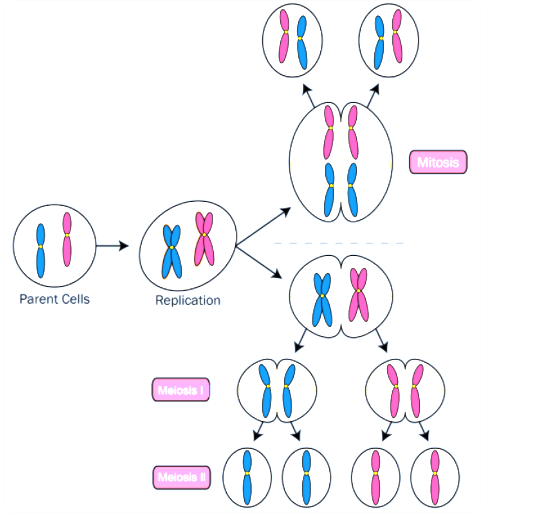
Note: In meiosis, prophase, metaphase, anaphase, and telophase occur twice. The first round of division is different from the second, the second round is much similar to mitosis. Both mitosis and meiosis occur in multiple stages including DNA replication and condensation, nuclear membrane degradation, spindle formation, chromosomal segregation, and nuclear reformation.
Complete answer:
Cells multiply and reproduce in two ways-mitosis and meiosis.
Meiosis is a type of cell division that results in the formation of four daughter cells each with half the number of chromosomes as the parent cell.
Mitosis is the type of cell division that results in the formation of two daughter cells each with the same number and kind of chromosomes as the parent cell.
| Mitosis | Meiosis |
| It was discovered by Walther Flemming | It was discovered by Oscar Hertwig |
| This type of cell division occurs in all types of cells, even sex cells | This type of cell division occurs in meiocytes (specialized cells) |
| Mitosis occurs in somatic cells | Meiosis occurs in germ cells |
| Different stages are – Prophase, metaphase, anaphase, and telophase | Different stages of meiosis are – Prophase I, metaphase I, anaphase I, and telophase I and then enters into Meiosis II which includes the following phases Prophase II and then metaphase II, anaphase II, and telophase II. |
| Only one nuclear division occurs | Two nuclear divisions occur |
| Chromosome number remains unaffected | Chromosome number is reduced to half |
| Mother cell can either be haploid or diploid | The mother cell is always diploid |
| Mode of reproduction- Asexual | Sexual |
| Cytokinesis occurs in telophase | Cytokinesis occurs in Telophase I and II |
| No recombination. | Recombination and crossing over take place between homologous chromosomes. |
Note: In meiosis, prophase, metaphase, anaphase, and telophase occur twice. The first round of division is different from the second, the second round is much similar to mitosis. Both mitosis and meiosis occur in multiple stages including DNA replication and condensation, nuclear membrane degradation, spindle formation, chromosomal segregation, and nuclear reformation.
Recently Updated Pages
Which will be the least stable resonating structure class 11 chemistry CBSE

How many 5 digit telephone numbers can be construc-class-11-maths-CBSE
How do you find the angle of the resultant vector class 11 physics CBSE
Draw labelled diagram of the following i Gram seed class 11 biology CBSE
1 Quintal is equal to a 110 kg b 10 kg c 100kg d 1000 class 11 physics CBSE
What is the need and importance of classification class 11 biology CBSE
Trending doubts
Find the value of the expression given below sin 30circ class 11 maths CBSE
One Metric ton is equal to kg A 10000 B 1000 C 100 class 11 physics CBSE
10 examples of friction in our daily life
Draw a diagram of a plant cell and label at least eight class 11 biology CBSE
Difference between physical and chemical change class 11 chemistry CBSE
Proton was discovered by A Thomson B Rutherford C Chadwick class 11 chemistry CBSE