



Who discovered the cell and how?
Answer
 Verified
547.5k+ views
Hint: Even though it is very difficult to differentiate externally, internally the cells of an elephant or a sunflower or amoeba are all made of similar building blocks. It Range from single cells that make up the trillions of cells forms the complete structure of the human body.
Complete answer:
Cell was discovered in the year 1665 by well-known scientist Robert Hooke.
The discovery of the cell was made possible after the discovery of a microscope. Robert Hooke had improved the design of compound microscopes in 1665. It had three lenses and a stage light which illuminated and enlarged the specimens.
The discovery of cells has by far the greatest impact on science that Hooke could have ever dreamed. It gives us a fundamental understanding of the building blocks of all living organisms and the discovery led to advances in medical technology and the treatments.
The first observation was done on a cork's cell, and Hooke observed it to be perforated and porous, like a honeycomb. These pores are actually cells, and were not regular but were indeed the first microscopical pores ever observed.
It was not long time, that even a unicellular organism was discovered by Leeuwenhoek. He finally designed the perfect simple microscope which had only one lens. He described spermatozoa in 1677.
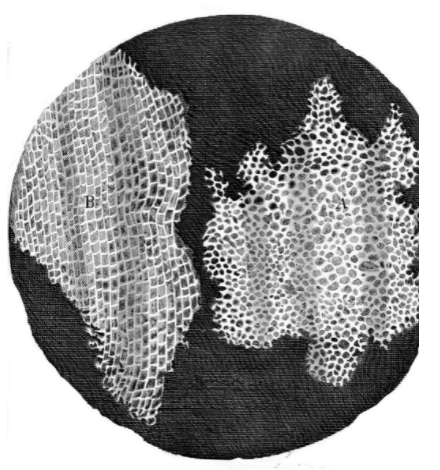
(diagram of honey comb observed by robert hooke)
Note:
The German scientist Schwann and Schleiden studied cells of animals and plants respectively. They identified the difference between the cells and put the idea of the cell being the fundamental unit of animal and plants both. They gave the world the cell theory, which was not well accepted for about 200 years.
Complete answer:
Cell was discovered in the year 1665 by well-known scientist Robert Hooke.
The discovery of the cell was made possible after the discovery of a microscope. Robert Hooke had improved the design of compound microscopes in 1665. It had three lenses and a stage light which illuminated and enlarged the specimens.
The discovery of cells has by far the greatest impact on science that Hooke could have ever dreamed. It gives us a fundamental understanding of the building blocks of all living organisms and the discovery led to advances in medical technology and the treatments.
The first observation was done on a cork's cell, and Hooke observed it to be perforated and porous, like a honeycomb. These pores are actually cells, and were not regular but were indeed the first microscopical pores ever observed.
It was not long time, that even a unicellular organism was discovered by Leeuwenhoek. He finally designed the perfect simple microscope which had only one lens. He described spermatozoa in 1677.
(diagram of honey comb observed by robert hooke)
Note:
The German scientist Schwann and Schleiden studied cells of animals and plants respectively. They identified the difference between the cells and put the idea of the cell being the fundamental unit of animal and plants both. They gave the world the cell theory, which was not well accepted for about 200 years.
Recently Updated Pages
Master Class 11 English: Engaging Questions & Answers for Success

Master Class 11 Social Science: Engaging Questions & Answers for Success
Master Class 11 Maths: Engaging Questions & Answers for Success
Master Class 11 Biology: Engaging Questions & Answers for Success
Master Class 11 Physics: Engaging Questions & Answers for Success
Master Class 11 Chemistry: Engaging Questions & Answers for Success
Trending doubts