




What is the difference between Natural number and Real number?
Answer
 Verified
630.6k+ views
Hint: Firstly we have to know the definition of real number and natural numbers. Then we have to include the sets for real numbers and natural numbers. And conclude the difference with examples and a diagram of real and natural numbers.
Complete step by step solution:
We know that real numbers are simply the combination of rational and irrational numbers, in the number system. In general, all the arithmetic operations can be performed on these numbers and they can be represented in the number line, also. At the same time, the imaginary numbers are the un-real numbers, which cannot be expressed in the number line and is commonly used to represent a complex number. For example we can say integers (-2, 0, 1), fractions \[\left( \dfrac{1}{2},2.5 \right)\] and irrational numbers such as \[\sqrt{3},\sqrt{2},\pi \] etc.
On the other hand Natural numbers are a part of the number system which includes all the positive integers from 1 till infinity and are also used for counting purposes. It does not include zero (0). It can be written as
\[\mathbb{N}=\left\{ 1,2,3,4........ \right\}\].
Which means All numbers such as 1, 2, 3, 4, 5, 6,……….
We can represent real number and natural number by this diagram,
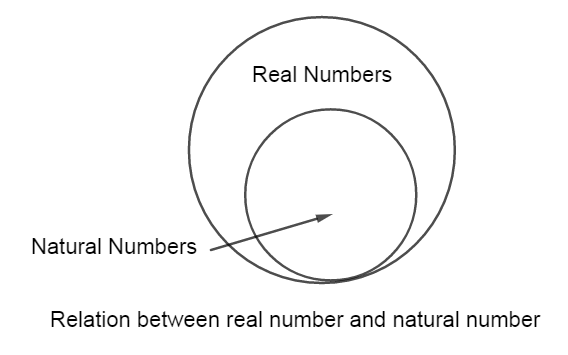
Where we can see natural numbers is part of the real number.
The set of real numbers consist of different categories, such as natural and whole numbers, integers, rational and irrational numbers. There are four main properties which include commutative property, associative property, distributive property and identity property.
Where for natural numbers there are four main properties which include Closure property, Commutative property, Associative property, Distributive property.
Note: To understand real numbers and natural numbers properly we have to understand the set theory of each number. This difference is incomplete without a diagram. We have to include examples for better understanding. Do not get confused with whole numbers and natural numbers, the difference between them is the element 0. Whole numbers contain 0 whereas natural numbers do not.
Complete step by step solution:
We know that real numbers are simply the combination of rational and irrational numbers, in the number system. In general, all the arithmetic operations can be performed on these numbers and they can be represented in the number line, also. At the same time, the imaginary numbers are the un-real numbers, which cannot be expressed in the number line and is commonly used to represent a complex number. For example we can say integers (-2, 0, 1), fractions \[\left( \dfrac{1}{2},2.5 \right)\] and irrational numbers such as \[\sqrt{3},\sqrt{2},\pi \] etc.
On the other hand Natural numbers are a part of the number system which includes all the positive integers from 1 till infinity and are also used for counting purposes. It does not include zero (0). It can be written as
\[\mathbb{N}=\left\{ 1,2,3,4........ \right\}\].
Which means All numbers such as 1, 2, 3, 4, 5, 6,……….
We can represent real number and natural number by this diagram,
Where we can see natural numbers is part of the real number.
The set of real numbers consist of different categories, such as natural and whole numbers, integers, rational and irrational numbers. There are four main properties which include commutative property, associative property, distributive property and identity property.
Where for natural numbers there are four main properties which include Closure property, Commutative property, Associative property, Distributive property.
Note: To understand real numbers and natural numbers properly we have to understand the set theory of each number. This difference is incomplete without a diagram. We have to include examples for better understanding. Do not get confused with whole numbers and natural numbers, the difference between them is the element 0. Whole numbers contain 0 whereas natural numbers do not.
Recently Updated Pages
Master Class 9 General Knowledge: Engaging Questions & Answers for Success

Master Class 9 Maths: Engaging Questions & Answers for Success
Master Class 9 Science: Engaging Questions & Answers for Success
Master Class 9 English: Engaging Questions & Answers for Success
Master Class 9 Social Science: Engaging Questions & Answers for Success
Class 9 Question and Answer - Your Ultimate Solutions Guide
Trending doubts
Find the sum of series 1 + 2 + 3 + 4 + 5 + + 100 class 9 maths CBSE
Difference Between Plant Cell and Animal Cell
Fill the blanks with the suitable prepositions 1 The class 9 english CBSE
What is pollution? How many types of pollution? Define it
Name 10 Living and Non living things class 9 biology CBSE
What is the full form of pH?