




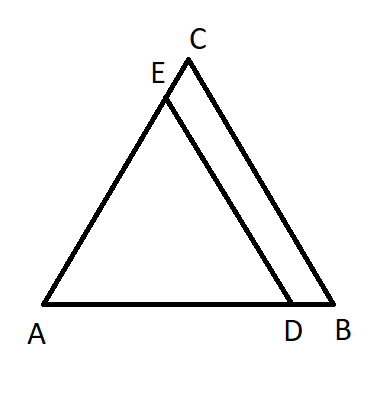
\[DE\parallel BC\], If \[AD=x,DB=x-2,AE=x+2,EC=x-1\] find the value of x.
Answer
 Verified
580.8k+ views
Hint: In this problem, we have to find the value of x from the given triangle ABC. We are given that the line DE is parallel to BC. We are also given that we can use Thales Theorem and substitute the given value in the fraction to find the value of x.
Complete step by step answer:
We know that the given triangle ABC, where the line DE is parallel to BC, \[DE\parallel BC\].
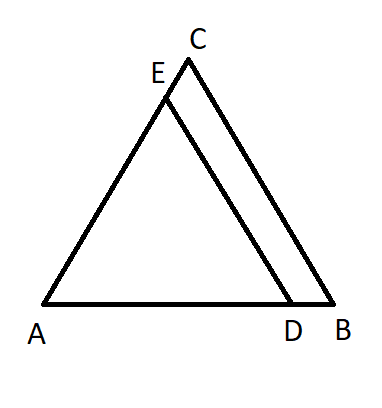
We know that the Thales Theorem from the diagram whose line DE is parallel to BC is,
\[\dfrac{AD}{DB}=\dfrac{AE}{EC}\]
We can write the above theorem as,
\[AD\times EC=AE\times DB\]
We know that the given values are, \[AD=x,DB=x-2,AE=x+2,EC=x-1\].
We can substitute these values in the above theorem, we get
\[\Rightarrow x\times \left( x-1 \right)=\left( x+2 \right)\times \left( x-2 \right)\]
We can multiply the term in the left-hand side and we can use the algebraic formula in the right-hand side, we get
\[\Rightarrow {{x}^{2}}-x={{x}^{2}}-4\]
Now we can cancel similar terms in both the left-hand side and the right-hand side in the above step, we get
\[\Rightarrow -x=-4\]
Now we can multiply -1 on both the left-hand side and the right-hand side in the above step, we get
\[\Rightarrow x=4\]
Therefore, the value of x is 4.
Note: Students make mistakes while writing the Thales theorem form the given diagram, which should be concentrated. To solve this problem, we have to understand the concept of Thales theorem to be used. We should go through the question properly, in order to find what should be taken from the question.
Complete step by step answer:
We know that the given triangle ABC, where the line DE is parallel to BC, \[DE\parallel BC\].
We know that the Thales Theorem from the diagram whose line DE is parallel to BC is,
\[\dfrac{AD}{DB}=\dfrac{AE}{EC}\]
We can write the above theorem as,
\[AD\times EC=AE\times DB\]
We know that the given values are, \[AD=x,DB=x-2,AE=x+2,EC=x-1\].
We can substitute these values in the above theorem, we get
\[\Rightarrow x\times \left( x-1 \right)=\left( x+2 \right)\times \left( x-2 \right)\]
We can multiply the term in the left-hand side and we can use the algebraic formula in the right-hand side, we get
\[\Rightarrow {{x}^{2}}-x={{x}^{2}}-4\]
Now we can cancel similar terms in both the left-hand side and the right-hand side in the above step, we get
\[\Rightarrow -x=-4\]
Now we can multiply -1 on both the left-hand side and the right-hand side in the above step, we get
\[\Rightarrow x=4\]
Therefore, the value of x is 4.
Note: Students make mistakes while writing the Thales theorem form the given diagram, which should be concentrated. To solve this problem, we have to understand the concept of Thales theorem to be used. We should go through the question properly, in order to find what should be taken from the question.
Recently Updated Pages
Master Class 12 Business Studies: Engaging Questions & Answers for Success

Master Class 12 Biology: Engaging Questions & Answers for Success
Master Class 12 Chemistry: Engaging Questions & Answers for Success
Class 12 Question and Answer - Your Ultimate Solutions Guide
Master Class 11 Social Science: Engaging Questions & Answers for Success
Master Class 11 English: Engaging Questions & Answers for Success
Trending doubts
Explain the Treaty of Vienna of 1815 class 10 social science CBSE
Who Won 36 Oscar Awards? Record Holder Revealed
What is the median of the first 10 natural numbers class 10 maths CBSE
Why is it 530 pm in india when it is 1200 afternoon class 10 social science CBSE
The highest temperature in Karnataka is recorded in class 10 social science CBSE
Define Potential, Developed, Stock and Reserved resources