




Define the term and give an example of Triploblastic.
Answer
 Verified
595.5k+ views
Hint: It includes three germ layers like mesoderm, ectoderm and endoderm which develop during the embryonic development. It is found in phylum Platyhelminthes to Chordata.
Complete answer:
Triploblastic organism is an organism where in the body tissues have originated from three clear layers particularly the ectoderm, endoderm and mesoderm. All the organisms initiate from a single cell referred to as the zygote this is formed as a fusion among the male and female gamete.
This zygote undergoes a set of mitotic divisions to form the blastula. At this stage the cells of the foetus are divided into clear layers, particularly the ectoderm, endoderm and mesoderm.
A fourth layer consists of the germ cells that are put aside within the embryo at the blastula stage, which is incorporated into the glands during organogenesis. The germ layers are formed during the gastrulation of the blastula.
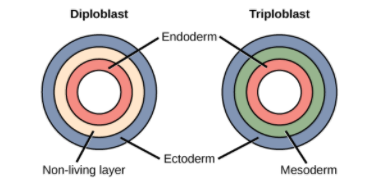
All the animals from flatworms to humans are triploblastic. The organisms show bilateral symmetry and have organ and organ systems in them. The layer mesoderm is in between the ectoderm and the endoderm. Examples are: worms, chordates etc.
Additional information:
Germ layers help in giving the organ or tissue to fully formed individuals. The germ layers in the animals are of:
-Diploblastic: The body cells are organized in layers on the outer ectoderm and on the internal endoderm. Example- Coelenterates
-Triploblastic: The wall of animals is made from three layers ectoderm, endoderm and mesoderm. Example includes: Platyhelminthes to chordates. All the higher and intermediate animals from flatworms to humans are triploblastic and are bilateral in nature.
Note: It is known that diploblastic animals have given birth to the triploblastic animals around 580 to 600 millions years ago. Therefore the evolution of the level of complexity within these organisms were observed.
Complete answer:
Triploblastic organism is an organism where in the body tissues have originated from three clear layers particularly the ectoderm, endoderm and mesoderm. All the organisms initiate from a single cell referred to as the zygote this is formed as a fusion among the male and female gamete.
This zygote undergoes a set of mitotic divisions to form the blastula. At this stage the cells of the foetus are divided into clear layers, particularly the ectoderm, endoderm and mesoderm.
A fourth layer consists of the germ cells that are put aside within the embryo at the blastula stage, which is incorporated into the glands during organogenesis. The germ layers are formed during the gastrulation of the blastula.
All the animals from flatworms to humans are triploblastic. The organisms show bilateral symmetry and have organ and organ systems in them. The layer mesoderm is in between the ectoderm and the endoderm. Examples are: worms, chordates etc.
Additional information:
Germ layers help in giving the organ or tissue to fully formed individuals. The germ layers in the animals are of:
-Diploblastic: The body cells are organized in layers on the outer ectoderm and on the internal endoderm. Example- Coelenterates
-Triploblastic: The wall of animals is made from three layers ectoderm, endoderm and mesoderm. Example includes: Platyhelminthes to chordates. All the higher and intermediate animals from flatworms to humans are triploblastic and are bilateral in nature.
Note: It is known that diploblastic animals have given birth to the triploblastic animals around 580 to 600 millions years ago. Therefore the evolution of the level of complexity within these organisms were observed.
Recently Updated Pages
Master Class 9 General Knowledge: Engaging Questions & Answers for Success

Master Class 9 Maths: Engaging Questions & Answers for Success
Master Class 9 Science: Engaging Questions & Answers for Success
Master Class 9 English: Engaging Questions & Answers for Success
Master Class 9 Social Science: Engaging Questions & Answers for Success
Class 9 Question and Answer - Your Ultimate Solutions Guide
Trending doubts
One Metric ton is equal to kg A 10000 B 1000 C 100 class 11 physics CBSE
Difference Between Prokaryotic Cells and Eukaryotic Cells
Two of the body parts which do not appear in MRI are class 11 biology CBSE
1 ton equals to A 100 kg B 1000 kg C 10 kg D 10000 class 11 physics CBSE
10 examples of friction in our daily life
Name the Largest and the Smallest Cell in the Human Body ?