




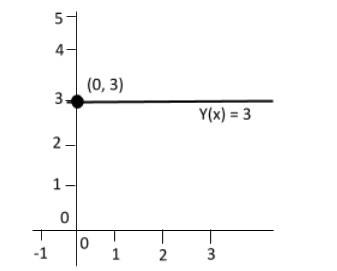
Define constant function. Also write its graph. Domain and range of function.
Answer
 Verified
632.4k+ views
Hint: A function is a rule which relates the values of one variable quantity to the values of another variable quantity.
Complete step by step solution: A constant function is a function whose (output) value is the same for every input value.
For example, the function \[y\left( x \right) = {\text{3}}\] is a constant function because the value of \[y\left( x \right)\] is \[{\text{3}}\] regardless of the input value $ x $.
Domain of function: The domain of a function is the complete set of possible values of the independent variable.
If\[f\left( x \right) = c\], they consist of all real numbers, there are no restrictions on the input. The only output value is the constant\[{\text{c}}\], so the range of the set \[\left\{ c \right\}\] that contains this single element
Range function: The range of a function is the complete set of all possible resulting values of the dependent variable of
For example:
Here: It is a set in the form of (\[{\text{x,y}}\]): $ \left\{ {( - 3,5),( - 2,5)( - 1,5)(2,5)(1,5)(2,5)} \right\} $
The values of\[\;{\text{y -}}\]values for the range.
Then range $ = \left\{ 5 \right\} $
Note: \[y\left( x \right) = {\text{3}}\] is the constant function where the range is $ 3 $ and the domain is $ x $.
Complete step by step solution: A constant function is a function whose (output) value is the same for every input value.
For example, the function \[y\left( x \right) = {\text{3}}\] is a constant function because the value of \[y\left( x \right)\] is \[{\text{3}}\] regardless of the input value $ x $.
Domain of function: The domain of a function is the complete set of possible values of the independent variable.
If\[f\left( x \right) = c\], they consist of all real numbers, there are no restrictions on the input. The only output value is the constant\[{\text{c}}\], so the range of the set \[\left\{ c \right\}\] that contains this single element
Range function: The range of a function is the complete set of all possible resulting values of the dependent variable of
For example:
Here: It is a set in the form of (\[{\text{x,y}}\]): $ \left\{ {( - 3,5),( - 2,5)( - 1,5)(2,5)(1,5)(2,5)} \right\} $
The values of\[\;{\text{y -}}\]values for the range.
Then range $ = \left\{ 5 \right\} $
Note: \[y\left( x \right) = {\text{3}}\] is the constant function where the range is $ 3 $ and the domain is $ x $.
Recently Updated Pages
Master Class 11 English: Engaging Questions & Answers for Success

Master Class 11 Social Science: Engaging Questions & Answers for Success
Master Class 11 Maths: Engaging Questions & Answers for Success
Master Class 11 Biology: Engaging Questions & Answers for Success
Master Class 11 Physics: Engaging Questions & Answers for Success
Master Class 11 Chemistry: Engaging Questions & Answers for Success
Trending doubts
One Metric ton is equal to kg A 10000 B 1000 C 100 class 11 physics CBSE
Difference Between Prokaryotic Cells and Eukaryotic Cells
Two of the body parts which do not appear in MRI are class 11 biology CBSE
Find the value of the expression given below sin 30circ class 11 maths CBSE
Draw a diagram of a plant cell and label at least eight class 11 biology CBSE
10 examples of friction in our daily life