




D is a point on the side of BC of a triangle ABC such that \[\angle ADC=\angle BAC\]. Show that \[C{{A}^{2}}=CB.CD\].
Answer
 Verified
648.6k+ views
Hint: Draw the rough figure. Consider \[\Delta ABC\] and\[\Delta ADC\]. Prove they are similar by AA criteria. Using AA similarity, postulate if 2 triangles are similar then corresponding sides are proportional. Hence equate sides.
Complete step-by-step answer:
Let us draw a rough figure of triangle ABC such that D is a point of the side BC (i.e. base) of the triangle. Then join AD. It is given that \[\angle ADC\] is equal to \[\angle BAC\] which is given in the figure, i.e. \[\angle ADC=\angle BAC\].
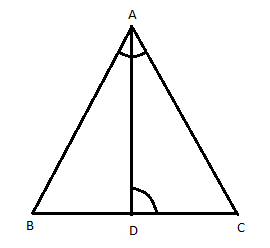
We need to prove that \[C{{A}^{2}}=CB.CD\].
This can be rearranged and written as,
\[\begin{align}
& CA.CA=CB.CD \\
& \Rightarrow \dfrac{CA}{CD}=\dfrac{CB}{CA} \\
\end{align}\]
Now let us consider \[\Delta ABC\]and\[\Delta ADC\].
\[\angle ACB=\angle ACD\], they are common angles of both the triangles and it is given that\[\angle ADC=\angle BAC\].
Thus by AA similarity criterion we can say that the two triangles are similar.
Here in the AA criterion, two triangles are similar if all the corresponding angles are congruent and their corresponding sides will be proportional, i.e. by AA similarity postulate, if two angles in one triangle are congruent to two angles in another triangle, then the two triangles are similar.
\[\therefore \Delta BAC\tilde{\ }\Delta ADC\].
We said that if two triangles are equal then their corresponding sides are proportional, which means we get,
\[\dfrac{BA}{AD}=\dfrac{AC}{CD}=\dfrac{BC}{AC}\]
Hence if we are taking, \[\dfrac{AC}{CD}=\dfrac{BC}{AC}\], i.e. \[\dfrac{CA}{CD}=\dfrac{CB}{CA}\].
We get by cross multiplying,
\[\begin{align}
& CA.CA=CB.CD \\
& \Rightarrow C{{A}^{2}}=CB.CD \\
\end{align}\]
Hence we proved what was asked in the question.
Note: The mathematical definition for similar triangles states that the triangles having proportional sides and all corresponding angles are the same.
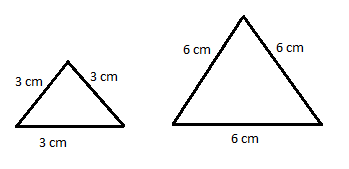
If we consider there are two triangles, where each side of the larger triangle is twice as large as the smaller triangle, then by AA criteria, the triangles are similar if two corresponding angles are similar to each other.
Complete step-by-step answer:
Let us draw a rough figure of triangle ABC such that D is a point of the side BC (i.e. base) of the triangle. Then join AD. It is given that \[\angle ADC\] is equal to \[\angle BAC\] which is given in the figure, i.e. \[\angle ADC=\angle BAC\].
We need to prove that \[C{{A}^{2}}=CB.CD\].
This can be rearranged and written as,
\[\begin{align}
& CA.CA=CB.CD \\
& \Rightarrow \dfrac{CA}{CD}=\dfrac{CB}{CA} \\
\end{align}\]
Now let us consider \[\Delta ABC\]and\[\Delta ADC\].
\[\angle ACB=\angle ACD\], they are common angles of both the triangles and it is given that\[\angle ADC=\angle BAC\].
Thus by AA similarity criterion we can say that the two triangles are similar.
Here in the AA criterion, two triangles are similar if all the corresponding angles are congruent and their corresponding sides will be proportional, i.e. by AA similarity postulate, if two angles in one triangle are congruent to two angles in another triangle, then the two triangles are similar.
\[\therefore \Delta BAC\tilde{\ }\Delta ADC\].
We said that if two triangles are equal then their corresponding sides are proportional, which means we get,
\[\dfrac{BA}{AD}=\dfrac{AC}{CD}=\dfrac{BC}{AC}\]
Hence if we are taking, \[\dfrac{AC}{CD}=\dfrac{BC}{AC}\], i.e. \[\dfrac{CA}{CD}=\dfrac{CB}{CA}\].
We get by cross multiplying,
\[\begin{align}
& CA.CA=CB.CD \\
& \Rightarrow C{{A}^{2}}=CB.CD \\
\end{align}\]
Hence we proved what was asked in the question.
Note: The mathematical definition for similar triangles states that the triangles having proportional sides and all corresponding angles are the same.
If we consider there are two triangles, where each side of the larger triangle is twice as large as the smaller triangle, then by AA criteria, the triangles are similar if two corresponding angles are similar to each other.
Recently Updated Pages
Master Class 10 English: Engaging Questions & Answers for Success

Master Class 10 Social Science: Engaging Questions & Answers for Success
Master Class 10 Computer Science: Engaging Questions & Answers for Success
Class 10 Question and Answer - Your Ultimate Solutions Guide
Master Class 10 General Knowledge: Engaging Questions & Answers for Success
Master Class 10 Maths: Engaging Questions & Answers for Success
Trending doubts
What is the full form of NDA a National Democratic class 10 social science CBSE
Explain the Treaty of Vienna of 1815 class 10 social science CBSE
Who Won 36 Oscar Awards? Record Holder Revealed
Bharatiya Janata Party was founded in the year A 1979 class 10 social science CBSE
What is the median of the first 10 natural numbers class 10 maths CBSE
Why is it 530 pm in india when it is 1200 afternoon class 10 social science CBSE