




Why current flows in a resistor connected with a battery although there is zero potential difference between one end of the battery and one end of the resistor?
Answer
 Verified
640.8k+ views
Hint: Firstly, understand that terminals used to measure the potential difference across the resistor are wrong. If you want to see whether there is potential difference across a given resistor or any element, you have to measure it across it. Maybe, you could recall the ohm’s law to give a better justification.
Complete answer:
In the given question, we are given a simple electric circuit in which a resistor is connected with a battery. Then, we are asked why there is a flow of current in the resistor when there is zero potential difference between one end of the battery and one end of the resistor.
For a student who is thorough with the concepts of current electricity may find this question quite meaningless.
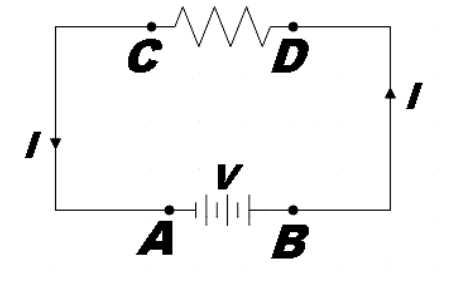
As per the question, the potential difference when measured between the points A and C (or B and D) is found to be zero. But that is not how we measure potential difference for an element (here, resistor).
The battery here provides a voltage of V volts. So when we keep a voltmeter across A and B we find the reading to be V volts. Similarly, when we measure the potential difference for the resistor we have to measure it across its two terminals that are C and D and we find it also to be V volts. And wherever there is a potential difference, the current will surely flow.
Note:
We know ohm’s law which is given by,
$I=\dfrac{V}{R}$
Where, V is the potential difference (voltage), I is the current and R is the resistance. So for zero potential difference there will be no flow of current. But when the resistance is zero, there will be infinite current flowing through the circuit. So if there is current flowing through a circuit there surely is a potential difference.
Complete answer:
In the given question, we are given a simple electric circuit in which a resistor is connected with a battery. Then, we are asked why there is a flow of current in the resistor when there is zero potential difference between one end of the battery and one end of the resistor.
For a student who is thorough with the concepts of current electricity may find this question quite meaningless.
As per the question, the potential difference when measured between the points A and C (or B and D) is found to be zero. But that is not how we measure potential difference for an element (here, resistor).
The battery here provides a voltage of V volts. So when we keep a voltmeter across A and B we find the reading to be V volts. Similarly, when we measure the potential difference for the resistor we have to measure it across its two terminals that are C and D and we find it also to be V volts. And wherever there is a potential difference, the current will surely flow.
Note:
We know ohm’s law which is given by,
$I=\dfrac{V}{R}$
Where, V is the potential difference (voltage), I is the current and R is the resistance. So for zero potential difference there will be no flow of current. But when the resistance is zero, there will be infinite current flowing through the circuit. So if there is current flowing through a circuit there surely is a potential difference.
Recently Updated Pages
If x a + bt + ct2 where x is in meters and t is in class 11 physics CBSE

A car covers the first half distance between two places class 11 physics CBSE
The resultant of two vectors overrightarrow P and overrightarrow class 11 physics CBSE
Find the value of cos 135 class 11 maths CBSE
A mass M is held in place by an applied force F and class 11 physics CBSE
A solution of glucose in water is labelled as 10 dfracwv class 11 chemistry CBSE
Trending doubts
Find the value of the expression given below sin 30circ class 11 maths CBSE
One Metric ton is equal to kg A 10000 B 1000 C 100 class 11 physics CBSE
Draw a diagram of nephron and explain its structur class 11 biology CBSE
10 examples of friction in our daily life
Proton was discovered by A Thomson B Rutherford C Chadwick class 11 chemistry CBSE
Bond order ofO2 O2+ O2 and O22 is in order A O2 langle class 11 chemistry CBSE