




How many chromosomes are found in human ovum?
a) 46
b) 64
c) 23
d) 32
Answer
 Verified
662.7k+ views
Hint: Human ovum is the female gamete. Gametes are formed by gametogenesis. Spermatogenesis forms sperms and oogenesis forms ovum. The ovum fuses with the sperm and thuis zygote is formed that undergoes further development to form embryo and then foetus.
Complete answer:
Sperms are formed by spermatogenesis and ovum is formed by oogenesis. The stem cells are the major pre-requirements for these processes. The main difference between the two processes is that oogenesis is an unequal division.
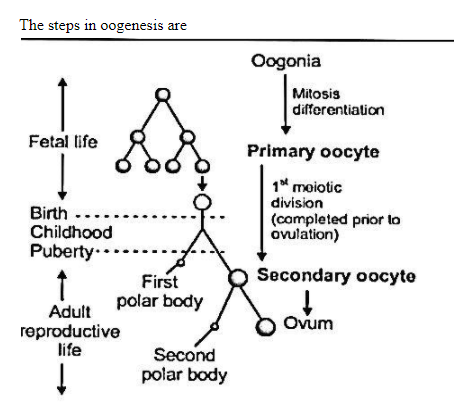
>Oogonia are the mother cells that start the process. These cells are formed in yolk sac but migrate to the gonads. These are diploid cells (2n=46).
>These cells undergo Mitosis to form Primary oocytes. Mitosis is equational division. Thus primary oocytes are also diploid.The Primary oocytes then undergo Meiosis 1 and form one secondary oocyte and first polar body. Meiosis 1 is reductional division. Hence the daughter cells are haploid (n=23).
>The secondary oocyte undergoes Meiosis 2 to form ovum and second polar body. (This process takes place only when sperm enters the egg). Meiosis 2 is also equational division and thus the ovum is haploid (n=23).
Hence the correct answer is option ‘c’.
Note: Humans show 46 chromosomes ( 23 pairs). The gametes are always haploid so that during fertilisation when the gametes fuse, the zygote is diploid and thus the ploidy level is maintained.
Complete answer:
Sperms are formed by spermatogenesis and ovum is formed by oogenesis. The stem cells are the major pre-requirements for these processes. The main difference between the two processes is that oogenesis is an unequal division.
>Oogonia are the mother cells that start the process. These cells are formed in yolk sac but migrate to the gonads. These are diploid cells (2n=46).
>These cells undergo Mitosis to form Primary oocytes. Mitosis is equational division. Thus primary oocytes are also diploid.The Primary oocytes then undergo Meiosis 1 and form one secondary oocyte and first polar body. Meiosis 1 is reductional division. Hence the daughter cells are haploid (n=23).
>The secondary oocyte undergoes Meiosis 2 to form ovum and second polar body. (This process takes place only when sperm enters the egg). Meiosis 2 is also equational division and thus the ovum is haploid (n=23).
Hence the correct answer is option ‘c’.
Note: Humans show 46 chromosomes ( 23 pairs). The gametes are always haploid so that during fertilisation when the gametes fuse, the zygote is diploid and thus the ploidy level is maintained.
Recently Updated Pages
What is BLO What is the full form of BLO class 8 social science CBSE

Explain the Treaty of Vienna of 1815 class 10 social science CBSE
10 examples of friction in our daily life
Draw a diagram of nephron and explain its structur class 11 biology CBSE
Write structures of the following compounds i 2 Chloro3methylpentane class 11 chemistry CBSE
A Paragraph on Pollution in about 100-150 Words
Trending doubts
Draw a labelled sketch of the human eye class 12 physics CBSE
Which are the Top 10 Largest Countries of the World?
Differentiate between homogeneous and heterogeneous class 12 chemistry CBSE
Draw ray diagrams each showing i myopic eye and ii class 12 physics CBSE
Which is the correct genotypic ratio of mendel dihybrid class 12 biology CBSE
What is the Full Form of PVC, PET, HDPE, LDPE, PP and PS ?