




What is the chemical name of the Niacin? Why is it required for the body?
Answer
 Verified
623.1k+ views
Hint: Niacin is also known as Nicotinic acid. Niacin is a type of Vitamin B, that performs various processes that are related to the DNA.
Step by step answer:
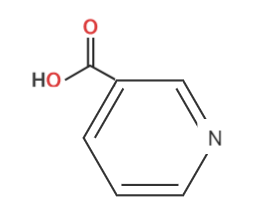
Niacin, also known as nicotinic acid, is popularly known by its common name, Vitamin \({B_3}\).
Its chemical name or IUPAC name is Pyridine-3-carboxylic acid. Its chemical formula is \({C_6}{H_5}N{O_2}\).
As niacin is a type of Vitamin B, thus, it is soluble in water, as Vitamin B is a water-soluble Vitamin.
The food items that are usually obtained from animals like meat, beef, pork, seafood, etc. have a high quality of Niacin in it. However, it is found less in eggs and dairy items, as compared to the other animal products. Spices are also considered an active source of Niacin.
Niacin is required by our bodies because it is the precursor of several coenzymes in our bodies. These co-enzymes include NAD (Nicotinamide Adenine Dinucleotide) and NADP (Nicotinamide Adenine Dinucleotide Phosphate). These co-enzymes help in the process of DNA repair. They are also used in many hydrogen-transfer processes in our body. NAD is actively commonly in catabolic processes, whereas, the NADP is active commonly in the anabolic processes.
Note: The deficiency of niacin causes pellagra in the body. This disease is characterized by lesions of skin and mouth. Other symptoms and signs include anemia, tiredness, and headaches.
Other conditions like diarrhea, dermatitis, dementia, and hyperpigmentation of the skin are also observed due to the severe deficiency of the Niacin. If the deficiency is left untreated, it could also lead to death.
Step by step answer:
Niacin, also known as nicotinic acid, is popularly known by its common name, Vitamin \({B_3}\).
Its chemical name or IUPAC name is Pyridine-3-carboxylic acid. Its chemical formula is \({C_6}{H_5}N{O_2}\).
As niacin is a type of Vitamin B, thus, it is soluble in water, as Vitamin B is a water-soluble Vitamin.
The food items that are usually obtained from animals like meat, beef, pork, seafood, etc. have a high quality of Niacin in it. However, it is found less in eggs and dairy items, as compared to the other animal products. Spices are also considered an active source of Niacin.
Niacin is required by our bodies because it is the precursor of several coenzymes in our bodies. These co-enzymes include NAD (Nicotinamide Adenine Dinucleotide) and NADP (Nicotinamide Adenine Dinucleotide Phosphate). These co-enzymes help in the process of DNA repair. They are also used in many hydrogen-transfer processes in our body. NAD is actively commonly in catabolic processes, whereas, the NADP is active commonly in the anabolic processes.
Note: The deficiency of niacin causes pellagra in the body. This disease is characterized by lesions of skin and mouth. Other symptoms and signs include anemia, tiredness, and headaches.
Other conditions like diarrhea, dermatitis, dementia, and hyperpigmentation of the skin are also observed due to the severe deficiency of the Niacin. If the deficiency is left untreated, it could also lead to death.
Recently Updated Pages
Master Class 11 English: Engaging Questions & Answers for Success

Master Class 11 Social Science: Engaging Questions & Answers for Success
Master Class 11 Maths: Engaging Questions & Answers for Success
Master Class 11 Biology: Engaging Questions & Answers for Success
Master Class 11 Physics: Engaging Questions & Answers for Success
Master Class 11 Chemistry: Engaging Questions & Answers for Success
Trending doubts
One Metric ton is equal to kg A 10000 B 1000 C 100 class 11 physics CBSE
Difference Between Prokaryotic Cells and Eukaryotic Cells
Find the value of the expression given below sin 30circ class 11 maths CBSE
Difference between physical and chemical change class 11 chemistry CBSE
Two of the body parts which do not appear in MRI are class 11 biology CBSE
Draw a diagram of a plant cell and label at least eight class 11 biology CBSE