




Car A has an acceleration of $2\,{{\rm{m}} {\left/{\vphantom {{\rm{m}} {{{\rm{s}}^{\rm{2}}}}}} \right.} {{{\rm{s}}^{\rm{2}}}}}$ due east and car B $4\,{{\rm{m}} {\left/{\vphantom {{\rm{m}} {{{\rm{s}}^{\rm{2}}}}}} \right.} {{{\rm{s}}^{\rm{2}}}}}$ due north. What is the acceleration of car B with respect to car A?
Answer
 Verified
593.1k+ views
Hint: The given case is in a two dimensional system, therefore the directional vectors should also be considered. The total magnitude of the acceleration depends on the acceleration among different directions.
Complete step by step answer:
When the two cars are moving in the different directions then the relative velocity of the cars is calculated by subtracting the velocities of the car. When the car moves in directly opposite directions then the relative velocity of the car is calculated by the sum of two velocities.
The direction of the cars is as shown:
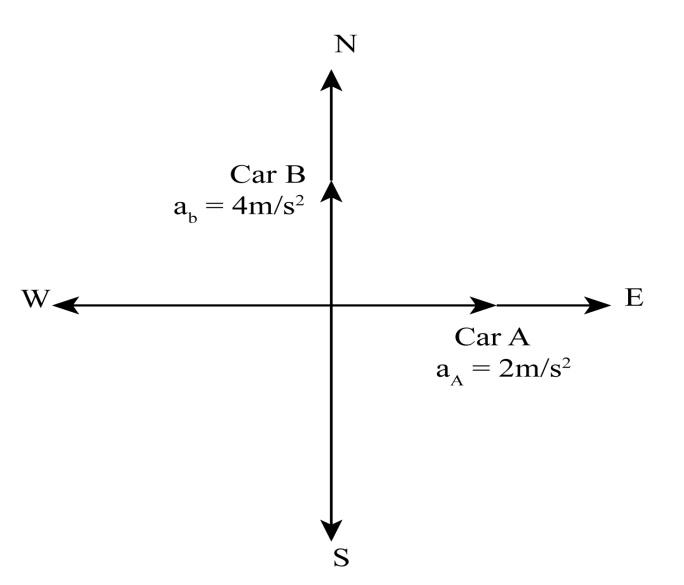
The formula to calculate the relative acceleration of car B with respect to car A is
${a_{BA}} = {a_B}\hat j - {a_A}\hat i$
Here, ${a_{BA}}$ is the relative acceleration of car A with respect to car B, ${a_A}$ is the acceleration of car A, $\hat i$ is the unit vector along east direction, ${a_B}$is the acceleration of car B and $\hat j$ is the unit vector along north direction.
Substitute $2\,{{\rm{m}} {\left/{\vphantom {{\rm{m}} {{{\rm{s}}^{\rm{2}}}}}} \right.
} {{{\rm{s}}^{\rm{2}}}}}$ for ${a_A}$ and $4\,{{\rm{m}} {\left/{\vphantom {{\rm{m}} {{{\rm{s}}^{\rm{2}}}}}} \right.} {{{\rm{s}}^{\rm{2}}}}}$for ${a_B}$ in the formula to calculate the relative acceleration of the car B with respect to car A.
${a_{BA}} = \left( {2\,{{\rm{m}} {\left/ {\vphantom {{\rm{m}} {{{\rm{s}}^{\rm{2}}}}}} \right.} {{{\rm{s}}^{\rm{2}}}}}} \right)\hat j - \left( {4\,{{\rm{m}} {\left/{\vphantom {{\rm{m}} {{{\rm{s}}^{\rm{2}}}}}} \right.} {{{\rm{s}}^{\rm{2}}}}}} \right)\hat i$
The formula to calculate the magnitude of relative acceleration of car B with respect to car A is
$\left| {{a_{BA}}} \right| = \sqrt {a_B^2 + a_A^2} \,\,$
Substitute $2\,{{\rm{m}} {\left/{\vphantom {{\rm{m}} {{{\rm{s}}^{\rm{2}}}}}} \right. } {{{\rm{s}}^{\rm{2}}}}}$ for ${a_A}$ and $4\,{{\rm{m}} {\left/{\vphantom {{\rm{m}} {{{\rm{s}}^{\rm{2}}}}}} \right.} {{{\rm{s}}^{\rm{2}}}}}$for ${a_B}$ in the formula to calculate magnitude of the relative acceleration of the car B with respect to car A.
$ \left| {{a_{BA}}} \right| = \sqrt {{{\left( {2\,{{\rm{m}} {\left/{\vphantom {{\rm{m}} {{{\rm{s}}^{\rm{2}}}}}} \right. } {{{\rm{s}}^{\rm{2}}}}}} \right)}^2} + {{\left( {4\,{{\rm{m}} {\left/ {\vphantom {{\rm{m}} {{{\rm{s}}^{\rm{2}}}}}} \right.} {{{\rm{s}}^{\rm{2}}}}}} \right)}^2}} \\
= \sqrt {4 + 16} \,{{\rm{m}} {\left/ {\vphantom {{\rm{m}} {{{\rm{s}}^{\rm{2}}}}}} \right. } {{{\rm{s}}^{\rm{2}}}}}\\
= \sqrt {20} \,{{\rm{m}} {\left/ {\vphantom {{\rm{m}} {{{\rm{s}}^{\rm{2}}}}}} \right.} {{{\rm{s}}^{\rm{2}}}}}\\
= 4.47\,{{\rm{m}} {\left/
{\vphantom {{\rm{m}} {{{\rm{s}}^{\rm{2}}}}}} \right.} {{{\rm{s}}^{\rm{2}}}}} $
Thus, the relative acceleration of car B with respect to car A is $4.47\,{{\rm{m}} {\left/ {\vphantom {{\rm{m}} {{{\rm{s}}^{\rm{2}}}}}} \right.} {{{\rm{s}}^{\rm{2}}}}}$.
Note:
The direction of car B relative to car A can also be found from this example because the direction of the car can be calculated using the acceleration of the cars in different directions.
Complete step by step answer:
When the two cars are moving in the different directions then the relative velocity of the cars is calculated by subtracting the velocities of the car. When the car moves in directly opposite directions then the relative velocity of the car is calculated by the sum of two velocities.
The direction of the cars is as shown:
The formula to calculate the relative acceleration of car B with respect to car A is
${a_{BA}} = {a_B}\hat j - {a_A}\hat i$
Here, ${a_{BA}}$ is the relative acceleration of car A with respect to car B, ${a_A}$ is the acceleration of car A, $\hat i$ is the unit vector along east direction, ${a_B}$is the acceleration of car B and $\hat j$ is the unit vector along north direction.
Substitute $2\,{{\rm{m}} {\left/{\vphantom {{\rm{m}} {{{\rm{s}}^{\rm{2}}}}}} \right.
} {{{\rm{s}}^{\rm{2}}}}}$ for ${a_A}$ and $4\,{{\rm{m}} {\left/{\vphantom {{\rm{m}} {{{\rm{s}}^{\rm{2}}}}}} \right.} {{{\rm{s}}^{\rm{2}}}}}$for ${a_B}$ in the formula to calculate the relative acceleration of the car B with respect to car A.
${a_{BA}} = \left( {2\,{{\rm{m}} {\left/ {\vphantom {{\rm{m}} {{{\rm{s}}^{\rm{2}}}}}} \right.} {{{\rm{s}}^{\rm{2}}}}}} \right)\hat j - \left( {4\,{{\rm{m}} {\left/{\vphantom {{\rm{m}} {{{\rm{s}}^{\rm{2}}}}}} \right.} {{{\rm{s}}^{\rm{2}}}}}} \right)\hat i$
The formula to calculate the magnitude of relative acceleration of car B with respect to car A is
$\left| {{a_{BA}}} \right| = \sqrt {a_B^2 + a_A^2} \,\,$
Substitute $2\,{{\rm{m}} {\left/{\vphantom {{\rm{m}} {{{\rm{s}}^{\rm{2}}}}}} \right. } {{{\rm{s}}^{\rm{2}}}}}$ for ${a_A}$ and $4\,{{\rm{m}} {\left/{\vphantom {{\rm{m}} {{{\rm{s}}^{\rm{2}}}}}} \right.} {{{\rm{s}}^{\rm{2}}}}}$for ${a_B}$ in the formula to calculate magnitude of the relative acceleration of the car B with respect to car A.
$ \left| {{a_{BA}}} \right| = \sqrt {{{\left( {2\,{{\rm{m}} {\left/{\vphantom {{\rm{m}} {{{\rm{s}}^{\rm{2}}}}}} \right. } {{{\rm{s}}^{\rm{2}}}}}} \right)}^2} + {{\left( {4\,{{\rm{m}} {\left/ {\vphantom {{\rm{m}} {{{\rm{s}}^{\rm{2}}}}}} \right.} {{{\rm{s}}^{\rm{2}}}}}} \right)}^2}} \\
= \sqrt {4 + 16} \,{{\rm{m}} {\left/ {\vphantom {{\rm{m}} {{{\rm{s}}^{\rm{2}}}}}} \right. } {{{\rm{s}}^{\rm{2}}}}}\\
= \sqrt {20} \,{{\rm{m}} {\left/ {\vphantom {{\rm{m}} {{{\rm{s}}^{\rm{2}}}}}} \right.} {{{\rm{s}}^{\rm{2}}}}}\\
= 4.47\,{{\rm{m}} {\left/
{\vphantom {{\rm{m}} {{{\rm{s}}^{\rm{2}}}}}} \right.} {{{\rm{s}}^{\rm{2}}}}} $
Thus, the relative acceleration of car B with respect to car A is $4.47\,{{\rm{m}} {\left/ {\vphantom {{\rm{m}} {{{\rm{s}}^{\rm{2}}}}}} \right.} {{{\rm{s}}^{\rm{2}}}}}$.
Note:
The direction of car B relative to car A can also be found from this example because the direction of the car can be calculated using the acceleration of the cars in different directions.
Recently Updated Pages
Basicity of sulphurous acid and sulphuric acid are

Master Class 11 Business Studies: Engaging Questions & Answers for Success
Master Class 11 Computer Science: Engaging Questions & Answers for Success
Master Class 11 Economics: Engaging Questions & Answers for Success
Master Class 11 Social Science: Engaging Questions & Answers for Success
Master Class 11 English: Engaging Questions & Answers for Success
Trending doubts
One Metric ton is equal to kg A 10000 B 1000 C 100 class 11 physics CBSE
The largest wind power cluster is located in the state class 11 social science CBSE
Explain zero factorial class 11 maths CBSE
State and prove Bernoullis theorem class 11 physics CBSE
What steps did the French revolutionaries take to create class 11 social science CBSE
Which among the following are examples of coming together class 11 social science CBSE