




Body of Euspongia is mainly composed of
(a) Calcareous spicules
(b) Spongin fibers
(c) Siliceous spicules
(d) Mesoglea
Answer
 Verified
560.6k+ views
Hint: A modified type of protein present in the phylum Porifera to give them structural support. The openings in sponges are surrounded by fibers.
Complete answer:
Euspongia also is known as Spongia is the variety of sponges commonly known as a bath sponge. It is used commercially. The individuals grow on large lobes having small openings which are formed by the interwoven network of primary and secondary spongin fibers.
Additional information :
1. Euspongia is found throughout the Mediterranean Sea to rocky surfaces.
2. They have small openings that are elevated and have cone-shaped gaps called conules.
3. A small mouth-like opening called oscula is present at the tip of the lobes.
4. Their ectosomal skeleton has primary and secondary spongin fibers together form the conulose openings.
5. They also have a choanosomal skeleton having a dark mesh of secondary fibers from which primary fibers arise.
6. These primary fibers are made up of spongin and have other particles like sand grains and spicules.
7. The secondary fibers are made up of only spongin and no other particles present.
8. The primary fibers are 50-100 nanometres in diameter while secondary fibers are 20-36 nanometres in diameter.
So, the correct answer is ‘Spongin fibers’.
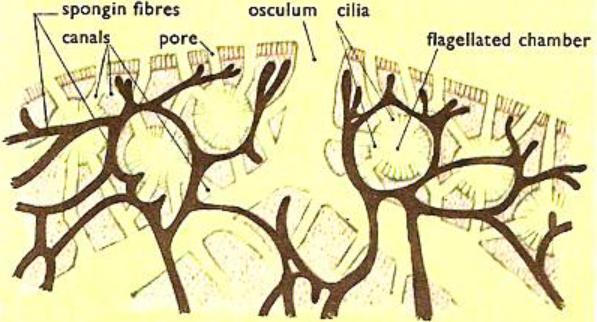
Note: Spongin fibers are the modified collagen proteins that form the fibrous skeleton of most of the organisms of phylum Porifera (sponges). They are secreted by sponge cells called spongocytes. Spongin fibers give flexibility to the sponges and help in connecting siliceous spicules. Siliceous spicules are made up of silicon dioxide which gives rough and porous texture to the shells. Calcareous spicules are made up of mainly calcium carbonate which gives the shell hardness and stiffness. The mesoglea is the innermost layer of the tissue which is the characteristic feature of the jellyfish.
Complete answer:
Euspongia also is known as Spongia is the variety of sponges commonly known as a bath sponge. It is used commercially. The individuals grow on large lobes having small openings which are formed by the interwoven network of primary and secondary spongin fibers.
Additional information :
1. Euspongia is found throughout the Mediterranean Sea to rocky surfaces.
2. They have small openings that are elevated and have cone-shaped gaps called conules.
3. A small mouth-like opening called oscula is present at the tip of the lobes.
4. Their ectosomal skeleton has primary and secondary spongin fibers together form the conulose openings.
5. They also have a choanosomal skeleton having a dark mesh of secondary fibers from which primary fibers arise.
6. These primary fibers are made up of spongin and have other particles like sand grains and spicules.
7. The secondary fibers are made up of only spongin and no other particles present.
8. The primary fibers are 50-100 nanometres in diameter while secondary fibers are 20-36 nanometres in diameter.
So, the correct answer is ‘Spongin fibers’.
Note: Spongin fibers are the modified collagen proteins that form the fibrous skeleton of most of the organisms of phylum Porifera (sponges). They are secreted by sponge cells called spongocytes. Spongin fibers give flexibility to the sponges and help in connecting siliceous spicules. Siliceous spicules are made up of silicon dioxide which gives rough and porous texture to the shells. Calcareous spicules are made up of mainly calcium carbonate which gives the shell hardness and stiffness. The mesoglea is the innermost layer of the tissue which is the characteristic feature of the jellyfish.
Recently Updated Pages
Master Class 12 Business Studies: Engaging Questions & Answers for Success

Master Class 12 Chemistry: Engaging Questions & Answers for Success
Master Class 12 Biology: Engaging Questions & Answers for Success
Class 12 Question and Answer - Your Ultimate Solutions Guide
Master Class 11 English: Engaging Questions & Answers for Success
Master Class 11 Social Science: Engaging Questions & Answers for Success
Trending doubts
Differentiate between homogeneous and heterogeneous class 12 chemistry CBSE
In order to find out the different types of gametes class 12 biology NEET_UG
Yeast reproduces by A Spore formation B Multiple fission class 12 biology CBSE
Write any five applications of photoelectric cells class 12 physics CBSE
Suicide bags of cells are aEndoplasmic reticulum bLysosome class 12 biology CBSE
Who is the father of zoology A Aristotle B Theophrastus class 12 biology CBSE