




Benthos of pond ecosystem are:
a. Producers
b. Primary consumers
c. Secondary consumers
d. Tertiary consumers
Answer
 Verified
662.1k+ views
Hint: Benthos are the organisms that are found at the nethermost of stream bodies such as streams, rivers, and lakes. In 1891, the term Benthos was coined by Haeckel. Benthos are depending on the organic matter.
Complete answer:
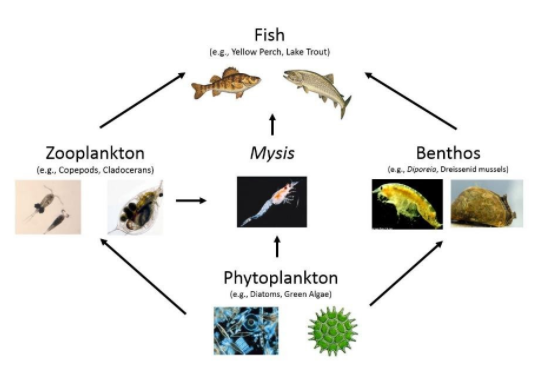
- The ponds and lakes are motionless or immobile freshwaters. In general, the ponds are thinner with depth less than 2 meters.
- In an ecosystem of pond or lake benthos (which are also known as the bottom dwellers) comprises snails, clams, mussels, crabs, prawns, etc.
- The benthos lives deep in any water resources. since the intensity of the light is not capable of reaching such a depth of water, consequently, they hinge upon the organic matter.
- This deceased and putrefying matter of organisms withstand their nourishment chain
Hence, The correct answer is option (B).
Additional information:
- As mentioned earlier, the Ponds and lakes are inactive and fixed ecosystems of freshwater. The ponds and lakes are categorized by a determined number of producers (the plants).
- Due to the reason that the light is captivated before it can influence deep ocean-water, the source of energy for deep ecosystems of benthic organisms are often organic materials from higher up in the water pilaster that implicates down to the depths.
- This dead and decaying matter helps the organisms living deep in the ocean to sustain their benthic food chain. And the reason for this sustainment is that most organisms in the benthic zone are scroungers or detritivores.
Note: The benthos is frequently known to be the scroungers or detritivores of the pond ecosystem, which belong to the category of primary consumers in the debris food chain. The benthos is deliberated as important components of the pond food chain since they will control the nourishment chain of the ecosystem.
Complete answer:
- The ponds and lakes are motionless or immobile freshwaters. In general, the ponds are thinner with depth less than 2 meters.
- In an ecosystem of pond or lake benthos (which are also known as the bottom dwellers) comprises snails, clams, mussels, crabs, prawns, etc.
- The benthos lives deep in any water resources. since the intensity of the light is not capable of reaching such a depth of water, consequently, they hinge upon the organic matter.
- This deceased and putrefying matter of organisms withstand their nourishment chain
Hence, The correct answer is option (B).
Additional information:
- As mentioned earlier, the Ponds and lakes are inactive and fixed ecosystems of freshwater. The ponds and lakes are categorized by a determined number of producers (the plants).
- Due to the reason that the light is captivated before it can influence deep ocean-water, the source of energy for deep ecosystems of benthic organisms are often organic materials from higher up in the water pilaster that implicates down to the depths.
- This dead and decaying matter helps the organisms living deep in the ocean to sustain their benthic food chain. And the reason for this sustainment is that most organisms in the benthic zone are scroungers or detritivores.
Note: The benthos is frequently known to be the scroungers or detritivores of the pond ecosystem, which belong to the category of primary consumers in the debris food chain. The benthos is deliberated as important components of the pond food chain since they will control the nourishment chain of the ecosystem.
Recently Updated Pages
Which of the following graphs shows the variation of class 12 physics CBSE

Draw a labelled diagram of the human male reproductive class 12 biology CBSE
Describe the experiment to compare the emf of two cells class 12 physics CBSE
What is standard hydrogen electrode
What is conventional current and electric current class 12 physics CBSE
2Bromopentane is treated with an alcoholic KOH solution class 12 chemistry CBSE
Trending doubts
Draw a labelled sketch of the human eye class 12 physics CBSE
Which are the Top 10 Largest Countries of the World?
Differentiate between homogeneous and heterogeneous class 12 chemistry CBSE
Draw ray diagrams each showing i myopic eye and ii class 12 physics CBSE
Which is the correct genotypic ratio of mendel dihybrid class 12 biology CBSE
What is the Full Form of PVC, PET, HDPE, LDPE, PP and PS ?