




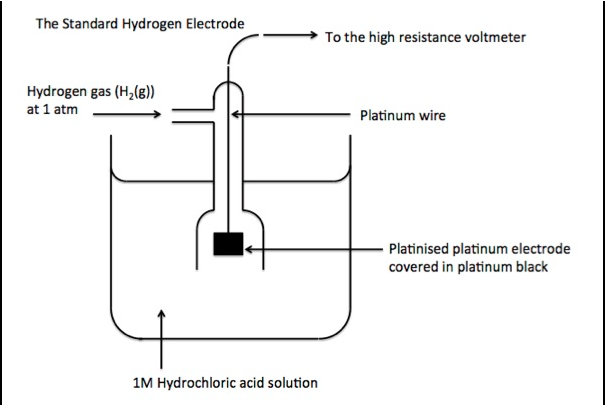
a) Draw Labelled diagram of Standard Hydrogen Electrode (SHE). Write its half-cell reaction of ${{\text{E}}^{0}}$ value.
b) Calculate $\Delta r{{G}^{0}}$ for the following reaction:
$F{{e}^{+2}}_{\left( aq \right)}+A{{g}^{+}}\to F{{e}^{+3}}_{(aq)}+A{{g}_{\left( s \right)}}$, (Given$E_{\left( cell \right)}^{0}=+0.03V,F=96500C$)
Answer
 Verified
618.6k+ views
Hint: The Standard Hydrogen Electrode, is a redox electrode which is the basic of the thermodynamic scale of oxidation-reduction potential. It is basically used as a reference electrode on half-cell potential reactions. The value of the standard electrode potential is zero, which forms the basis to calculate cell potentials using different electrodes or different concentrations.
Complete answer:
The Standard Hydrogen Electrode also known as SHE. The potential of SHE is always 0 at 298K, this is the reason it is used as a reference electrode.
The redox half-cell reaction of the SHE is:
$2{{H}^{+}}_{\left( aq \right)}+2{{e}^{-}}\to {{H}_{2}}_{\left( g \right)}$${{E}^{0}}$
Hydrogen Standard electrode potential (${{E}^{0}}$) is declared as zero at any temperature.
Addition Information:
The absolute electrode potential of SHE is measured to be 4.44+-0.02V at room temperature. But for a basic comparison with all other electrode reactions, Hydrogen standard electrode potential (${{E}^{0}}$) is declared to be zero volts at any temperature.
The reasons for choice for platinum for the hydrogen electrode is:
-Inertness of platinum
-The capability of platinum to catalyze the reaction of proton reduction
-Use a surface material that absorbs hydrogen well at its interface. This increases the reaction kinetics
Note:
The value of standard electrode potential is always zero. During the reaction, hydrogen gas is passed through and into the solution and the reaction that takes place is: $2{{H}^{+}}_{\left( aq \right)}+2{{e}^{-}}\to {{H}_{2}}_{\left( g \right)}$
b) Calculate $\Delta r{{G}^{0}}$ for the following reaction:
$F{{e}^{+2}}_{\left( aq \right)}+A{{g}^{+}}\to F{{e}^{+3}}_{(aq)}+A{{g}_{\left( s \right)}}$, (Given$E_{(cell)}^{0}=+0.03V,F=96500C$)
Complete answer:
The Standard Hydrogen Electrode also known as SHE. The potential of SHE is always 0 at 298K, this is the reason it is used as a reference electrode.
The redox half-cell reaction of the SHE is:
$2{{H}^{+}}_{\left( aq \right)}+2{{e}^{-}}\to {{H}_{2}}_{\left( g \right)}$${{E}^{0}}$
Hydrogen Standard electrode potential (${{E}^{0}}$) is declared as zero at any temperature.
Addition Information:
The absolute electrode potential of SHE is measured to be 4.44+-0.02V at room temperature. But for a basic comparison with all other electrode reactions, Hydrogen standard electrode potential (${{E}^{0}}$) is declared to be zero volts at any temperature.
The reasons for choice for platinum for the hydrogen electrode is:
-Inertness of platinum
-The capability of platinum to catalyze the reaction of proton reduction
-Use a surface material that absorbs hydrogen well at its interface. This increases the reaction kinetics
Note:
The value of standard electrode potential is always zero. During the reaction, hydrogen gas is passed through and into the solution and the reaction that takes place is: $2{{H}^{+}}_{\left( aq \right)}+2{{e}^{-}}\to {{H}_{2}}_{\left( g \right)}$
b) Calculate $\Delta r{{G}^{0}}$ for the following reaction:
$F{{e}^{+2}}_{\left( aq \right)}+A{{g}^{+}}\to F{{e}^{+3}}_{(aq)}+A{{g}_{\left( s \right)}}$, (Given$E_{(cell)}^{0}=+0.03V,F=96500C$)
Recently Updated Pages
What is BLO What is the full form of BLO class 8 social science CBSE

Explain the Treaty of Vienna of 1815 class 10 social science CBSE
10 examples of friction in our daily life
Draw a diagram of nephron and explain its structur class 11 biology CBSE
Write structures of the following compounds i 2 Chloro3methylpentane class 11 chemistry CBSE
A Paragraph on Pollution in about 100-150 Words
Trending doubts
Draw a labelled sketch of the human eye class 12 physics CBSE
Which are the Top 10 Largest Countries of the World?
Differentiate between homogeneous and heterogeneous class 12 chemistry CBSE
Draw ray diagrams each showing i myopic eye and ii class 12 physics CBSE
Materials which do not allow an electric current to class 12 physics CBSE
Which is the correct genotypic ratio of mendel dihybrid class 12 biology CBSE