




Avena curvature test is a bioassay for the activity of
(a) Auxin
(b) Ethylene
(c) Cytokinin
(d) Gibberellin
Answer
 Verified
649.5k+ views
Hint: The Avena curvature test is a bioassay for the activity of a plant hormone that promotes cell elongation and it is produced at the stem tip. It travels to the darker side of the plant and causes the cells to grow larger compared to the cells on the lighter side of the plant.
Complete step by step answer:
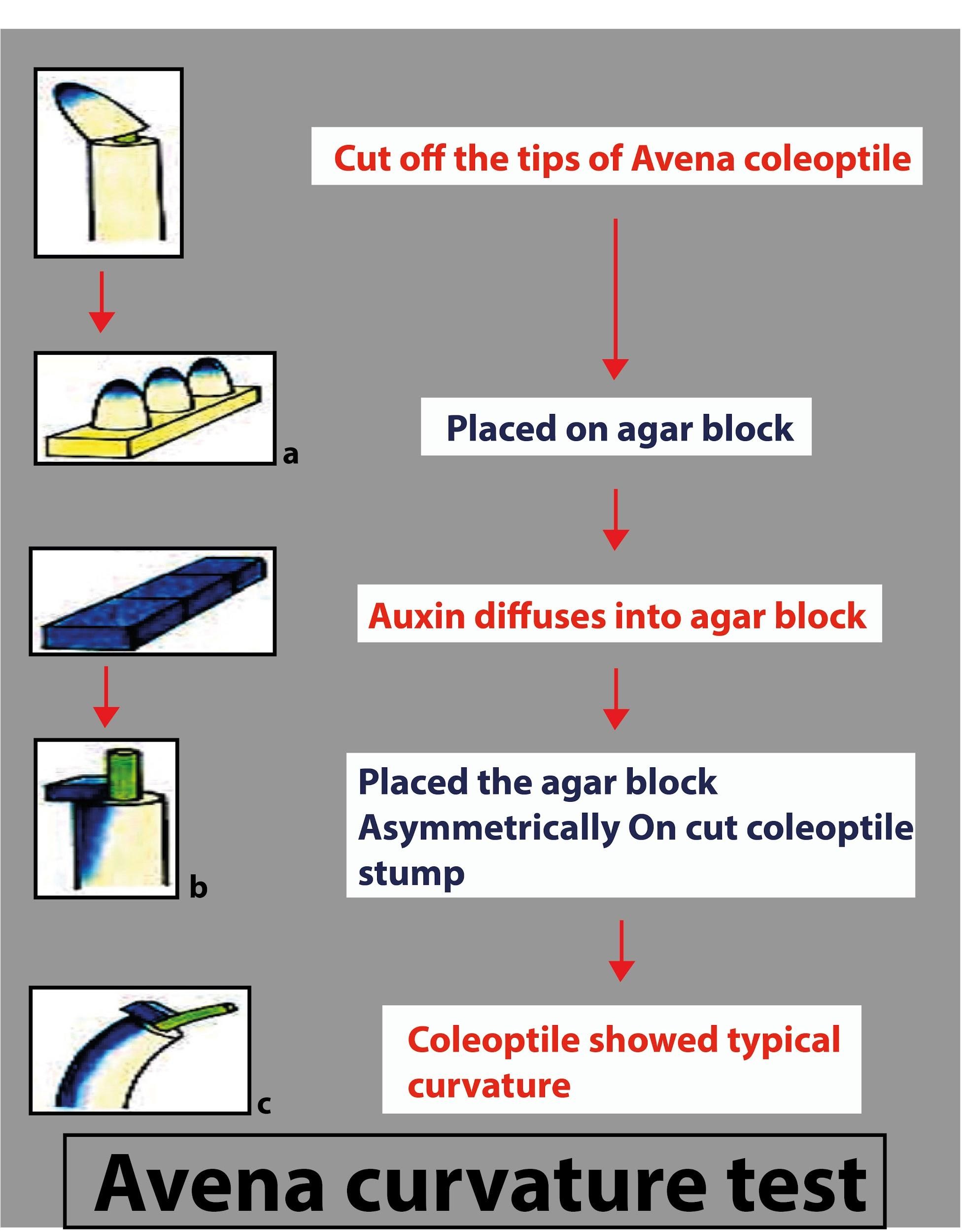
F.W. Went suggested the Avena coleoptile curvature assay for auxin bioassay. In this, an auxin-containing agar block is positioned on one side of the coleoptile oat and the curvature angle of the decapitated Avena coleoptile is measured.
The increased concentration of auxin on one side promotes cell elongation, although the decreased concentration of auxin on the other side induces decreased growth rate as a result of the absence of coleoptile tips. This differential pattern of growth induces coleoptile curvature.
A bioassay for auxin-type growth regulators is the Avena geo-curvature test. This is for indole-3-acetic acid (IAA) .
So, the correct answer is, ‘Auxin’.
Additional information: Ethylene is considered a multifunctional phytohormone that controls both development and senescence. Depending on its concentration, the timing of application, and the plant species, it promotes or inhibits growth and senescence processes.
Cytokinins are a class of plant growth substances (phytohormones) that in plant roots and shoots promote cell division, or cytokinesis. They are mainly involved in the growth and differentiation of cells, but also influence apical dominance, growth of axillary buds, and leaf senescence.
Gibberellins are plant hormones that control various processes of development, including elongation of the stem, germination, dormancy, flowering, flower development, and senescence of the leaf and fruit. It is one of the longest known plant hormone groups.
Note: Different bioassays are available to assess the auxin hormone concentration in plants, such as the Avena curvature test, split pea stem curvature test, cress root inhibition test, etc. After placing an agar block containing auxin on one side, it tests the angle of the curvature of a decapitated coleoptile.
Complete step by step answer:
F.W. Went suggested the Avena coleoptile curvature assay for auxin bioassay. In this, an auxin-containing agar block is positioned on one side of the coleoptile oat and the curvature angle of the decapitated Avena coleoptile is measured.
The increased concentration of auxin on one side promotes cell elongation, although the decreased concentration of auxin on the other side induces decreased growth rate as a result of the absence of coleoptile tips. This differential pattern of growth induces coleoptile curvature.
A bioassay for auxin-type growth regulators is the Avena geo-curvature test. This is for indole-3-acetic acid (IAA) .
So, the correct answer is, ‘Auxin’.
Additional information: Ethylene is considered a multifunctional phytohormone that controls both development and senescence. Depending on its concentration, the timing of application, and the plant species, it promotes or inhibits growth and senescence processes.
Cytokinins are a class of plant growth substances (phytohormones) that in plant roots and shoots promote cell division, or cytokinesis. They are mainly involved in the growth and differentiation of cells, but also influence apical dominance, growth of axillary buds, and leaf senescence.
Gibberellins are plant hormones that control various processes of development, including elongation of the stem, germination, dormancy, flowering, flower development, and senescence of the leaf and fruit. It is one of the longest known plant hormone groups.
Note: Different bioassays are available to assess the auxin hormone concentration in plants, such as the Avena curvature test, split pea stem curvature test, cress root inhibition test, etc. After placing an agar block containing auxin on one side, it tests the angle of the curvature of a decapitated coleoptile.
Recently Updated Pages
If x a + bt + ct2 where x is in meters and t is in class 11 physics CBSE

A car covers the first half distance between two places class 11 physics CBSE
The resultant of two vectors overrightarrow P and overrightarrow class 11 physics CBSE
Find the value of cos 135 class 11 maths CBSE
A mass M is held in place by an applied force F and class 11 physics CBSE
A solution of glucose in water is labelled as 10 dfracwv class 11 chemistry CBSE
Trending doubts
One Metric ton is equal to kg A 10000 B 1000 C 100 class 11 physics CBSE
Find the value of the expression given below sin 30circ class 11 maths CBSE
Draw a diagram of nephron and explain its structur class 11 biology CBSE
10 examples of friction in our daily life
Proton was discovered by A Thomson B Rutherford C Chadwick class 11 chemistry CBSE
Bond order ofO2 O2+ O2 and O22 is in order A O2 langle class 11 chemistry CBSE