




What is asexual reproduction? Describe the asexual reproduction in Amoeba.
Answer
 Verified
655.8k+ views
Hint:There are different types of asexual reproduction. Some of them are budding, binary fission, gemmules formation, vegetative reproduction, etc.
Complete answer:
Reproduction is characterized as a biological process in which the individual gives birth to the offspring identical to themselves. The offspring develops, matures, and creates new offspring. There is, thus, a sequence of life, rise, and death. Reproduction causes the population to live, generation after generation. The ecosystem of the cell, its internal morphology, and many other variables are generally responsible for how it reproduces. It is of two kinds, depending on whether one or two species engage in the reproductive process. When the offspring is produced by a single parent with or without the presence of a gamete, the reproduction is asexual. When two opposite sex involves in the reproductive process and requires the fusion of female and male gametes, it is known as sexual reproduction.
In the case of asexual reproduction, a single parent cell is capable of producing offspring. As a consequence, the young ones that are created are similar to one another and they are also the exact clones of their parents. Asexual reproduction is common in unicellular organisms. In Monerans and Protists, the parent cell is divided into two cells to give birth to new organisms. In these cells, thus, cell division is itself a mode of reproduction. Many unicellular species replicate by binary fission, where the cell splits into two halves and develops rapidly into an adult. In yeast, the separation is inconsistent and small buds are developed which remain initially attached to the mother cell, which eventually divides and matures into new yeast organisms.
Amoeba is a unicellular creature, which reproduces by binary fission, much like bacteria. Since replicating the genetic material by mitotic differentiation, the cell is separated into two equal-sized daughter cells. In this process, two identical individuals are created from a single parent cell. An amoeba that is about to be separated becomes larger, and gradually the nucleus expands and splits into two. After the division of the nucleus, the cytoplasm starts to divide. Thus, two amoebae are created from a single parent cell.
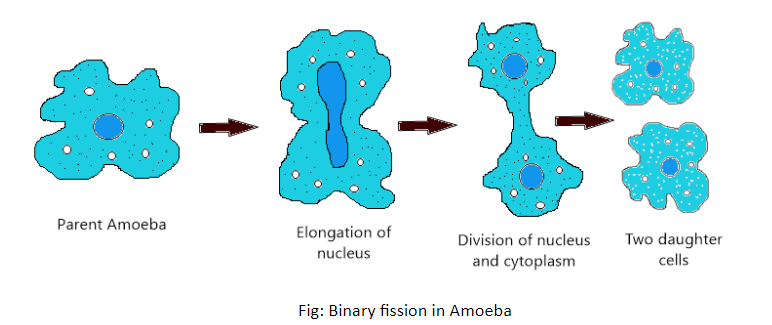
Note:Binary fission is a type of asexual reproduction where two daughter cells are produced from a single mother cell. This type of asexual reproduction can be seen only in unicellular organisms. Like amoeba, bacteria can also reproduce through binary fission.
Complete answer:
Reproduction is characterized as a biological process in which the individual gives birth to the offspring identical to themselves. The offspring develops, matures, and creates new offspring. There is, thus, a sequence of life, rise, and death. Reproduction causes the population to live, generation after generation. The ecosystem of the cell, its internal morphology, and many other variables are generally responsible for how it reproduces. It is of two kinds, depending on whether one or two species engage in the reproductive process. When the offspring is produced by a single parent with or without the presence of a gamete, the reproduction is asexual. When two opposite sex involves in the reproductive process and requires the fusion of female and male gametes, it is known as sexual reproduction.
In the case of asexual reproduction, a single parent cell is capable of producing offspring. As a consequence, the young ones that are created are similar to one another and they are also the exact clones of their parents. Asexual reproduction is common in unicellular organisms. In Monerans and Protists, the parent cell is divided into two cells to give birth to new organisms. In these cells, thus, cell division is itself a mode of reproduction. Many unicellular species replicate by binary fission, where the cell splits into two halves and develops rapidly into an adult. In yeast, the separation is inconsistent and small buds are developed which remain initially attached to the mother cell, which eventually divides and matures into new yeast organisms.
Amoeba is a unicellular creature, which reproduces by binary fission, much like bacteria. Since replicating the genetic material by mitotic differentiation, the cell is separated into two equal-sized daughter cells. In this process, two identical individuals are created from a single parent cell. An amoeba that is about to be separated becomes larger, and gradually the nucleus expands and splits into two. After the division of the nucleus, the cytoplasm starts to divide. Thus, two amoebae are created from a single parent cell.
Note:Binary fission is a type of asexual reproduction where two daughter cells are produced from a single mother cell. This type of asexual reproduction can be seen only in unicellular organisms. Like amoeba, bacteria can also reproduce through binary fission.
Recently Updated Pages
Which of the following graphs shows the variation of class 12 physics CBSE

Draw a labelled diagram of the human male reproductive class 12 biology CBSE
Describe the experiment to compare the emf of two cells class 12 physics CBSE
What is standard hydrogen electrode
What is conventional current and electric current class 12 physics CBSE
2Bromopentane is treated with an alcoholic KOH solution class 12 chemistry CBSE
Trending doubts
Draw a labelled sketch of the human eye class 12 physics CBSE
Which are the Top 10 Largest Countries of the World?
Differentiate between homogeneous and heterogeneous class 12 chemistry CBSE
Draw ray diagrams each showing i myopic eye and ii class 12 physics CBSE
Which is the correct genotypic ratio of mendel dihybrid class 12 biology CBSE
What is the Full Form of PVC, PET, HDPE, LDPE, PP and PS ?