




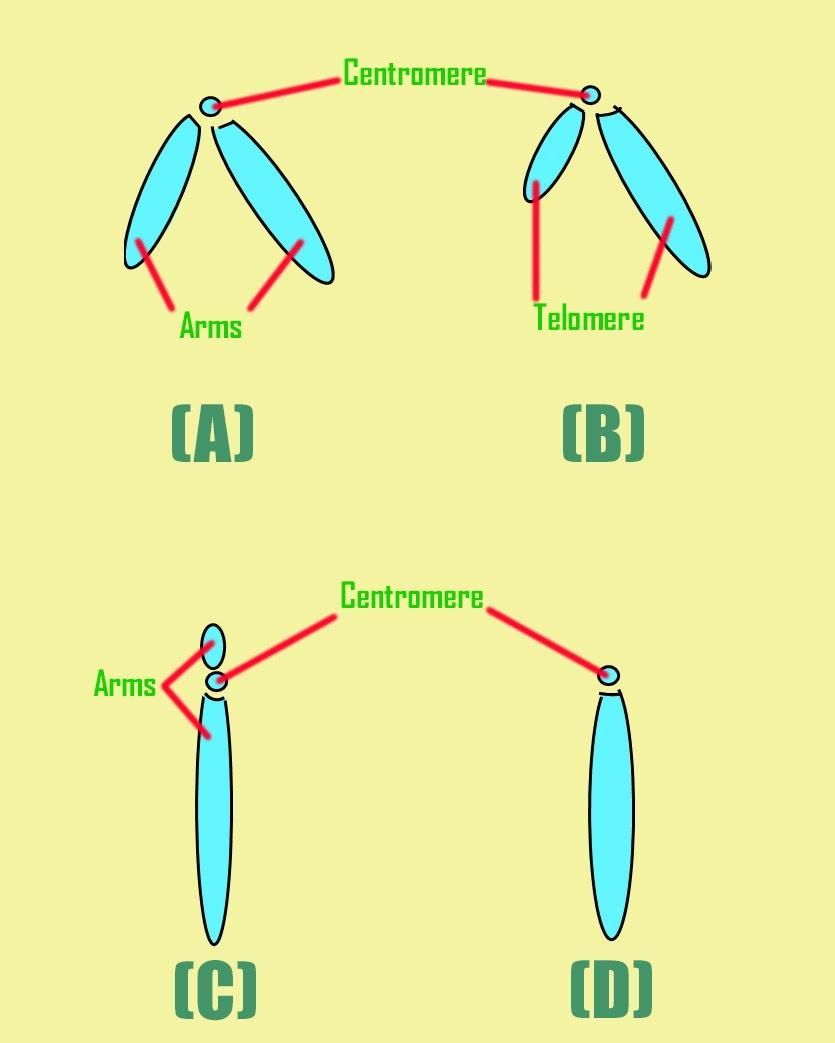
What are the shapes of chromosomes A, B, C, D.
Answer
 Verified
578.1k+ views
Hint: During metaphase, chromosomes are stretched as they are separated due to the forces exerted by the spindle fibers. The various shapes of the chromosomes occur due to the dragging of the daughter nucleus. The shapes of the chromosomes are of four types based on the appearance of chromosomes at the metaphase stage of cell division.
Complete answer:
The chromosome is divided into two sections or ‘arms' at a constriction point known as the centromere. The link between the chromatids is the centromere which is a point in the DNA. The centromere on each chromosome depends upon the characteristic shape of the chromosome. The four main types of chromosomes are -
Metacentric: The centromere is present almost exactly at the center. The two arms have almost the same length because the centromere is located in the middle. These chromosomes appear in the shape of the alphabet ‘V’ during metaphase.
Submetacentric: The centromere is present slightly near the center. As a result, the two arms of the chromosome appear unequal. These chromosomes appear in the shape of the alphabet ‘L’ during metaphase.
Acrocentric: The centromere is situated towards the end region. The term “acro” is a Greek word that means “peak”. Thus, the word acrocentric refers to the type of chromosome where the centromere is located near the terminal region forming a ‘J - shaped’ chromosome during metaphase.
Telocentric: The centromere is located towards the end called the telomeric region. However, these telocentric chromosomes are absent in humans and appear as ‘i - shaped’ during metaphase.
Thus, in the given figure, ‘A’ is a metacentric chromosome. ‘B’ is sub-metacentric. ’C’ is telocentric and ‘D’ is acrocentric.
The centromere also has a major function which is the attachment of spindle fibers during the cell division process. Based on the location of the centromere, the short arm, and the long arm are called p and q arms respectively. It’s the position of the centromere that helps us categorize the chromosomes into four types.
Note:
Some chromosomes also have secondary constriction called SAT. Chromosomes or marker chromosomes. During the formation of nucleoli, some secondary constrictions are required.
-The centromere also has a major function which is the attachment of spindle fibers during the cell division process. Based on the location of the centromere, the short arm, and the long arm are called p and q arms respectively. It’s the position of the centromere that helps us categorize the chromosomes into four types.
Complete answer:
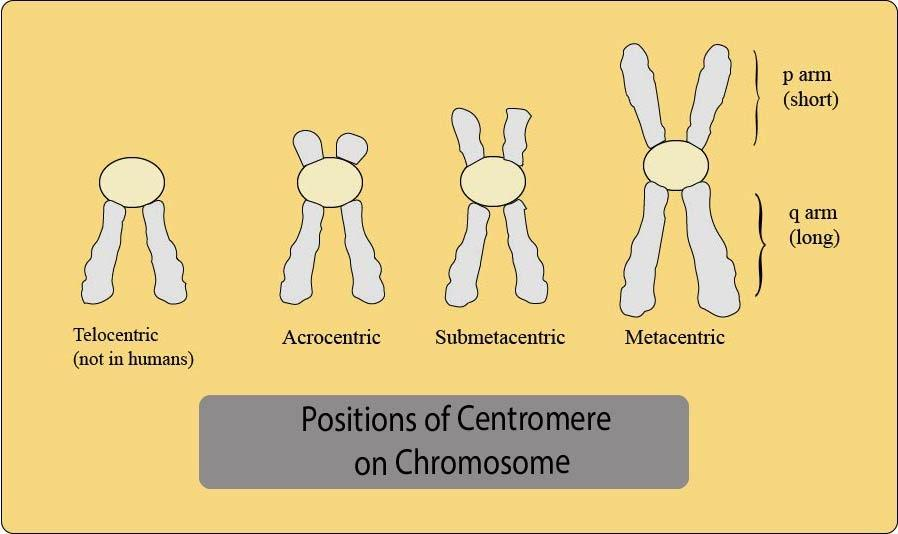
The chromosome is divided into two sections or ‘arms' at a constriction point known as the centromere. The link between the chromatids is the centromere which is a point in the DNA. The centromere on each chromosome depends upon the characteristic shape of the chromosome. The four main types of chromosomes are -
Metacentric: The centromere is present almost exactly at the center. The two arms have almost the same length because the centromere is located in the middle. These chromosomes appear in the shape of the alphabet ‘V’ during metaphase.
Submetacentric: The centromere is present slightly near the center. As a result, the two arms of the chromosome appear unequal. These chromosomes appear in the shape of the alphabet ‘L’ during metaphase.
Acrocentric: The centromere is situated towards the end region. The term “acro” is a Greek word that means “peak”. Thus, the word acrocentric refers to the type of chromosome where the centromere is located near the terminal region forming a ‘J - shaped’ chromosome during metaphase.
Telocentric: The centromere is located towards the end called the telomeric region. However, these telocentric chromosomes are absent in humans and appear as ‘i - shaped’ during metaphase.
Thus, in the given figure, ‘A’ is a metacentric chromosome. ‘B’ is sub-metacentric. ’C’ is telocentric and ‘D’ is acrocentric.
The centromere also has a major function which is the attachment of spindle fibers during the cell division process. Based on the location of the centromere, the short arm, and the long arm are called p and q arms respectively. It’s the position of the centromere that helps us categorize the chromosomes into four types.
Note:
Some chromosomes also have secondary constriction called SAT. Chromosomes or marker chromosomes. During the formation of nucleoli, some secondary constrictions are required.
-The centromere also has a major function which is the attachment of spindle fibers during the cell division process. Based on the location of the centromere, the short arm, and the long arm are called p and q arms respectively. It’s the position of the centromere that helps us categorize the chromosomes into four types.
Recently Updated Pages
Which of the following graphs shows the variation of class 12 physics CBSE

Draw a labelled diagram of the human male reproductive class 12 biology CBSE
Describe the experiment to compare the emf of two cells class 12 physics CBSE
What is standard hydrogen electrode
What is conventional current and electric current class 12 physics CBSE
2Bromopentane is treated with an alcoholic KOH solution class 12 chemistry CBSE
Trending doubts
Draw a labelled sketch of the human eye class 12 physics CBSE
Which are the Top 10 Largest Countries of the World?
Differentiate between homogeneous and heterogeneous class 12 chemistry CBSE
Draw ray diagrams each showing i myopic eye and ii class 12 physics CBSE
Which is the correct genotypic ratio of mendel dihybrid class 12 biology CBSE
What is the Full Form of PVC, PET, HDPE, LDPE, PP and PS ?