




What are the homologous organs of the male and female reproductive systems of humans?
Answer
 Verified
637.2k+ views
Hint: Homologous organs are those organs that perform the same function but are of different anatomical structures present in a different organism. It helps us to establish a link in the evolutionary process. For example, an arm of a human, a wing of a bird, the limb of a dog all perform the same or similar function but have different anatomical structures.
Complete answer:
In the male and female reproductive system of humans there are many homologous organs present. They may seem to be very different in the anatomical structure and may vary greatly in the grown-up adult but they have some similarities in their functions.
- In males’ penis and in the female clitoris is the homologous organ. By their structure, one can say they vary greatly but it’s not the case. They are responsible for the orgasm experienced by one during coitus. In males, the growth of the penis occurs rapidly. It leads to the formation of the penile shaft and then to the penile raphe. In females, it is noted that growth occurs rather less rapidly which leads to the formation of a small clitoris. In females, the urethral folds do not fuse as in males, which leads to the formation of labia minora.
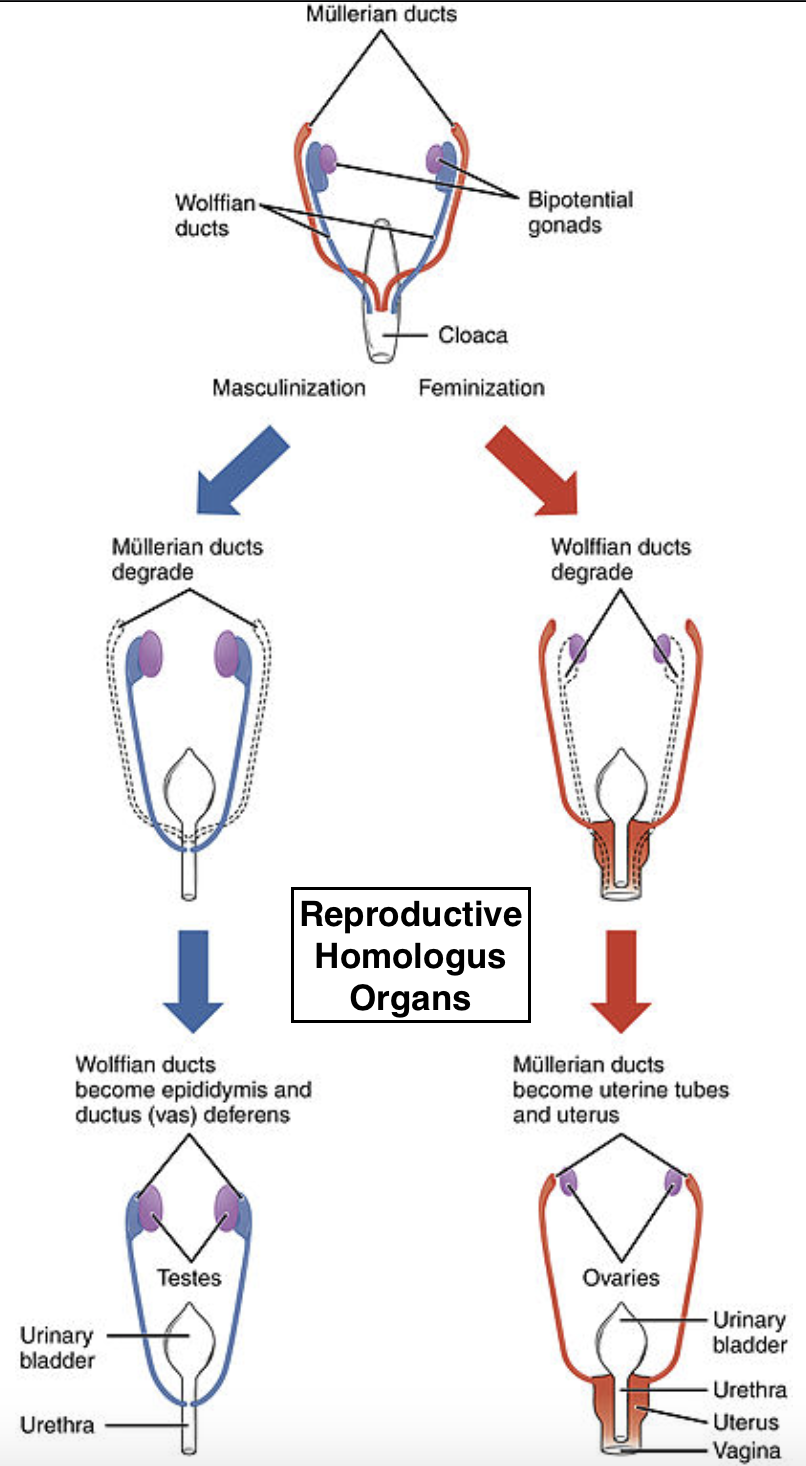
- Both in males and females, there is the presence of ducts namely, Mullerian duct and Wolffian duct. The Mullerian duct arises from anterolaterally along the length of the urogenital ridge, whereas the Wolffian duct is an intermediate derivative between the upper thoracic and the upper lumbar region. In females it forms uterine canal which further changes to fallopian tube and uterus and in males it degenerates to form appendix testis. A majority of parts degenerates during foetal stage only.
- Some other organs which are homologous to each other are: testis in male and ovary in female, epididymis in males and Gartner’s duct in female, bulbourethral gland in males and Bartholin’s gland in females, foreskin in males and clitoral hood in males and many more.
Note: The homologous structure in the human reproductive system may not seem to be related to homology as they have very different anatomical structures. But most of the organs have the same function in both males and females.
Complete answer:
In the male and female reproductive system of humans there are many homologous organs present. They may seem to be very different in the anatomical structure and may vary greatly in the grown-up adult but they have some similarities in their functions.
- In males’ penis and in the female clitoris is the homologous organ. By their structure, one can say they vary greatly but it’s not the case. They are responsible for the orgasm experienced by one during coitus. In males, the growth of the penis occurs rapidly. It leads to the formation of the penile shaft and then to the penile raphe. In females, it is noted that growth occurs rather less rapidly which leads to the formation of a small clitoris. In females, the urethral folds do not fuse as in males, which leads to the formation of labia minora.
- Both in males and females, there is the presence of ducts namely, Mullerian duct and Wolffian duct. The Mullerian duct arises from anterolaterally along the length of the urogenital ridge, whereas the Wolffian duct is an intermediate derivative between the upper thoracic and the upper lumbar region. In females it forms uterine canal which further changes to fallopian tube and uterus and in males it degenerates to form appendix testis. A majority of parts degenerates during foetal stage only.
- Some other organs which are homologous to each other are: testis in male and ovary in female, epididymis in males and Gartner’s duct in female, bulbourethral gland in males and Bartholin’s gland in females, foreskin in males and clitoral hood in males and many more.
Note: The homologous structure in the human reproductive system may not seem to be related to homology as they have very different anatomical structures. But most of the organs have the same function in both males and females.
Recently Updated Pages
Which of the following graphs shows the variation of class 12 physics CBSE

Draw a labelled diagram of the human male reproductive class 12 biology CBSE
Describe the experiment to compare the emf of two cells class 12 physics CBSE
What is standard hydrogen electrode
What is conventional current and electric current class 12 physics CBSE
2Bromopentane is treated with an alcoholic KOH solution class 12 chemistry CBSE
Trending doubts
Draw a labelled sketch of the human eye class 12 physics CBSE
Which are the Top 10 Largest Countries of the World?
Differentiate between homogeneous and heterogeneous class 12 chemistry CBSE
Draw ray diagrams each showing i myopic eye and ii class 12 physics CBSE
Which is the correct genotypic ratio of mendel dihybrid class 12 biology CBSE
What is the Full Form of PVC, PET, HDPE, LDPE, PP and PS ?