



How are prisms and cylinders alike
A. Its base becomes larger and larger
B. Its base becomes smaller and smaller
C. Either
D. Neither
Answer
 Verified
626.1k+ views
Hint: Prism and cylinders are 3D shape objects, which do not lie completely in a plane. 3D objects have different views from different positions. Therefore, in this question first we need to know about the basics of these 3D structures.
Complete step-by-step answer:
A prism is a polyhedron whose bottom and top faces (known as bases) are congruent polygons and faces known as lateral faces are parallelograms (when the side faces are rectangles, the shape is known as right prism).
All prisms have two identical, parallel faces. These two faces are always polygons. A prism’s other faces are always parallelograms.
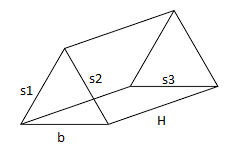
This prism is known as a triangular prism. Simply it is a polyhedron that has two parallel, congruent bases. The bases can be any polygon. The other faces are parallelograms.
A cylinder has two parallel, congruent bases that are circles as shown below.

As we see in the above two figures of prism and cylinder respectively, we conclude that the bases of both 3D structures are fixed.
Therefore, in prism and cylinder, base is always constant
Hence, option (D) is the correct answer.
Note: A cylinder has 2 flat ends and a curved surface while a prism has two polygons for the two ends and the rest are plain rectangular faces. A cylinder has no vertices while a prism has several vertices. A cylinder has two curved edges while a prism has no curved edge. a prism is a polyhedron, which means all faces are flat! No curved sides. For example, a cylinder is not a prism, because it has curved sides.
Complete step-by-step answer:
A prism is a polyhedron whose bottom and top faces (known as bases) are congruent polygons and faces known as lateral faces are parallelograms (when the side faces are rectangles, the shape is known as right prism).
All prisms have two identical, parallel faces. These two faces are always polygons. A prism’s other faces are always parallelograms.
This prism is known as a triangular prism. Simply it is a polyhedron that has two parallel, congruent bases. The bases can be any polygon. The other faces are parallelograms.
A cylinder has two parallel, congruent bases that are circles as shown below.
As we see in the above two figures of prism and cylinder respectively, we conclude that the bases of both 3D structures are fixed.
Therefore, in prism and cylinder, base is always constant
Hence, option (D) is the correct answer.
Note: A cylinder has 2 flat ends and a curved surface while a prism has two polygons for the two ends and the rest are plain rectangular faces. A cylinder has no vertices while a prism has several vertices. A cylinder has two curved edges while a prism has no curved edge. a prism is a polyhedron, which means all faces are flat! No curved sides. For example, a cylinder is not a prism, because it has curved sides.
Recently Updated Pages
Basicity of sulphurous acid and sulphuric acid are

Master Class 11 Business Studies: Engaging Questions & Answers for Success
Master Class 11 Computer Science: Engaging Questions & Answers for Success
Master Class 11 Economics: Engaging Questions & Answers for Success
Master Class 12 English: Engaging Questions & Answers for Success
Master Class 12 Social Science: Engaging Questions & Answers for Success
Trending doubts
Fill the blanks with the suitable prepositions 1 The class 9 english CBSE
Difference Between Plant Cell and Animal Cell
Find the sum of series 1 + 2 + 3 + 4 + 5 + + 100 class 9 maths CBSE
Distinguish between Conventional and nonconventional class 9 social science CBSE
Find the greatest fivedigit number which is a perfect class 9 maths CBSE
Find the mode and median of the data 13 16 12 14 1-class-9-maths-CBSE